Helping design and engineering professionals discover, evaluate and specify technologies and processes that shorten the design cycle and enable success.


Alert!
Digital Engineering ceased publication on July 1, 2026. This website remains available as an archive of engineering content.
For inquiries or information, please email [email protected].

Digital Engineering April 2026
In the latest issue of Digital Engineering, we take a look at the latest innovations in design for additive manufacturing, including the use of natural language inputs, social media cosplayers, and AI integration. The issue also includes a feature…

January Special Focus Issue: Design for Additive
In this Special Focus Issue of Digital Engineering, learn about the latest advancements in design for additive manufacturing, including new software tools, additive in automotive, custom medical devices, and more.
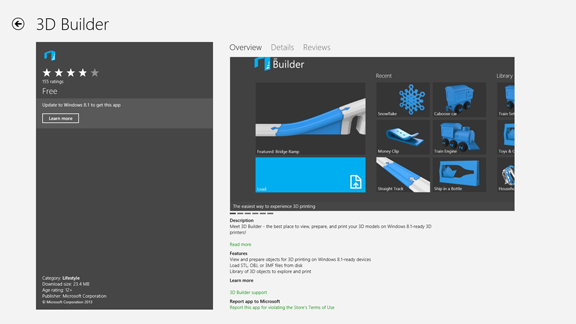
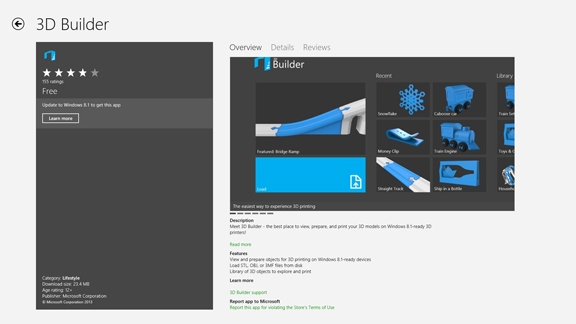 In upcoming Windows OS 8.1, the free 3D Builder app is expected to turn 3D printing into a plug-and-play function.
Two weeks ago, at Congress On the Future of Engineering Software (COFES, Scottsdale, AZ, April 24-27), Kris Iverson, Microsoft's principal development lead, and Simon Floyd, Microsoft's director of innovation and PLM, hosted a tech briefing on additive manufacturing. Iverson views 3D printers as "powerful devices to help you realize what you're thinking." But there are some barriers to widespread adoption, even in the professional design and engineering community. Floyd said, "The material is expensive, the machine is costly, so companies sometimes stop the younger engineers from experimenting with additive manufacturing."
The 3D printer Iverson and Floyd brought along to the tech brief — a $600 MakerBot machine targeting consumers — offers some clues to Microsoft's strategy. "Even for the professionals, a professional 3D printer may not be affordable. That's why we focus on a consumer printer," said Iverson.
At $7,000 - $20,000, professional 3D printers are ideal for prototyping close-to-production designs, but may not be suitable for liberal use in the early phase where engineers may need to try out dozens of design variations in order to identify one winning idea. A low-cost consumer machine that occupies less space and doesn't generate heat or noise, on the other hand, is a better choice, in Microsoft's reasoning.
Floyd observed, "3D printing is not plug and play [at the moment]. Somewhere between plug and print, there's a number of steps to repair the model."
That's where Microsoft sees an opportunity to play a role. Accordingly, the company struck a partnership with Netfab to launch a cloud-hosted model-repair service. Simply dubbed Model Repair Service, the Microsoft-Netfab portal lets you upload your model, automatically analyze and fix the geometry to make it print-ready, then return the repaired model.
In Windows 8.1, Microsoft's free 3D Builder app is expected to further promote the idea of plug-and-play 3D printing. It offers direct links to downloadable 3D models, ready for print.
Though STL currently stands as the de facto standard for 3D printing, Microsoft is introducing its own file format, 3MF (3D manufacturing format), with color support. The company is currently in talks with CAD software developers to offer 3MF export functions from mainstream CAD programs.
Microsoft's embrace of 3D printing, as evident in its push to integrate it into the operating system itself, marks a significant milestone. Its emphasis on affordable, consumer-level machines may prompt many 3D printer makers to rethink pricing, introduce more affordable printers, or realign some of their offerings to be consistent with Microsoft's approach.


Kenneth Wong is Digital Engineering's resident blogger and senior editor. Email him at [email protected] or share your thoughts or suggestions at digitaleng.news/facebook.
Follow DE






About Us · Contact Us · Editorial Team · Advertising · Privacy Policy · Subscriber Services · © 2026 Digital Engineering 24/7 · Peerless Media