Helping design and engineering professionals discover, evaluate and specify technologies and processes that shorten the design cycle and enable success.



Digital Engineering April 2026
In the latest issue of Digital Engineering, we take a look at the latest innovations in design for additive manufacturing, including the use of natural language inputs, social media cosplayers, and AI integration. The issue also includes a feature…

January Special Focus Issue: Design for Additive
In this Special Focus Issue of Digital Engineering, learn about the latest advancements in design for additive manufacturing, including new software tools, additive in automotive, custom medical devices, and more.
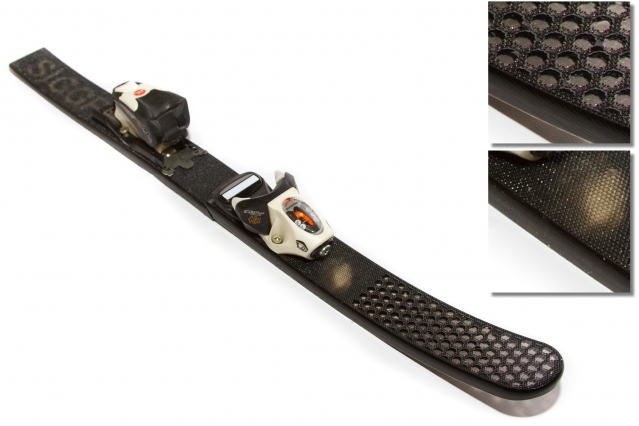 Using Foundry, MIT researchers designed and fabricated skis with retro-reflective surfaces, a ping-pong paddle, a helmet, and a bone. Image: MIT News
MIT’s Computer Science and Artificial Intelligence Laboratory (CSAIL) has come up with a way to design objects out of multiple or mixed materials, and the system is so simple to use that even novices can quickly create such designs.
CSAIL unveiled the new solution, called Foundry, back in October. The project was supported by the National Science Foundation.
“In traditional manufacturing, objects made of different materials are manufactured via separate processes and then assembled with an adhesive or another binding process,” said PhD student Kiril Vidimče, the first author on the paper. “Even existing multi-material 3D printers have a similar workflow: parts are designed in traditional CAD systems one at a time and then the print software allows the user to assign a single material to each part.”
What Foundry does is provide an easy-to-use interface so that designers can vary material properties at a very fine resolution. This makes it possible to design with multiple materials or mixtures of materials.
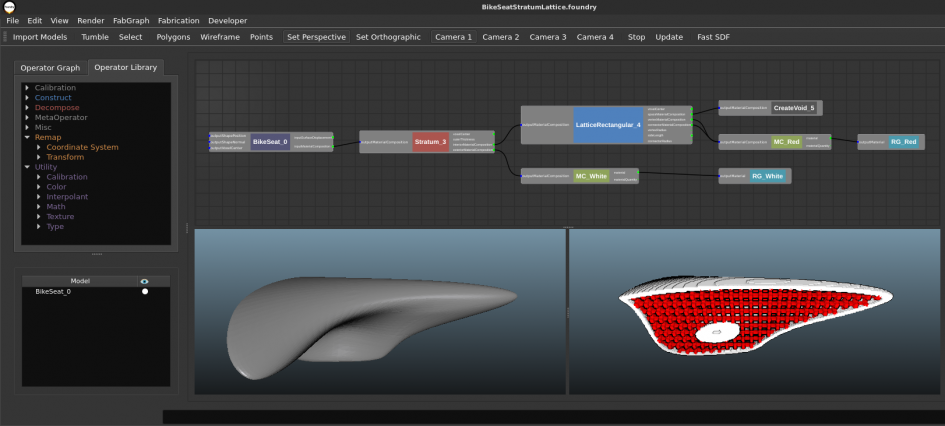 And users can do so without complex programming. “It’s like Photoshop for 3D materials, allowing you to design objects made of new composite materials that have the optimal mechanical, thermal, and conductive properties that you need for a given task,” Vidimče said. “You are only constrained by your creativity and your ideas on how to combine materials in novel ways.”
Users can design an object in a CAD program, then export it into Foundry. Designers can then determine the object’s composition using roughly 100 fine-tuned actions (referred to as operators). Those operators can then remap and assign materials in the object.
The solution is so easy to use that MIT tested it with non-designers. With just an hour’s worth of instruction, the test group was able to design a teddy bear, a bone structure and an integrated tire/wheel. Most of the test group were able to create workable designs in less than an hour.
Source: MIT News


Brian Albright is the editorial director of Digital Engineering.
Contact him at [email protected].

Join over 90,000 engineering professionals who get fresh engineering news as soon as it is published.






About Us · Contact Us · Editorial Team · Advertising · Privacy Policy · Subscriber Services · © 2026 Digital Engineering 24/7 · Peerless Media