Helping design and engineering professionals discover, evaluate and specify technologies and processes that shorten the design cycle and enable success.


Alert!
Digital Engineering ceased publication on July 1, 2026. This website remains available as an archive of engineering content.
For inquiries or information, please email [email protected].

Design & Simulation Software Guide 2025
In this Special Issue, Digital Engineering presents its second annual guide to design and simulation software vendors.

Design & Simulation Software Guide
In this Special Issue, Digital Engineering presents its inaugural guide to design and simulation software vendors, including listings for CAD, CAM, simulation, generative design, PLM, rendering and visualization, design for additive manufacturing,…
Kubotek Kosmos, a developer of geometric software technology, has introduced the 8.0 major release of its 3D Framework libraries. The Framework provides software development teams with a unified application programming interface to read, display, edit, and author models and complete 3D product definition data across Windows, Linux, web, and other platforms. The 8.0 release expands support for recent ISO standards-based file formats that enable model-based enterprise strategies across manufacturing systems.
Edition 4 of the newest application protocol 242 (AP242) for 3D engineering was published in 2025 and established a system for tagging data objects with persistent identifiers (ID) for traceability of product data across different manufacturing systems and suppliers. Complete persistent ID support has been incorporated into release 8.0 of the Kubotek Kosmos libraries allowing traceability of product data from CAD formats as it moves into standard STEP files used in various applications across manufacturing and inspection.
To aid recipients in understanding a complex part, 3D product definitions commonly include saved view definitions containing camera orientation, zoom scale, and sets of annotations related to that view. These views are supported in the STEP AP242 standard and the 8.0 release expands toolkit support for such views.
For 8.0 the Kosmos API also added support for reading STEP XML, the Part 28 STEP format for storage of complex product assemblies. STEP XML is commonly used for long-term archiving of 3D product designs in Aerospace and Defense industries.
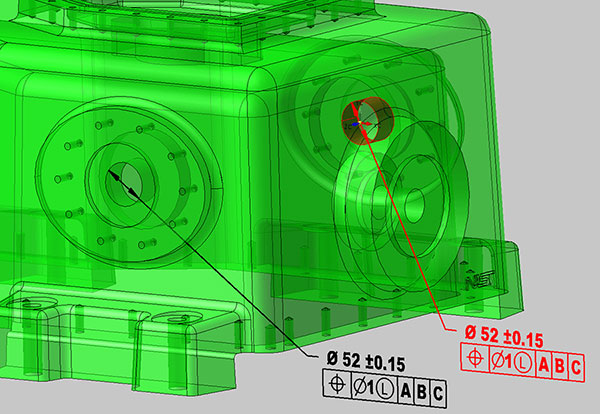
Support for reading precise part models, connected product manufacturing information, and their persistent IDs from QIF files is now included in the 8.0 version of the 3D Framework libraries. The Kosmos libraries support enrichment of such model-based datasets, with native objects for annotations and dimensions, planes, points, centerline, etc. as well as semantic PMI.
The 8.0 release continues to improve on the toolkit’s established modeling capabilities and performance in various areas such as Boolean volume operations, skinning through profiles, sweeping profiles through space, and imprinting curves along a vector onto surfaces.
Support for adding fillet and round features to solid models (aka blending) has grown in 8.0 with handling of capping of multiple faces adjacent to the new blend face. Blending operations often change model topology and legacy modeling kernels commonly generate new internal IDs for the resulting edge and face objects. Maintenance of object IDs even as the Kosmos kernel expands to handle more sophisticated blending cases supports digital thread connectivity to the original model.
Sources: Press materials received from the company and additional information gleaned from the company’s website.


DE's editors contribute news and new product announcements to Digital Engineering. Press releases may be sent to them via [email protected].
Follow DE






About Us · Contact Us · Editorial Team · Advertising · Privacy Policy · Subscriber Services · © 2026 Digital Engineering 24/7 · Peerless Media