Helping design and engineering professionals discover, evaluate and specify technologies and processes that shorten the design cycle and enable success.


Alert!
Digital Engineering ceased publication on July 1, 2026. This website remains available as an archive of engineering content.
For inquiries or information, please email [email protected].

May 2026 Special Focus: Artificial Intelligence in Design and Simulation
In this Special Focus Issue, learn about the latest developments in the integration of artificial intelligence into engineering workflows.

Design & Simulation Software Guide 2025
In this Special Issue, Digital Engineering presents its second annual guide to design and simulation software vendors.
MultiMechanics has released MultiMech 19.0. MultiMech 19.0 delivers new material models, new damage scenarios, faster run times and expanded integration with commonly used FEA systems, the company reports.
Highlights of this release include:
This addition will enable engineers to better capture the mechanical behavior of carbon fibers. In addition to exhibiting nonlinear elastic behavior at small deformation, carbon fibers also possess different mechanical properties in tension and compression, making them especially difficult to model and simulate. MultiMech 19.0 allows engineers to more realistically predict the behavior of these materials, the company reports.
This will allow engineers to reduce the runtime of DoE jobs using MultiMechanics’ Optimizer and get answers faster.
MultiMech 19.0 implements new material and failure models, including continuum damage models for orthotropic materials and new damage laws that will allow users to capture unique material behavior with higher accuracy.
MultiMech 19.0 features improved automated time step and optional displacement convergence check, as well as the ability to check for large displacements in the nonlinear solver.
The MultiMech material database has been redesigned and enhanced to speed up the workflow. Users can now create their own database of material cards to be used with MultiMech, including material definitions for individual constituents, as well as define an entire Representative Volume Element as an entry to the material database.
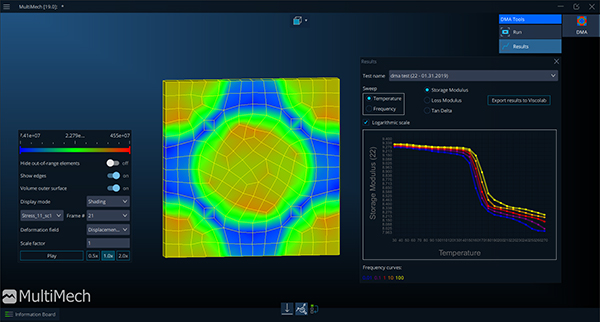
MultiMech 19.0 includes a streamlined tool to run Dynamic Mechanical Analyzer (DMA) tests virtually. With this tool, users can easily and quickly characterize the viscoelastic behavior of complex microstructures in all directions, at different temperatures and frequencies.
With the new ANSYS DX integration, users can perform Optimization studies at both the macro and micro scale using ANSYS DX’s unique capabilities.
“As the use of material modeling and simulation software expands, material scientists are demanding more accurate results without compromising speed and functionality, as well as easier and more integrated workflows. MultiMech 19.0 marks the significant progress we have made towards closing that gap,” says Dr. Flavio Souza, president & CTO of MultiMechanics.
Sources: Press materials received from the company and additional information gleaned from the company’s website.


We develop software that helps engineers accelerate innovation and the product development lifecycle by virtually predicting failure in advanced materials at an unprecedented level of speed and accuracy.

DE's editors contribute news and new product announcements to Digital Engineering. Press releases may be sent to them via [email protected].
Follow DE






About Us · Contact Us · Editorial Team · Advertising · Privacy Policy · Subscriber Services · © 2026 Digital Engineering 24/7 · Peerless Media