Helping design and engineering professionals discover, evaluate and specify technologies and processes that shorten the design cycle and enable success.


Alert!
Digital Engineering ceased publication on July 1, 2026. This website remains available as an archive of engineering content.
For inquiries or information, please email [email protected].

May 2026 Special Focus: Artificial Intelligence in Design and Simulation
In this Special Focus Issue, learn about the latest developments in the integration of artificial intelligence into engineering workflows.

Design & Simulation Software Guide 2025
In this Special Issue, Digital Engineering presents its second annual guide to design and simulation software vendors.
Editor’s note: This commentary was sponsored as part of DE’s Visionary Voices section.
Every engineer dreams of inventing--of creating something genuinely new to improve the lives of others. The creative process is so fundamental to engineering that it defines careers, companies, and industries. So for the desktop engineer, living in the era of innovation--a time when creativity through technology is on everyone’s mind--is truly a privilege.
Bringing Ideas to Life
As the developers of multiphysics simulation software, we have had the opportunity to see tens of thousands of high-tech organizations come up with radically new products and processes. New battery technology has been designed for greener cars and trains. Arc welding methods have been optimized by multiphysics simulations combining electromagnetic forces, fluid flow, and heat transfer. Scientists have been able to simulate cloaking devices to make objects invisible for the eye and radar. The list goes on and on. The common denominator for all these remarkable inventions is the ingenuity of the inventors themselves and their skillful use of simulation software.
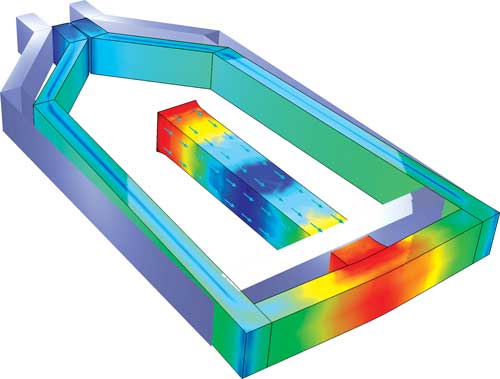
The image above, created using COMSOL Multiphysics, shows a simulation
of a piezoelectric microgripper. Made up of a stacked piezoactuator, simultaneous
contraction in the transversal direction and elongation in the longitudinal direction
closes this microgripper. Shown is the von Mises stresses and deformation.
One key to our customers’ success is the ability to include all relevant physical effects into their simulations. That is to say the simulation is able to “capture the concept.” We designed COMSOL Multiphysics from the ground up with exactly this in mind, providing multiphysics simulation capabilities even in our most basic products. The integrity of our core technology is so solid that adapting the software to entirely new application areas is as simple as writing it down. This makes the simulation process highly productive. It frees the user to model just about any physical system, opening the doors to fresh ideas from creative minds.
The Next Step for Multiphysics Simulation
The current focus of our development of COMSOL is expanding multiphysics applications. This means we will continue to include capabilities that will reach out to new communities of engineers. From one angle, we’re adding new products to our LiveLink suite that will make it easy for design engineers using popular CAD software to incorporate multiphysics with just a few clicks. From another angle, we’re adding fundamentally new capabilities that overcome previously insurmountable barriers.
A great example of this is the Particle Tracing Module. This new tool extends the functionality of the modeling environment for computing the trajectory of particles in a fluid or electromagnetic field, including particle-field interaction. The absence of particle-field interaction, in particular, prevented some engineers from incorporating multiphysics into their work. But now these engineers are free to use particle tracing for both traditional CFD and electromagnetics analysis, and for more novel combinations with any other physics simulation.
Other examples of expanding multiphysics applications can be found in most industries. One fascinating case comes from the mobile device market. Small speakers are critical for the performance of smart phones, hearing aids, and earpieces. On that scale, even thermal effects impact performance and sound quality. Now, manufacturers of these small acoustic devices can perform thermoacoustic simulations with an off-the-shelf software package for the first time. The ability to combine such simulations with electrical circuits and structural vibrations brings a new simulation solution to this fiercely competitive industry where a hi-fi sound feature would be a crucial differentiator.
User Developed Applications
Going forward, we are expecting a tremendous increase in the number of application-specific simulation solutions. The best part is that these applications will be developed by the users themselves, who, after all, have the ultimate application expertise. We believe it’s time for a simulation software package that is built to adapt to the varied needs of the user to bring bold product ideas to life.
David Kan, is Vice President of Sales--Southwest USA, for COMSOL, Inc.


DE's editors contribute news and new product announcements to Digital Engineering. Press releases may be sent to them via [email protected].
Follow DE
Join over 90,000 engineering professionals who get fresh engineering news as soon as it is published.






About Us · Contact Us · Editorial Team · Advertising · Privacy Policy · Subscriber Services · © 2026 Digital Engineering 24/7 · Peerless Media