Helping design and engineering professionals discover, evaluate and specify technologies and processes that shorten the design cycle and enable success.


Alert!
Digital Engineering ceased publication on July 1, 2026. This website remains available as an archive of engineering content.
For inquiries or information, please email [email protected].
Digital Engineering: Can you provide an overview of the “CubeQuest Challenge” program?
Liz Hyde: NASA’s CubeQuest Challenge is a competition where the best CubeSat wins. One of the current limitations of CubeSats is they have not left low-Earth orbit. The agency’s Space Launch System is going to launch 13 CubeSats into cislunar (between the Earth and the moon) space, opening up a new opportunity for CubeSats to journey into deep space. The intent of the challenge is to stimulate growth in the small satellite industry, especially in the areas of propulsion and communications. Any non-NASA, U.S.-based team is eligible; most of the teams competing come from the small business, startup or academic worlds.
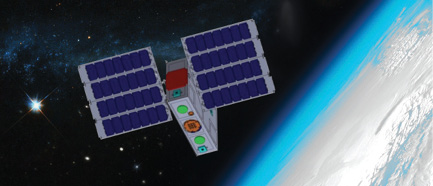 In NASA’s CubeQuest Challenge, entrants design prototypes of CubeSats—miniaturized satellites used for space research.
DE: What becomes of the innovations that are presented?
Hyde: One of the key aspects of spacecraft mission design is the knowledge that the hardware is going to work as desired—measured by technology readiness levels, or TRLs. Proving out designs on the bench or in a simulated space environment is great, but proving it on a real mission is key if you’re trying to use that hardware on a big-budget, science-centered mission.
Once a certain piece of hardware has been used successfully, it becomes very attractive to future mission designers who want to buy down risk. Because the CubeQuest satellites will be some of the first to launch outside of low-Earth orbit, the hardware on them will be some of the first to gain that coveted deep-space “flight heritage” TRL.
DE: Can you provide some examples of what you expect it to produce?
Hyde: One of the oft-shown technologies on the bench, and in papers and YouTube videos, is electric propulsion. Electronic propulsion is very attractive to small satellite developers because while it may be low-thrust, it can contain much more delta-v in a small space than conventional thrusters. It is also very difficult to characterize in a lab. A CubeQuest mission can make the characterization and operation of the thrusters the crux of their mission without sacrificing a science payload.
DE: Do you have any corporate sponsors in the event?
Hyde: The challenge itself is fully government-funded, and as such doesn’t have any corporate sponsors. Teams are free to do whatever marketing or fundraising they wish. Some have also been successful with crowdsourcing campaigns.
DE: Anything else you’d like to share about the event?
Hyde: There have been many NASA challenges over the years. The thing that sets CubeQuest apart from the others is it will be the first competition where hardware will actually fly. The Exploration Mission-1 launch opportunity is a big boon for these teams in my mind.
More information:


Jim Romeo is a freelance writer based in Chesapeake, VA. Send e-mail about this article to [email protected].
Follow DE






About Us · Contact Us · Editorial Team · Advertising · Privacy Policy · Subscriber Services · © 2026 Digital Engineering 24/7 · Peerless Media