Helping design and engineering professionals discover, evaluate and specify technologies and processes that shorten the design cycle and enable success.


Alert!
Digital Engineering ceased publication on July 1, 2026. This website remains available as an archive of engineering content.
For inquiries or information, please email [email protected].


May 2026 Special Focus: Artificial Intelligence in Design and Simulation
In this Special Focus Issue, learn about the latest developments in the integration of artificial intelligence into engineering workflows.

April 2026 Special Focus Issue: Generative Design
In this Special Focus Issue, Digital Engineering takes a look at how generative design solutions can be used across different types of design problems and with a variety of manufacturing approaches to accelerate design space exploration, and…
No doubt as a result of this trend, the US National Institutes of Health (NIH) have launched a 3D Print Exchange webpage devoted to providing easier access to existing 3D models, and as a platform for new developments. Essentially you can think of the new exchange as a Thingiverse for the medical field.
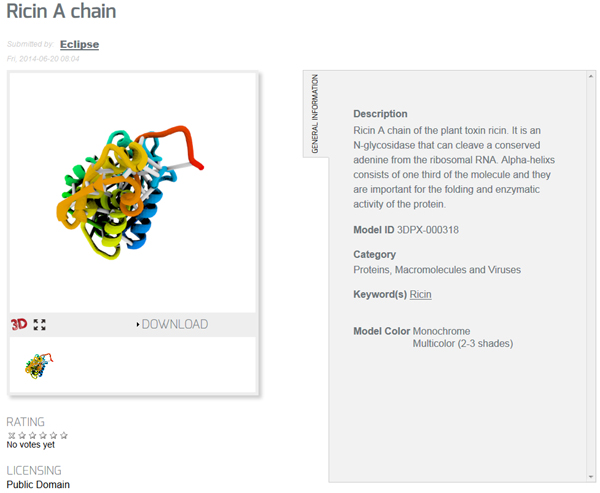 An example of the 3D models available on NIH's new exchange site. Courtesy of NIH.
“3D printing is a potential game changer for medical research,” said NIH Director Francis S. Collins, M.D., Ph.D. “At NIH, we have seen an incredible return on investment; pennies’ worth of plastic have helped investigators address important scientific questions while saving time and money. We hope that the 3D Print Exchange will expand interest and participation in this new and exciting field among scientists, educators and students.”
The new exchange already contains NIH’s library of medical 3D models, which covers everything from Ricin A chains to impacted wisdom teeth. The collection also offers a number of digital designs for printable lab equipment, which have the potential to save testing facilities thousands of dollars each year in expenses, as well as providing useful equipment for areas of the world where lab supplies are harder to acquire.
In the event someone would like to add to the exchange but doesn’t have much in the way of a digital design background, the NIH site includes a tutorial on creating a 3D image from images (they call it isosurface extraction from volumetric data). Other tutorials covering how to create medical and molecular 3D models are listed as “coming soon.”
More help can be found in the “Learn” section with additional tutorials explaining how customize 3D models and tips for maximizing 3D printer usage, such as one tutorial covering how to build hollow digital designs to save on material expenses. The FAQ explains basic AM terms such as defining what a .STL file is or providing an overview of how 3D printers build objects.
Hopefully the NIH can help spread the word of the versatility of AM for the medical field. Doctors have already begun using the technology to prepare for surgery, build inexpensive prosthetics, and design vital medical equipment.
Below you’ll find a video from NIH about the new exchange site.
Source: NIH


John Newman is a Digital Engineering contributor who focuses on 3D printing. Contact him via [email protected] and read his posts on Rapid Ready Technology.
Follow DE






About Us · Contact Us · Editorial Team · Advertising · Privacy Policy · Subscriber Services · © 2026 Digital Engineering 24/7 · Peerless Media