Helping design and engineering professionals discover, evaluate and specify technologies and processes that shorten the design cycle and enable success.



Digital Engineering April 2026
In the latest issue of Digital Engineering, we take a look at the latest innovations in design for additive manufacturing, including the use of natural language inputs, social media cosplayers, and AI integration. The issue also includes a feature…

January Special Focus Issue: Design for Additive
In this Special Focus Issue of Digital Engineering, learn about the latest advancements in design for additive manufacturing, including new software tools, additive in automotive, custom medical devices, and more.
Additive manufacturing (AM) is making the construction of UAVs faster and less expensive than ever. A new model, designed and built by the University of Sheffield, can be printed quickly using ABS plastic. The fixed-wing, glider model was also built without the use of support materials, further bringing down costs and the overall weight of the UAV.
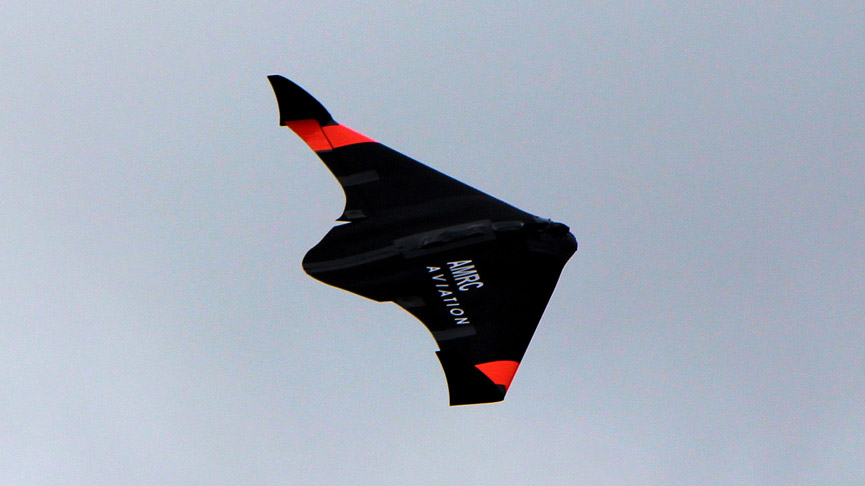 The University of Sheffield produced this UAV is was built entirely through AM. Courtesy of the University of Sheffield.
“By understanding the capability of the FDM [Fused Deposition Modeling] process and associated software, we were able to manipulate the design to contain a number of unique features as well as preventing build deformation,” said project lead, Mark Cocking. “All parts required for the airframe can be combined onto a single build within the DPGs [Stratasys] Fortus 900 machine, taking less than 24 hours with ABS-M30 material. Before design for additive manufacture optimization, this airframe would take over 120 hours to produce.”
The final product is a UAV that comes in nine parts, which can be snapped together prior to use. The new model weighs less than 2 kg (around 4.4 lbs.) and has a wingspan of 1.5 m (slightly less than 5 ft.). Flight control is achieved with direct action servos built into trailing edge elvons. The servos are fixed onto mounting spigots housed in the rear section of the body. The design was tested as a radio controlled slope soaring glider.
Following the successful test, researchers are investigating methods for adding blended winglets and twin ducted fan propulsion. The team would also like to add to the UAV’s onboard systems in hopes of promoting autonomous operation by GPS, and control by surface morphing technology.
The University of Sheffield’s UAV isn’t the first model to benefit from AM, but it is the first model to be entirely designed and constructed for production via 3D printing. Other models, such as the 2Seas drone, only used AM for the body. Eventually entire drones could be printed out, electronics and all, in less time than it takes to learn to fly one.
Below you’ll find a short video about the University of Sheffield’s drone.


John Newman is a Digital Engineering contributor who focuses on 3D printing. Contact him via [email protected] and read his posts on Rapid Ready Technology.
Follow DE
Join over 90,000 engineering professionals who get fresh engineering news as soon as it is published.






About Us · Contact Us · Editorial Team · Advertising · Privacy Policy · Subscriber Services · © 2026 Digital Engineering 24/7 · Peerless Media