Helping design and engineering professionals discover, evaluate and specify technologies and processes that shorten the design cycle and enable success.



Digital Engineering April 2026
In the latest issue of Digital Engineering, we take a look at the latest innovations in design for additive manufacturing, including the use of natural language inputs, social media cosplayers, and AI integration. The issue also includes a feature…

January Special Focus Issue: Design for Additive
In this Special Focus Issue of Digital Engineering, learn about the latest advancements in design for additive manufacturing, including new software tools, additive in automotive, custom medical devices, and more.
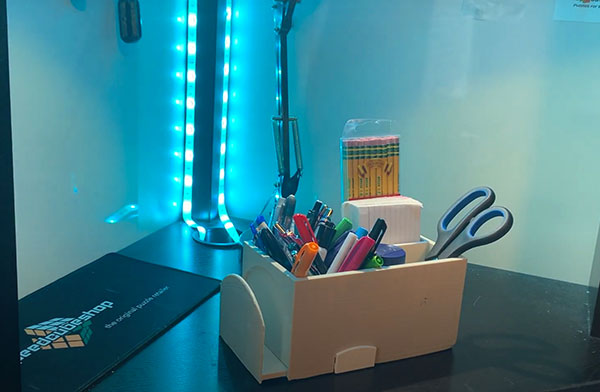
MakerBot is a 3D printer manufacturer in New York City. The company hosted a competition where students were asked to create a desk organizer or another component to use at home, as they learned and continued their studies. While not required, students were free to design and fabricate the object using any available 3D printer.
Andrea Zermeño is the education lead for MakerBot. We spoke to Andrea to learn more about this design challenge.
Digital Engineering: Can you provide an overview of the competition, how it came to be and the intent of the program?
Andrea Zermeño: MakerBot held the MakerBot Student Virtual Prototyping Design Challenge. Submissions were open from August to October 2020, with winners announced in November 2020.
The competition asked students to create a desk organizer or component that classmates would be able to use to make learning from home easier. The competition challenged students to think and problem-solve creatively. Although a 3D printer was not required, students who had access to one were allowed to use it in their design process.
In addition to the design, participants were asked to provide more information on their concept.
The competition was open to students aged 13 and older who reside in the U.S. There were over 570 submissions, out of which we selected three students as finalists. The students presented their winning designs during a live webinar.
The first-place winner received one SKETCH 3D printer for themselves and one for their teacher, as well as one MakerBot Certification Online Course for the classroom (which includes 30 seats). Second- and third-place winners received one Visa gift card each as well as one MakerBot Certification Online Course for their respective classrooms.
DE: Can you tell us about some of the designs that are part of the event and how they came to be?
Zermeño: One of the desk organizers was designed with the goal to help students who have limited workspaces. This organizer clamps onto the desk as an extension and can hold a mobile phone, Post-its and pens or pencils. When designing this part, the student had to account for the range of thicknesses across different desks. The clamp gives users the flexibility to attach it to desks of any thickness. The organizer platform was also cut in a way that allows the pieces to slide on, making it easy to put together. It also has two little bumps on either side, which helps prevent the pieces from sliding off unexpectedly.
This desk organizer was designed as a simple, compact, aesthetically pleasing and versatile desk organizer that can fit everyone’s e-learning or work needs. It allows users to store away items that are not in use, keeping their desk clean and their mind focused. The organizer can hold a variety of items, including laptops, notebooks and folders. In addition, parts of the design are collapsible so users can save space when not using those compartments.
DE: Can you provide some examples of what the event has produced?
Zermeño: The design challenge was a direct opportunity for students and whole classrooms who had previously zero to little experience working with 3D printing and refining their own ideas through the design thinking process—starting from a sketch to a conceptualized prototype.
More and more careers within different industries today require the skill sets that come from 3D printing and design thinking and the design challenge was a great way to have students interact with these two processes in a way that enabled them to follow through and iterate on their ideas while showing them potential career paths they can take in the future.
We expect this challenge showed students that there is power in their ideas and that there are tools accessible to them to allow them to work through and refine their ideas, as well as giving them a sneak peek of processes used in professional industries today.

At MakerBot, we believe the easier the user experience, the more you can focus on developing your ideas. Whether you're already 3D printing or just starting out, learning how to read, write, and talk about your process with the right terms…

Jim Romeo is a freelance writer based in Chesapeake, VA. Send e-mail about this article to [email protected].
Follow DE
Join over 90,000 engineering professionals who get fresh engineering news as soon as it is published.






About Us · Contact Us · Editorial Team · Advertising · Privacy Policy · Subscriber Services · © 2026 Digital Engineering 24/7 · Peerless Media