Helping design and engineering professionals discover, evaluate and specify technologies and processes that shorten the design cycle and enable success.



May 2026 Special Focus: Artificial Intelligence in Design and Simulation
In this Special Focus Issue, learn about the latest developments in the integration of artificial intelligence into engineering workflows.

April 2026 Special Focus Issue: Generative Design
In this Special Focus Issue, Digital Engineering takes a look at how generative design solutions can be used across different types of design problems and with a variety of manufacturing approaches to accelerate design space exploration, and…
This week, the city of San Jose, California, struggled to cope with record-breaking temperatures, downtown street closures that forced Uber and Lyft drivers to reroute, and an estimated 30,000 people flooding its hotels and restaurants. The rising temperatures, peaking in the 90s in the afternoon, was brought on by a heatwave. The street closures, the overbooked hotels, and full-capacity restaurants -- an economic boost for the city but a commute headache -- were a regular feature of the annual NVIDIA GTC (GPU Technology Conference).
In its early days, GTC was about how the GPUs could boost the skin textures and explosions in your videogames and movies. But these days, GTC is unabashedly about how the GPUs would empower your AI applications, whatever your domain or industry might be.
Jensen Huang, CEO, NVIDIA. He pointed out AI has evolved from perceiving to generating and reasoning. "We are now at the beginning of a new platform shift," he said. "You won't ask [the AI] who, what, where, when, and how questions. You will ask it to create and do."
When AI first emerged, everyone relied on it to deal with structure data. "These DataFrames are giant spreadsheets. This is the ground truth of businesses, the foundation of enterprise computing," Huang said. But the new generation of AI is capable of dealing with unstructured data. "It represents the vast majority of the world. Vector databases, PDF files, videos, speeches ... Until now, this data has been completely useless to the world, because you cannot easily search or query them. There's no easy way to index them," explained Huang. "But now, we can have AI do that. Just as AI was able to solve multi-modality perception, it can use the same technology to read a PDF."
To let the AI decipher unstructured data, NVIDIA came up with various libraries, based on its CUDA programming language for GPUs: cuVS for vector data; cuDF for DataFrame libraries.
At GTC, IBM announced its "expanded collaboration with NVIDIA to help enterprises operationalize AI at scale." The announcement says, "IBM and NVIDIA are collaborating on an open-source integration to increase performance and reduce costs around how enterprises extract intelligence from their massive datasets. IBM watsonx.data’s SQL engine Presto is accelerated by NVIDIA cuDF to enable faster query execution on large datasets."
As he listed all the major cloud providers that had become NVIDIA partners in some form or other, he singled out CoreWeave. "They are the world's first AI-native cloud," he said.
A general way to accelerate any application running on a computer is to get a faster CPU, Haung pointed out. "But that has run out of steam. The only way to accelerate applications going forward ... is through application- or domain-specific acceleration. That is why NVIDIA is building library after library, domain after domain, vertical after vertical. We are a vertically integrated computing company ... We have to understand the application, the domain, and fundamentally the algorithms."
At the same time, Haung assured NVIDIA would be "horizontally open." He said, "We'll integrate our technology into whatever platform you'd like us to integrate."
This is reflected in the diversity of the partners present in the GTC pavilion, spanning healthcare and financial services to design and simulation software developers such as Synopsys, Dassault Systemes, and SimScale. During GTC, NVIDIA revealed, "Cadence, Dassault Systèmes, Siemens, and Synopsys are building NVIDIA-powered AI agents to plan, optimize and verify complex chip and system workflows."
One of the exhibitors at GTC was Tata Consultancy Services (TCS), which offers AI-driven data and analytics. It caters to manufacturing, healthcare, and life sciences, among others. Brian Purvis, Product Manager, TCS, said, "It's not just the acceleration, but how quickly we can modify, adjust, and change our manufacturing systems based on AI's predictions."
(For more on the NVIDIA-Synopsys partnership, read our report from Synopsys Converge conference. For more on the NVIDIA-Dassault Systemes partnership, read out report from 3DEXPERIENCE World."
During GTC, NVIDIA announced it is working with Cadence, Dassault Systèmes, PTC, Siemens, and Synopsys to bring NVIDIA CUDA-X, NVIDIA Omniverse, and GPU-accelerated industrial software and tools to their customers.
"Every single one of these companies need compute -- lots and lots of it. They need tokens -- lots and lots of it," said Huang. "Every company is going to be thinking about their token factory." NVIDIA's proposed solution is the NVIDIA Vera Rubin DSX, described by Huang as "an AI factory platform."
In the design, configuration, and validation of the reference DSX system, NVIDIA used a number of partner technologies, including those from Dassult Systemes, Cadence, Siemens, and PTC. Mahesh Deshpande, Senior Director, Global High Tech Industry, Dassault Systèmes, saw this as a high-profile example of Model-Based Systems Engineering (MBSE).
"Having a virtual twin infused with agentic AI is a game changer," he said. "The reference architecture of DSX was realized in our 3DEXPERIENCE platform. In the 1D simulation to study power draws and tradeoffs, behavior simulations, and thermal analysis, CATIA and SIMULIA technologies were used."
NVIDIA's use case exemplifies how systems engineers could study the data center's heatloads and cooling mechanism using Dassault Systemes's thermal and flow solvers, then import the results into NVIDIA Omniverse for visualization. "What is critical to the virtualization of the AI factory is the physics simulation and validation, and the continuous and closed loop between modeling and simulation, going back and forth," said Deshpande.
Steve Lainé, Director Solution Engineering, SimScale, was at the conference, demonstrating how the Agentic AI in SimScale could make simulation much easier. "You can bring in PDF documents -- for example, RFQs -- and the SimScale agentic AI will extract the requirements and start setting up the simulation. Our vision is, in the next few years, engineers will no longer be concerned with the details of setting up a simulation, because AI agents will be doing the laborious, repetitive works in the background."
The AI agent in SimScale is relatively new, making its first appearance a few months ago in Beta. "The Beta version is in our product, but it can also be deployed in a custom mode, tailored to a specific use case," said Laine.
During GTC, SimScale announced a strategic collaboration with AI Engineering GmbH to integrate the PAMICS solver into the SimScale ecosystem. "Leveraging accelerated computing on NVIDIA AI infrastructure, the integration removes meshing bottlenecks and dramatically reduces simulation runtimes for complex industrial applications that have traditionally struggled with grid-based methods, delivering simulation speeds 10-20x faster," according to the announcement.
NVIDIA DGX 1, introduced in 2016, was NVIDIA's first computer for deep learning. Back then, the package included eight NVIDIA Pascal GPUs, churning out 170 Teraflops. This year, Huang introduced NVIDIA Vera Rubin as "the next frontier of agentic AI."
According to the announcement, "The platform brings together the NVIDIA Vera CPU, NVIDIA Rubin GPU, NVIDIA NVLink 6 Switch, NVIDIA ConnectX-9 SuperNIC, NVIDIA BlueField-4 DPU and NVIDIA Spectrum-6 Ethernet switch, as well as the newly integrated NVIDIA Groq 3 LPU. Designed to operate together as one incredible AI supercomputer, the chips power every phase of AI -- from massive-scale pretraining, post-training and test-time scaling to real-time agentic inference."
NVIDIA has just released the Vera Rubin DSX AI Factory reference design, giving hardware partners a guide for building codesigned AI infrastructure. Vera Rubin's launch partners include Dell, Lenovo, HP, ASUS, and Supermicro, among others.
"When we think of Vera Rubin, we think of it as the entire system, vertically integrated, completely with software, optimized as one giant system," said Huang. "Notice all the cables are gone. It's 100% liquid-cooled. What used to take two days to install, now takes two hours. This is also a supercomputer that's cooled by 45* hot water. It takes the pressure off the data center."
In DGX 1, the system used 20-core Intel Xeon CPUs. But eventually, NVIDIA began producing its own data-center CPUs instead of relying on Intel. The Vera Rubin system is powered by 36 NVIDIA Vera CPUs connected with sixth generation NVLink connection.
"We created a brand-new CPU for extremely high single-threaded performance, with incredibly high data output, extremely energy-efficient," Huang said. "We never though we would be selling CPUs standalone. We are now selling a lot of them. For sure, it's going to be a multi-million-dollar business for us," said Haung.

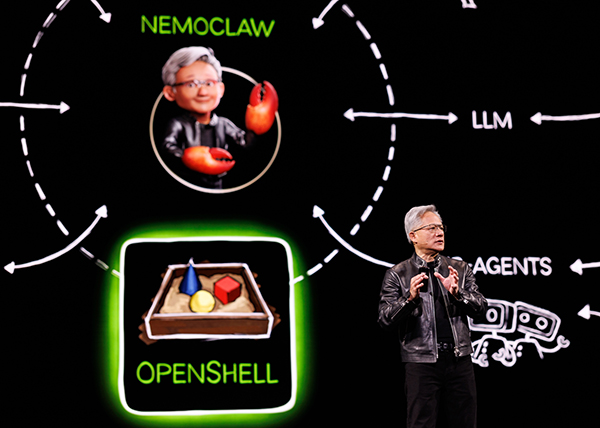
OpenClaw -- written by the Austrian developer Peter Steinberger, published in late 2025 -- is the latest code to grab the AI community's attention. It was marketed as "AI that actually does things."
"I don't know if [Steinberger] realized how successful it would become. It became the most popular open source project in just a few weeks. It exceeded what Linux did in 30 years," noted Huang.
NVIDIA is releasing NemoClaw, an open source stack that adds privacy and security controls to OpenClaw. "This provides the missing infrastructure layer beneath claws to give them the access they need to be productive, while enforcing policy-based security, network and privacy guardrails," according to the press release.
For more NVIDIA GTC news, read:
Supermicro Launches New AI Data Platform Solutions
NVIDIA Brings Agentic AI to Engineering Software
Cadence, NVIDIA Collaborate on Agentic AI Chip and System Design


Since its founding in 1993, NVIDIA (NASDAQ: NVDA) has been a pioneer in accelerated computing. The company’s invention of the GPU in 1999 sparked the growth of the PC gaming market, redefined computer graphics, ignited the era of modern AI and…

Cut Retrieval-Augmented Generation (RAG) Hallucinations by 50%
Most teams hit the same wall with enterprise AI: LLMs that hallucinate, pipelines that don’t scale, and infrastructure that’s harder to design than the models themselves.

Kenneth Wong is Digital Engineering's resident blogger and senior editor. Email him at [email protected] or share your thoughts or suggestions at digitaleng.news/facebook.
Follow DE
Join over 90,000 engineering professionals who get fresh engineering news as soon as it is published.






About Us · Contact Us · Editorial Team · Advertising · Privacy Policy · Subscriber Services · © 2026 Digital Engineering 24/7 · Peerless Media