Helping design and engineering professionals discover, evaluate and specify technologies and processes that shorten the design cycle and enable success.


Alert!
Digital Engineering ceased publication on July 1, 2026. This website remains available as an archive of engineering content.
For inquiries or information, please email [email protected].
Artificial Intelligence for Design and Engineering Workflows
In this white paper, learn how artificial intelligence and machine learning can improve design and simulation.

Technology Focus: Designing for Optimization & Simulation
Simulation is pervasive, with people from different departments and backgrounds discovering new ways to put it to use, in all of its varied forms.
In its early days, NVIDIA’s GTC conference was about how the GPUs could boost the skin textures and explosions in your videogames and movies. But these days, GTC is unabashedly about how the GPUs would empower your AI applications, whatever your domain or industry might be. For manufacturers, the company rolled out new solutions for powering physical AI workflows in design, simulation, plant optimization, autonomous solutions and more.
In March, GTC returned to San Jose, California, drawing an estimated crowd of 30,000 with vested interest in the growing AI commerce.
In his keynote, NVIDIA CEO Jensen Huang pointed out AI has evolved far beyond perception (powered by computer vision) to generative capabilities, and now to Agentic and ultimately Physical AI. "We are now at the beginning of a new platform shift," he said. "You won't ask [the AI] who, what, where, when, and how questions. You will ask it to create and do."
The new generation of AI is capable of dealing with the types of unstructured data that will be important for unlocking value in manufacturing applications–video, images, maintenance logs, sensor data, and more. "It represents the vast majority of the world. Vector databases, PDF files, videos, speeches ... Until now, this data has been completely useless to the world, because you cannot easily search or query them. There's no easy way to index them," explained Huang. "But now, we can have AI do that. Just as AI was able to solve multi-modality perception, it can use the same technology to read a PDF."
During GTC, NVIDIA announced it is working with simulation and design ISVs Cadence, Dassault Systèmes, PTC, Siemens, and Synopsys to bring NVIDIA CUDA-X, NVIDIA Omniverse, and GPU-accelerated industrial software and tools to their manufacturing customers.
"Every single one of these companies needs to compute – lots and lots of it. They need tokens – lots and lots of them," said Huang. "Every company is going to be thinking about their token factory." NVIDIA's proposed solution is the NVIDIA Vera Rubin DSX, described by Huang as "an AI factory platform."
In the design, configuration, and validation of the reference DSX system, NVIDIA used a number of partner technologies, including those from Dassault, Cadence, Siemens, and PTC. In addition, NVIDIA is also collaborating with companies across the MEP value chain to facilitate building massive AI factories, including Trane Technologies, Schneider Electric, Switch, Vertiv, and others to ensure coordination across infrastructure, power, cooling, software and compute. You can read more about those efforts here.
NVIDIA’s technology has been at the heart of ISV efforts to incorporate GPU acceleration into simulation solvers for multiple physics (CAE) and electronic design automation (EDA). Now the companies are working together to incorporate AI into simulation solutions in a number of ways.
Cadence, Dassault Systèmes, Siemens and Synopsys are accelerating engineering workflows by bringing agentic AI into their platforms, using the NVIDIA NeMo platform and Physics NeMo, NVIDIA Nemotron open models, NVIDIA CUDA‑X libraries and NVIDIA accelerated computing to power autonomous design agents for complex chip and system workflows. These solutions include Cadence's ChipStack AI SuperAgent, which combines electronic design automation (EDA) with agentic orchestration; Dassault's partnership with NVIDIA to combine its Virtual Twin technologies with NVIDIA’s AI technology to establish Industry World Models and agentic capabilities on the on the 3DEXPERIENCE platform; Siemens' Fuse EDA AI Agent for semiconductor/PCB design and manufacturing; and Synopsys AgentEngineer for semiconductor and systems design.
Along with hardware partners like Dell Technologies, NVIDIA and its simulation partners are bringing physical AI to bear for more advanced simulation, developing digital twins with NVIDIA Omniverse Libraries to create factory or system-level virtual environments for analyzing design behaviors and running experiments using massive amounts of real-world and synthetic data.
NVIDIA’s simulation software partners also announced a number of major case study examples leveraging NVIDIA technology with simulation, design, and digital twin solutions, including ANUC, HD Hyundai, Honda, JLR, KION, Mercedes-Benz, MediaTek, PepsiCo, Samsung, SK hynix and TSMC. You can read more about the announcements here.
NVIDIA is also partnering with leading robotics companies to integrate physical AI with robotics systems. FANUC, ABB Robotics, YASKAWA and KUKA are integrating NVIDIA Omniverse libraries and NVIDIA IsaacSim simulation frameworks into their virtual commissioning solutions to develop and validate complex robot applications and production using digital twins. The companies are also integrating NVIDIA Jetson modules into their controllers for real-time AI inference at the edge.
In addition, developers such as FieldAI and Skild AI are building generalized robot brains using NVIDIA Cosmos world models for data generation and Isaac simulation frameworks to quickly train robots to master new tasks using simulation. NVIDIA also announced Isaac Lab 3.0 in early access, which adds multiphysics simulation and improved support for complex, dexterous manipulation.
NVIDIA DGX 1, introduced in 2016, was NVIDIA's first computer for deep learning. Back then, the package included eight NVIDIA Pascal GPUs, churning out 170 Teraflops. This year, Huang introduced NVIDIA Vera Rubin, its new supercomputing platform, as "the next frontier of agentic AI."
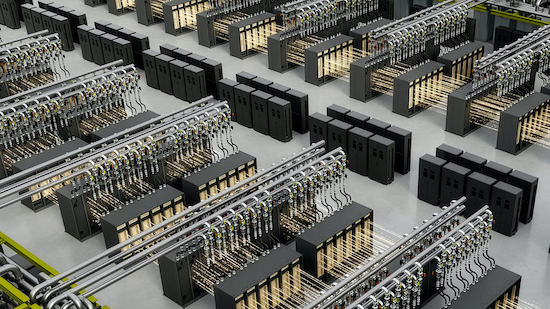
A rendering of the inside of the Vera Rubin system. Image courtesy of NVIDIA.
According to the announcement, the platform is designed “to operate together as one incredible AI supercomputer, the chips power every phase of AI – from massive-scale pretraining, post-training and test-time scaling to real-time agentic inference."
NVIDIA has just released the Vera Rubin DSX AI Factory reference design, giving hardware partners a guide for building codesigned AI infrastructure. Vera Rubin's launch partners include Dell and other hardware companies.
The Vera Rubin system is powered by 72 Rubin GPUs paired with 36 NVIDIA Vera CPUs connected with sixth generation NVLink connection. "We created a brand-new CPU for extremely high single-threaded performance, with incredibly high data output, extremely energy-efficient," Huang said. "We never thought we would be selling CPUs standalone. We are now selling a lot of them. For sure, it's going to be a multi-billion-dollar business for us," said Huang.
OpenClaw –written by the Austrian developer Peter Steinberger, published in late 2025 – is the latest code to grab the AI community's attention. It was marketed as "AI that actually does things." It is an AI agent framework that can automate tasks and operate autonomously.

"I don't know if [Steinberger] realized how successful it would become. It became the most popular open source project in just a few weeks. It exceeded what Linux did in 30 years," noted Huang.
NVIDIA is releasing NemoClaw, an open source stack that adds privacy and security controls to OpenClaw. "This provides the missing infrastructure layer beneath claws to give them the access they need to be productive, while enforcing policy-based security, network and privacy guardrails," according to the press release.
OpenClaw can be used in engineering environments for autonomously monitoring simulation or experiments (as well as sending alerts or logging results) or automating 3D modeling tasks. OpenClaw agents can also interact with the models, libraries, and framework provided by the NVIDIA Isaac platform, helping robotics developers automate and orchestrate simulation workflows. You can read more about NVIDIA’s GTC announcements in this blog.


DE's editors contribute news and new product announcements to Digital Engineering. Press releases may be sent to them via [email protected].
Follow DE
Join over 90,000 engineering professionals who get fresh engineering news as soon as it is published.






About Us · Contact Us · Editorial Team · Advertising · Privacy Policy · Subscriber Services · © 2026 Digital Engineering 24/7 · Peerless Media