Helping design and engineering professionals discover, evaluate and specify technologies and processes that shorten the design cycle and enable success.



May 2026 Special Focus: Artificial Intelligence in Design and Simulation
In this Special Focus Issue, learn about the latest developments in the integration of artificial intelligence into engineering workflows.

Design & Simulation Software Guide 2025
In this Special Issue, Digital Engineering presents its second annual guide to design and simulation software vendors.
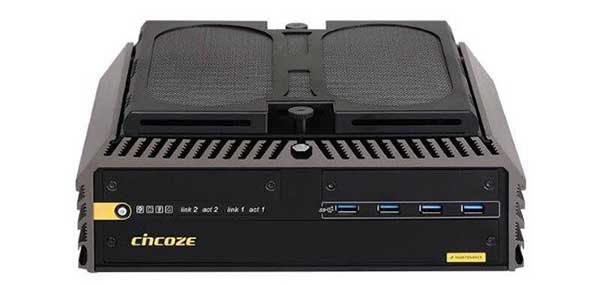
Industrial computer hardware manufacturer and IoT solution provider, OnLogic now debuts the new Cincoze GM-1000, a rugged embedded computer, configurable with MXM form factor GPUs from NVIDIA and AMD. The system is designed for equipment manufacturers, system integrators, computer vision solution providers and end customers who need computing and graphics processing for machine vision, security, autonomous vehicles, medical imaging or edge AI applications.
The global market for machine vision is expected to reach $31.1 billion by 2024, with a CAGR of 9.7%, according to BCC Research. Machine vision is used in industrial and manufacturing applications ranging from object positioning, inspection, measurement, identification and sorting. The GM-1000 uses a combination of CPU and GPU computing for artificial intelligence of things (AIoT) and machine learning tasks.
"Utilizing traditional fan-cooled graphics cards for machine vision and image processing in harsh environments has previously required a compromise," says OnLogic Rugged Line Product Manager Maxx Garrison. "The required graphics processing capabilities meant users were forced to settle for solutions with fewer environmental protections. Now, with the GM-1000 and its passively cooled MXM GPUs, our customers can take advantage of GPU-accelerated computing in a truly rugged system."
Three features of GM-1000 with benefit to machine vision applications are:
The GM-1000 incorporates an Intel 9th/8th generation workstation-grade CPU and an MXM 3.1 Type A/B GPU module to accelerate compute-intensive applications like machine learning, Al and high-end image processing.
High-speed vision cameras and sensors require high-speed connections for near-instantaneous data transfer for image processing and analysis. The GM-1000 provides high-speed I/O interfaces including four USB 3.2 Gen 2 (10Gbps) ports and two GbE LAN connections. Additional expansion options include two 10GbE LAN, four GbE LAN and PoE.
The GM-1000 machine vision computer measures only 260x200x85 mm, for easy integration under workspaces, within devices or on robotic arms. To help it stand up to challenging installation environments, the system features a wide operating temperature range of -40 to 55°C (-40 to 70°C without the GPU), anti-shock and vibration resistance of 50G/5G, wide-range voltage input of 9 to 48 VDC, over-voltage protection, over-current protection, and ESD protection, the company notes. The thermal design and discrete cooling systems for the CPU and GPU maximize heat dissipation efficiency. An external fan kit provides additional active airflow to aid in heat dissipation in low airflow environments or under heavy computing loads.
The Cincoze GM-1000 can be configured with a wide range of storage, memory options, and OS options, including Windows and Linux. The system is available to configure and purchase now.
Sources: Press materials received from the company and additional information gleaned from the company’s website.


DE's editors contribute news and new product announcements to Digital Engineering. Press releases may be sent to them via [email protected].
Follow DE
Join over 90,000 engineering professionals who get fresh engineering news as soon as it is published.






About Us · Contact Us · Editorial Team · Advertising · Privacy Policy · Subscriber Services · © 2026 Digital Engineering 24/7 · Peerless Media