Helping design and engineering professionals discover, evaluate and specify technologies and processes that shorten the design cycle and enable success.


Alert!
Digital Engineering ceased publication on July 1, 2026. This website remains available as an archive of engineering content.
For inquiries or information, please email [email protected].

May 2026 Special Focus: Artificial Intelligence in Design and Simulation
In this Special Focus Issue, learn about the latest developments in the integration of artificial intelligence into engineering workflows.

April 2026 Special Focus Issue: Generative Design
In this Special Focus Issue, Digital Engineering takes a look at how generative design solutions can be used across different types of design problems and with a variety of manufacturing approaches to accelerate design space exploration, and…
By creating scale robotic models of dinosaur bones, the researchers hope to discover how the creatures moved. Additive manufacturing (AM) is a useful tool for this research because the technology is capable of creating complex geometrical objects that are sturdy, yet still lightweight. Part of the problem in using actual bones to determine how dinosaurs might have moved is the weight.
I can’t pick up a 1,100-pound femur and see how it articulates with a 400-pound tibia and 150-pound fibula; not without getting a hernia at least. –Dr. Kenneth Lacovara, paleontologist at Drexel University
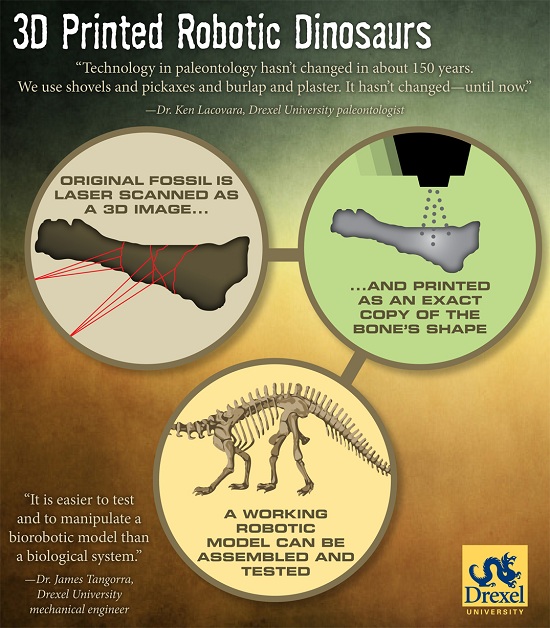
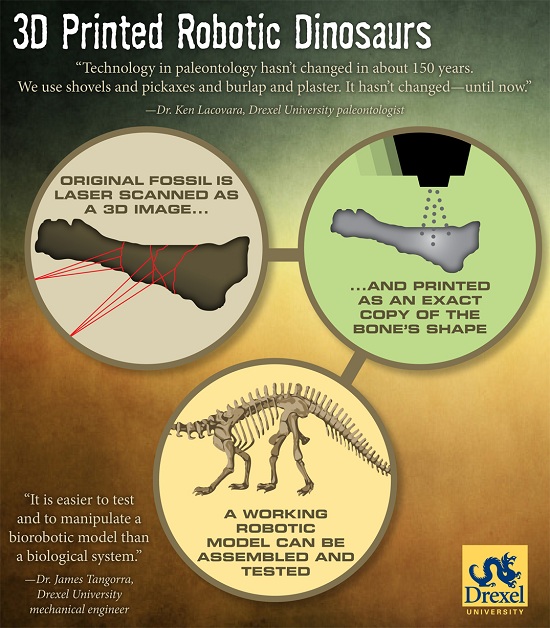
The process of creating the models begins with researchers using a 3D scanner to create a CAD file the scientists can study and alter (in cases of missing pieces). From there, the CAD image is sent to a 3D printer and the bone is built. By teaming up with Dr. James Tangorra from Drexel’s College of Engineering, the AM bones are integrated with robotics to create a moving model.
Besides creating robotic terrors, AM can help paleontologists in other ways. Scale models can be created (sans robot parts) for use in education without worrying about students damaging actual fossils, or dealing with heavy and expensive cast models. Scientists can also create exact-size replicas for use in museum displays. One might imagine the researchers would find that it’s also easier to share a CAD file with their fellows rather than shipping large bones over long distances.
The team at Drexel plans to have a robotic dinosaur completed by the end of 2012. From there they expect to run a number of tests to learn more about the dinosaurs, though without a true flesh-and-bone creature to study, most of the findings will still involve a fair amount of speculation.
Below you’ll find a video that demonstrates how a dinosaur skull can be created with AM.
Sources: Time, Drexel University


John Newman is a Digital Engineering contributor who focuses on 3D printing. Contact him via [email protected] and read his posts on Rapid Ready Technology.
Follow DE
Join over 90,000 engineering professionals who get fresh engineering news as soon as it is published.






About Us · Contact Us · Editorial Team · Advertising · Privacy Policy · Subscriber Services · © 2026 Digital Engineering 24/7 · Peerless Media