Helping design and engineering professionals discover, evaluate and specify technologies and processes that shorten the design cycle and enable success.


Sponsored
Artificial Intelligence for Design and Engineering Workflows
In this white paper, learn how artificial intelligence and machine learning can improve design and simulation.

Technology Focus: Designing for Optimization & Simulation
Simulation is pervasive, with people from different departments and backgrounds discovering new ways to put it to use, in all of its varied forms.
 When hurricanes bear down on the coast of North Carolina, it is essential that storm surge forecasters at the National Hurricane Center in Miami, FL—and local and regional emergency managers—have as much high-fidelity information as possible. Their forecast guides storm surge predictions and warnings used to inform the public about potentially hazardous water levels and wave heights.
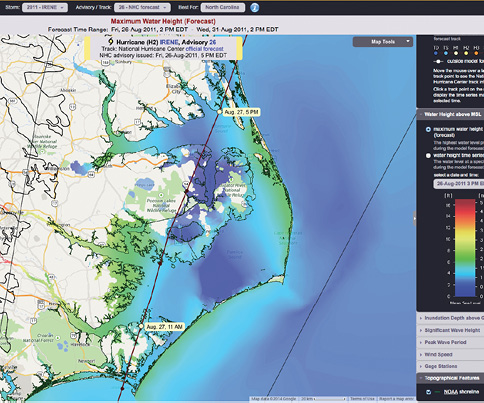 RENCI’s Hatteras HPC cluster depends on Dell technologies for high-resolution storm surge and hurricane wind wave predictions. Image: RENCI
Getting the most detailed storm surge information and data to forecasters is one of the goals of the Renaissance Computing Institute (RENCI). Part of the University of North Carolina at Chapel Hill, RENCI is a collaborative effort between UNC–Chapel Hill, Duke University and North Carolina State University. The institute, which uses high performance computing (HPC) to develop and deploy advanced technologies, focuses on providing computations such as storm surge data to customers including the National Hurricane Center and FEMA.
Perhaps the biggest challenge for RENCI is getting storm surge data to customers as quickly as possible. For example, the typical forecast cycle is six hours long, meaning that federal forecasting operational centers publish their meteorological forecasts every six hours. To be effective and relevant, RENCI’s storm surge prediction system needs to complete its analysis as soon as possible after the official forecast time. Coarse storm surge models run in minutes, but RENCI’s modeling system resolves small but important details of the coastal region, and hence takes longer to complete.
Learn how RENCI created a new HPC cluster called Hatteras that is based on Dell PowerEdge M1000e blade enclosures and PowerEdge M420 blade servers to create more complete storm surge modeling in a shorter time frame.


Join over 90,000 engineering professionals who get fresh engineering news as soon as it is published.






About Us · Contact Us · Editorial Team · Advertising · Privacy Policy · Subscriber Services · © 2026 Digital Engineering 24/7 · Peerless Media