Helping design and engineering professionals discover, evaluate and specify technologies and processes that shorten the design cycle and enable success.


Alert!
Digital Engineering ceased publication on July 1, 2026. This website remains available as an archive of engineering content.
For inquiries or information, please email [email protected].

Digital Engineering April 2026
In the latest issue of Digital Engineering, we take a look at the latest innovations in design for additive manufacturing, including the use of natural language inputs, social media cosplayers, and AI integration. The issue also includes a feature…

January Special Focus Issue: Design for Additive
In this Special Focus Issue of Digital Engineering, learn about the latest advancements in design for additive manufacturing, including new software tools, additive in automotive, custom medical devices, and more.
If you’ve found one system capable of producing quality prints in the material of your choice, it’s more than likely you’ll be able to find two more with the same specs. At this point, most people will choose the least expensive option. A new material extrusion 3D printer needs to have something extra going for it to set it apart from the crowd.
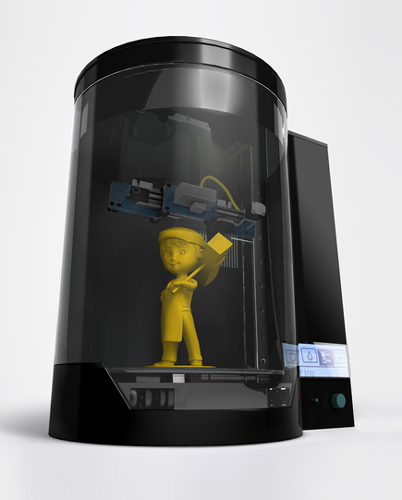
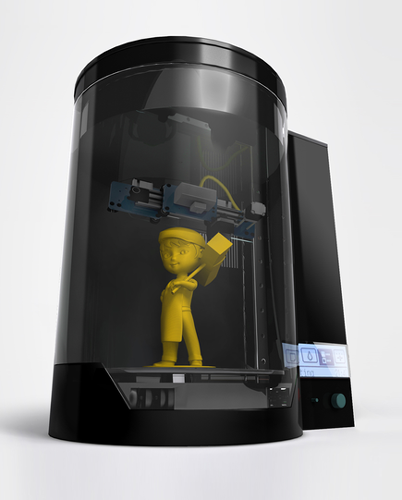 Print and scan from one platform. Courtesy of Blacksmith.
Blacksmith, a company formed at Nanyang Technological University in Singapore, is set to release a new material extrusion AM system named Blacksmith Genesis later this year. Rather than rely on shiny touchscreens or a sleeker design to draw attention to the 3D printer, Blacksmith has brought additional functionality. Along with building 3D objects, the new system also includes a 3D scanner.
According to the company, the Blacksmith Genesis incorporates a rotating build platform. This operates like a standard print bed when the system is in build mode. The platform is also meant to speed up build times by moving in concert with the extruder head rather than relying on the head alone to move around the build. When in 3D scan mode, the platform rotates to ensure each part of an object is recorded.
Specs for the 3D printer half of the Blacksmith Genesis include a 9.1 in. diameter x 6.3 in. height build envelope, and a layer resolution up to 50 microns. The system’s only material option at this point in development is 1.75mm PLA. Unsurprisingly, the scanner volume is the same as the build envelope, with a complete scan requiring about six minutes. The system performs 1200 steps per rotation, using a 3.1 MP CMOS Image Sensor.
The same camera that records data from scans can also be used to remotely monitor a print. Users can also remotely cancel a print if they catch any problems. The Blacksmith Genesis also comes with its own software, called Blacksmith Sorcerer, which will run on Windows, Mac and Linux. No word yet on price.
Below you’ll find a video about the Blacksmith Genesis.
Source: Blacksmith


John Newman is a Digital Engineering contributor who focuses on 3D printing. Contact him via [email protected] and read his posts on Rapid Ready Technology.
Follow DE






About Us · Contact Us · Editorial Team · Advertising · Privacy Policy · Subscriber Services · © 2026 Digital Engineering 24/7 · Peerless Media