Helping design and engineering professionals discover, evaluate and specify technologies and processes that shorten the design cycle and enable success.


Alert!
Digital Engineering ceased publication on July 1, 2026. This website remains available as an archive of engineering content.
For inquiries or information, please email [email protected].


Digital Engineering April 2026
In the latest issue of Digital Engineering, we take a look at the latest innovations in design for additive manufacturing, including the use of natural language inputs, social media cosplayers, and AI integration. The issue also includes a feature…

January Special Focus Issue: Design for Additive
In this Special Focus Issue of Digital Engineering, learn about the latest advancements in design for additive manufacturing, including new software tools, additive in automotive, custom medical devices, and more.
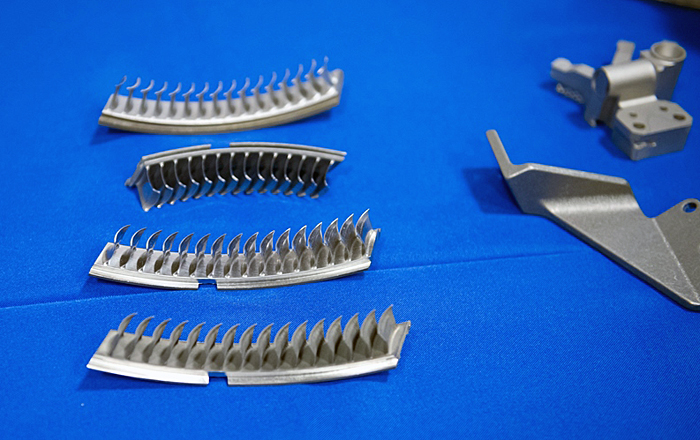 These compressor stators were created via additive manufacturing, and will be used in jet engines by Bombardier. Image: Pratt & Whitney
In aerospace, additive manufacturing has enabled rapid creation of prototype parts that, in the past, would have been created using more expensive machining techniques. But parts created this way have yet to be placed into service in actual jet engine. That's about to change.
Later this year, Pratt & Whitney will deliver PurePower PW1500G engines to Bombardier that include compressor stators and synch ring brackets that were created via 3D printing powder bed additive manufacturing. The geared turbofan engines are used exclusively in the Bombardier CSeries aircraft.
"Pratt & Whitney has been working with additive manufacturing since the 1980s, and we are looking forward to our upcoming milestone, when the first production PurePower PW1500G engines with parts produced through additive manufacturing will be delivered," said Tom Prete, Pratt & Whitney's Engineering vice president. "We are a vertically integrated additive manufacturing producer with our own metal powder source and the printers necessary to create parts using this innovative technology. As a technology leader, we are intrigued by the potential of additive manufacturing to support our suite of technologies and benefits to customers and the global aerospace industry."
According to Pratt & Whitney, the company has saved 15 months in lead time compared to conventional manufacturing processes, and reduced the weight in a single part by up to 50%.
Other components in the PurePower engines are produced via metal injection molding, electron beam melt, and laser powder bed fusion (including direct metal laser sintering).
In 2013, Pratt & Whitney announced its Additive Manufacturing Innovation Center (formed in collaboration with the University of Connecticut), which the company says is the first of its kind in the Northeast region to work with metal powder bed technologies. The facility includes two Arcam electron beam melting A2X machines for manufacturing large, complex metal parts at high temperatures.
Source: Pratt & Whitney


Brian Albright is the editorial director of Digital Engineering.
Contact him at [email protected].






About Us · Contact Us · Editorial Team · Advertising · Privacy Policy · Subscriber Services · © 2026 Digital Engineering 24/7 · Peerless Media