Helping design and engineering professionals discover, evaluate and specify technologies and processes that shorten the design cycle and enable success.


Alert!
Digital Engineering ceased publication on July 1, 2026. This website remains available as an archive of engineering content.
For inquiries or information, please email [email protected].

Design & Simulation Software Guide 2025
In this Special Issue, Digital Engineering presents its second annual guide to design and simulation software vendors.

Design & Simulation Software Guide
In this Special Issue, Digital Engineering presents its inaugural guide to design and simulation software vendors, including listings for CAD, CAM, simulation, generative design, PLM, rendering and visualization, design for additive manufacturing,…
LiquidPlanner, a maker of what it calls “dynamic” project management software, is teaming up with P3 Group, a global manufacturing consultancy, to try to change that scenario. Citing what it calls a “tidal wave” of complexity in light of Industry 4.0 trends like the Internet of Things (IoT), 3D printing, and mass customization, LiquidPlanner says engineering, product development and manufacturing teams need a mechanism to navigate multidimensional, fluid relationships between people, priorities and effort. This set of dynamics, officials say, is just not possible to manage efficiently using standard project management tools, let alone the still popular spreadsheet.
“Traditional project management tools are very date-driven—humans put dates in plans and the plans stay static, disconnected, and siloed,” explains Liz Pearce, LiquidPlanner CEO. “We take a dynamic project management approach. Instead of having every project plan manually owned and updated by someone in the organization, we look at the work as a whole.”
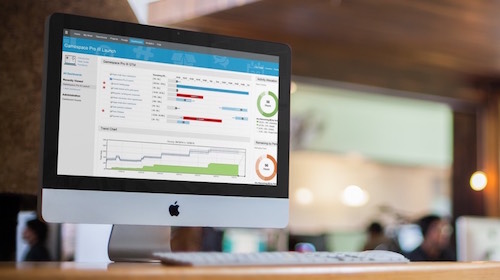 LiquidPlanner takes a dynamic approach to project management. Image Courtesy of LiquidPlanner
With traditional project management packages, users maintain separate project plans for individual projects, which doesn’t allow a higher level view to recalibrate resources across the totality of projects when things change, Pearce explains. In addition, traditional tools require users to manually update schedules and make adjustments. In comparison, LiquidPlanner works off of a predictive scheduling engine that handles project organization and scheduling based on user estimates of how long a project will take as well as prioritization.
“Our customers have anywhere from 20 to 100 active projects at a time and nearly all share resources,” she says, explaining that specialized talent like electrical engineers or mold engineers are involved in multiple projects, thus often become the bottleneck. “People don’t always know when resources are freed up—resourcing often comes down to who’s the last person that yelled at me,” she says.
LiquidPlanner, which is Web-based, helps teams organize tasks by priority and work through best case/worst case estimates, officials say. The software ensures all project collaborators are working from a central location, which keeps projects current while allowing users to more easily adapt to unknowns—a common occurrence in today’s highly-complex development and manufacturing environments.
Manufacturers, in particular, have flocked to LiquidPlanner more so than other industries, officials say. That led LiquidPlanner to forge a partnership with P3 North America, a consulting firm specializing in this sector, to help accelerate deployments and provide consulting services.
“With siloed project plans, it’s hard to keep on top of when things are landing with different resources, and the impact of not having good information for engineering organizations is high,” Pearce explains. “We help companies identify bottlenecks faster.”
To learn more about how LiquidPlanner works, watch this video.


Beth Stackpole is a contributing editor to Digital Engineering. Send e-mail about this article to [email protected].
Follow DE






About Us · Contact Us · Editorial Team · Advertising · Privacy Policy · Subscriber Services · © 2026 Digital Engineering 24/7 · Peerless Media