Helping design and engineering professionals discover, evaluate and specify technologies and processes that shorten the design cycle and enable success.


Alert!
Digital Engineering ceased publication on July 1, 2026. This website remains available as an archive of engineering content.
For inquiries or information, please email [email protected].

Digital Engineering April 2026
In the latest issue of Digital Engineering, we take a look at the latest innovations in design for additive manufacturing, including the use of natural language inputs, social media cosplayers, and AI integration. The issue also includes a feature…

January Special Focus Issue: Design for Additive
In this Special Focus Issue of Digital Engineering, learn about the latest advancements in design for additive manufacturing, including new software tools, additive in automotive, custom medical devices, and more.
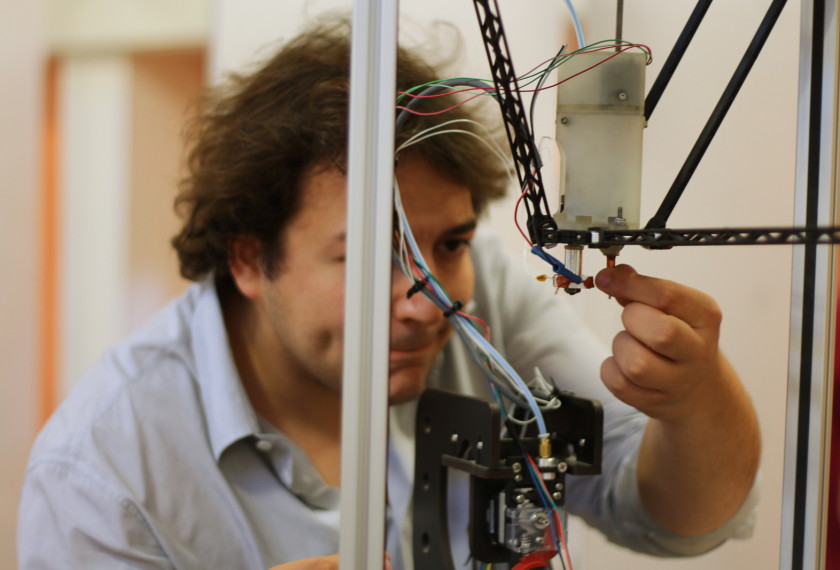
Most of the work of integrating AM and printed electronics has taken place in labs, but that may be changing. Designed by a group of Harvard graduate students, the Rabbit Proto is a new printing head that can be attached to RepRap systems to lay down circuitry. The project is open source and could spur further development fusing 3D printing and printed electronics.
From the website:
Rabbit Proto is a print head add-on that easily plugs into your 3D printer, enabling it to print complex conductive traces within your 3D design. The project source code, documentation, and example designs are open source and available on GitHub.
Essentially, what the Rabbit Proto does is print a layer of circuitry using a conductive material as ink. This requires replacing the usual extruder head you’d find on a RepRap with the Rabbit Proto head. Once the conductive material is in place, users can replace the extruder head and continue printing an object. The end result is a 3D printed object with internal circuitry.
The team behind the Rabbit Proto has worked on a number of concept pieces as proof of design. One of the simplest projects was a plastic puzzle that included printed circuitry and connecting pins. When the puzzle was correctly assembled the circuitry would align and a light would shine.
A more complex example of what can be accomplished was the design and build of a Super Nintendo inspired game controller. The team worked out the design of the controller in CAD, including space for buttons and circuitry. The digital design was then made real by a combination of standard material extrusion 3D printing and printed circuitry from the Rabbit Proto.
While having to swap out print heads may not be the easiest way to mix printed electronics and AM, it’s probably the least expensive. Assuming you already have a 3D printer, the Rabbit Proto is sold for $350. For those people who don’t want to mess around with swapping out heads, the Rabbit Proto dual extrusion head allows faster swapping between materials.
Below you’ll find a video about the design and build of the game controller.
Source: Rabbit Proto


John Newman is a Digital Engineering contributor who focuses on 3D printing. Contact him via [email protected] and read his posts on Rapid Ready Technology.
Follow DE






About Us · Contact Us · Editorial Team · Advertising · Privacy Policy · Subscriber Services · © 2026 Digital Engineering 24/7 · Peerless Media