Helping design and engineering professionals discover, evaluate and specify technologies and processes that shorten the design cycle and enable success.


Alert!
Digital Engineering ceased publication on July 1, 2026. This website remains available as an archive of engineering content.
For inquiries or information, please email [email protected].

Digital Engineering April 2026
In the latest issue of Digital Engineering, we take a look at the latest innovations in design for additive manufacturing, including the use of natural language inputs, social media cosplayers, and AI integration. The issue also includes a feature…

January Special Focus Issue: Design for Additive
In this Special Focus Issue of Digital Engineering, learn about the latest advancements in design for additive manufacturing, including new software tools, additive in automotive, custom medical devices, and more.
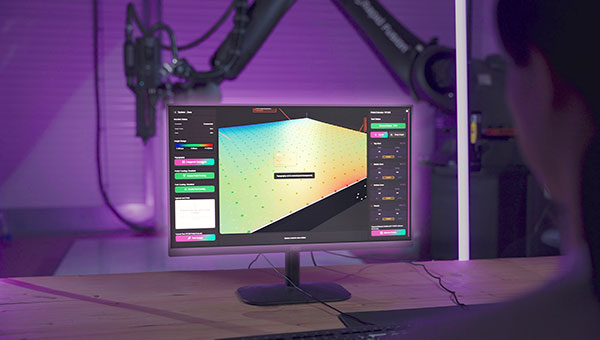
Rapid Fusion has unveiled a new AI print assistant that is designed to enhance the performance of its robotic additive manufacturing systems. This solution is designed for customers printing complex components for the automotive, aerospace, construction, medical and military sectors.
After 8 months of coding, troubleshooting and live tests, ‘Bob (Base of Build)’ is being rolled out to existing clients. It promises to optimize its robots by making them easier to use, providing more operator control and ensuring less downtime via preventive maintenance.
The pre-loaded knowledge bank, a large collection of 3D printing expertise, works in secure online/cloud-connected and offline/air-gapped configurations for military or IP-sensitive clients. This works with Rapid Fusion’s existing models like Apollo and Zeus and for its most recent system Medusa, a UK-built large-format hybrid 3D gantry printer.
“There is a lot of talk about how AI can transform the business world and numerous companies are jumping on the bandwagon,” explains Martin Jewell, chief technology officer at Rapid Fusion. “It’s something we’ve been aware of from day one and all of our robotic additive manufacturing systems have been built so that we can use artificial intelligence to unleash the full potential of our technology.”
“Having our own AI ‘print assistant’ is a gamechanger and will cut machine downtime and boost efficiency. We’re teaching our systems to understand challenges and different scenarios, which means we can make the user interface more responsive and simpler to embrace—opening it up to all the workforce," Jewell adds.
Rapid Fusion, which employs 10 people at its demo center in Exeter, UK, has factored in over 1,000 different printing parameters into its AI language to develop ‘best-in-class settings for more than 100 different components, the company says.
The solution features smart extrusion readiness, which analyzes the live temperature across four heating zones with rolling stability windows, providing confidence-scored go/no-go decisions using heating/cooling profiles per material and pre-determined safety thresholds.
Material aware intelligence also covers extensive variants, including carbon fiber composites and high-temperature polymers.
"Task completion orchestrator operates three-tier intent processing; fast pattern matching for simple commands, AI interpretation accesses comprehensive material databases for complex requests, and advanced contextual understanding ensures accurate execution across all scenarios." Jewell adds. “Finally, the AI temperature command handler includes 'smart chained' intentions that combine multiple actions."
There will be two levels of users for Bob. First, a super user, such as a trusted partner or university, who can continue to inform and iterate the way Rapid Fusion does things. Secondly, there will be a standard offer released at the start of 2026 for everyone who has one of the systems.
Sources: Press materials received from the company and additional information gleaned from the company’s website.


DE's editors contribute news and new product announcements to Digital Engineering. Press releases may be sent to them via [email protected].
Follow DE






About Us · Contact Us · Editorial Team · Advertising · Privacy Policy · Subscriber Services · © 2026 Digital Engineering 24/7 · Peerless Media