Helping design and engineering professionals discover, evaluate and specify technologies and processes that shorten the design cycle and enable success.


Alert!
Digital Engineering ceased publication on July 1, 2026. This website remains available as an archive of engineering content.
For inquiries or information, please email [email protected].

Digital Engineering April 2026
In the latest issue of Digital Engineering, we take a look at the latest innovations in design for additive manufacturing, including the use of natural language inputs, social media cosplayers, and AI integration. The issue also includes a feature…

January Special Focus Issue: Design for Additive
In this Special Focus Issue of Digital Engineering, learn about the latest advancements in design for additive manufacturing, including new software tools, additive in automotive, custom medical devices, and more.
We'll start today's Roundup with a bang. Sintercore, a small company founded by former US Marine Neal Brace, has developed a muzzle break for the AR-15 using AM. The complex internal geometry of the muzzle break could only be produced through AM, and leads to a reduction of muzzle rise and recoil. The muzzle break, named Auxetik, was built from Inconel, an alloy generally used to build parts for jet engines.
Brace is able to reproduce the part for just $300 by sending orders to services bureaus, which then print it out on professional metal AM systems. Brace claims he has other firearms peripherals in the works, but is quick to distance himself from entities like Defense Distributed. According to Brace, not only is he not in the business of printing guns, he doesn't intend to start.
Moving on, police in Japan have found a new use for AM by printing out busts of wanted criminals and terrorists. The project has already been successful in helping to capture the last member of Aum Shinrikyo, the terrorist group responsible for the 1995 subway sarin gas attack. The fugitive Katsuya Takahashi was arrested at a manga cafe after the bust's release, which apparently gave people a better idea of what his overall appearance.
In addition to printing out the heads of criminals, Japanese police are looking to use AM to print out replicas of weapons used in attacks, and to build scale models of crime scenes. These props may find their way into jury rooms, where they will be used to assist prosecutors (and eventually defenders, no doubt) as part of the proceedings. The video below is in Japanese, but you can set it up for English captions.
Next, we have a quick word about Stratasys' material options. At last count the company was up to more than 130 different materials including the PolyJet and Fused Deposition Modeling processes. That many materials presents a daunting amount of information for customers to absorb, and Stratasys has decided to ease the burden by releasing a series of videos focused on materials. You'll find the first such video below.
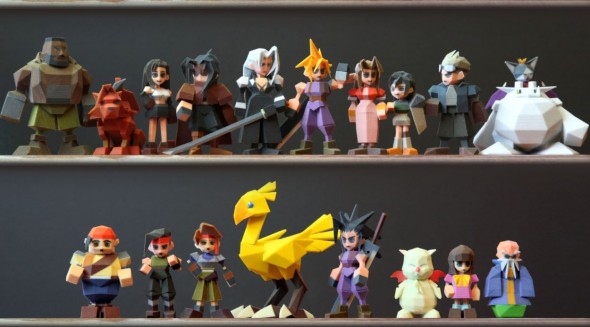
Last, people are always trying to find some way to use 3D printing to create unique models based on their favorite superheroes, sports teams or video game characters. Joaquin Baldwin created a set of 26 characters from the popular Final Fantasy video game series.
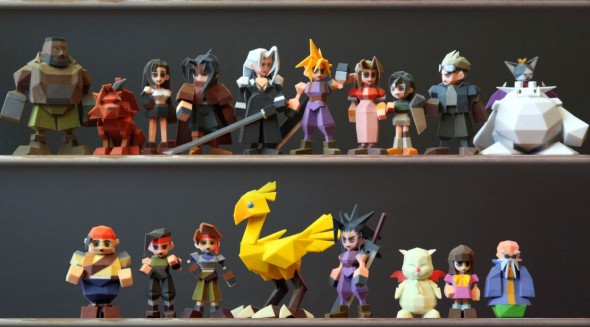
The characters are unique to Final Fantasy VII. Alas, Square Enix, owner of the Final Fantasy IP sent Baldwin a cease-and-desist notice, so you aren't going to be able to own a spikey headed Cloud of your own unless you design it yourself.
Sources: MLive, Stratasys, Geek, WebProNews


John Newman is a Digital Engineering contributor who focuses on 3D printing. Contact him via [email protected] and read his posts on Rapid Ready Technology.
Follow DE






About Us · Contact Us · Editorial Team · Advertising · Privacy Policy · Subscriber Services · © 2026 Digital Engineering 24/7 · Peerless Media