Helping design and engineering professionals discover, evaluate and specify technologies and processes that shorten the design cycle and enable success.



Digital Engineering April 2026
In the latest issue of Digital Engineering, we take a look at the latest innovations in design for additive manufacturing, including the use of natural language inputs, social media cosplayers, and AI integration. The issue also includes a feature…

January Special Focus Issue: Design for Additive
In this Special Focus Issue of Digital Engineering, learn about the latest advancements in design for additive manufacturing, including new software tools, additive in automotive, custom medical devices, and more.
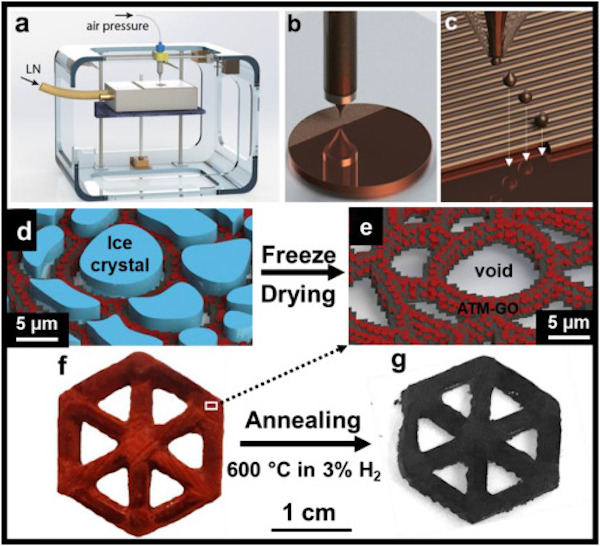
A research team at Kansas State University 3D printed batteries using freeze casting and hybrid MoS2-graphene aerogels.
The process uses inkjet printing and freeze casting to control the microstructure and macroporosity of the structures during printing. Ink droplets (consisting of a molecular MoS2 precursor missed with graphene oxide nanosheets) are frozen during the 3D print process using a cold substrate plate set at -30° Celsius. The ice crystals formed when the droplets frozen form a matrix. The frozen droplets were used to form the aerogel, and undergo additional refinements and processes to create anodes for sodium ion batteries.
The resulting interconnected porous structures could mitigate the stress induced by larger volume changes during charge-discharge cycles of sodium ion batteries because of the higher specific capacity of the materials and larger ion size.
The researchers believe this is the first time that MoS2-rGO hybrid aerogels have been 3D printed.
The research, titled 3D printing of hybrid MoS2-graphene aerogels as highly porous electrode materials for sodium ion battery anodes,” appeared in Materials & Design.
According to the researchers, previous work using 3D printing to fabricate Li-ion battery electrodes have used materials with relatively low theoretical specific capacities.
Source: Materials & Design


Brian Albright is the editorial director of Digital Engineering.
Contact him at [email protected].

Join over 90,000 engineering professionals who get fresh engineering news as soon as it is published.






About Us · Contact Us · Editorial Team · Advertising · Privacy Policy · Subscriber Services · © 2026 Digital Engineering 24/7 · Peerless Media