Helping design and engineering professionals discover, evaluate and specify technologies and processes that shorten the design cycle and enable success.


Alert!
Digital Engineering ceased publication on July 1, 2026. This website remains available as an archive of engineering content.
For inquiries or information, please email [email protected].

Digital Engineering April 2026
In the latest issue of Digital Engineering, we take a look at the latest innovations in design for additive manufacturing, including the use of natural language inputs, social media cosplayers, and AI integration. The issue also includes a feature…

January Special Focus Issue: Design for Additive
In this Special Focus Issue of Digital Engineering, learn about the latest advancements in design for additive manufacturing, including new software tools, additive in automotive, custom medical devices, and more.
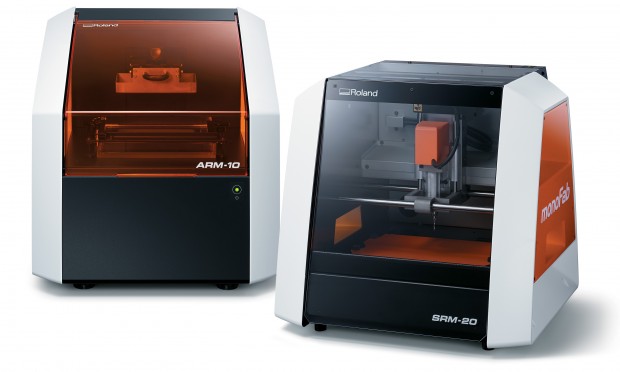 Roland DGA has released the monoFab series of complementary desktop fabrication tools, the ARM-10 (left) 3D printer and the SRM-20 (right) subtractive milling machine. Image courtesy of Roland DGA Corp.
Roland DGA describes the ARM-10 3D printer as being ideal for design validation in the initial stages of prototyping or modeling. It uses a stereolithography process with a proprietary UV-LED projection system to build models by sequentially curing layers of liquid photopolymer resin. Designers can build complex parts that previously required multi-axis milling, such as hollowing or undercuts, quickly and easily with ARM-10, reports the company.
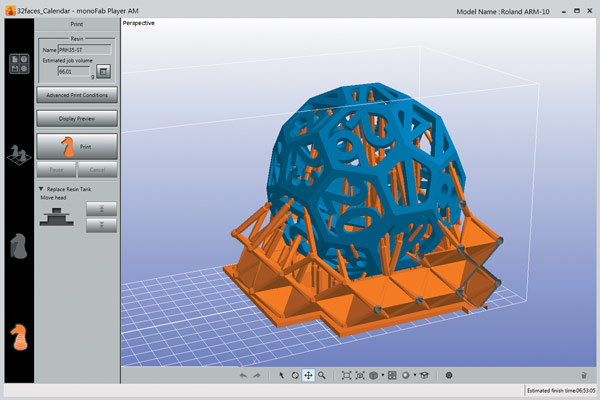 The ARM-10’s monoFab Player AM software supports 3D printing from STL files with such features as automatic support creation as well as healing and simplifying mesh data. Image courtesy of Roland DGA Corp.
The ARM-10’s build area is 5.11 (130 mm) W x 2.75 (70 mm) D x 2.75 in. (70 mm) H. X,Y resolution is 0.00079 in. (0.2 mm) and Z-axis resolution is 0.0004 in. (0.01 mm).
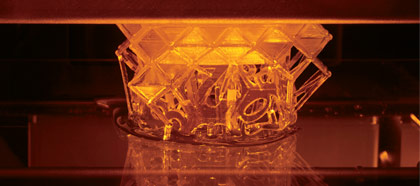 The ARM-10 stereolithographic 3D printer uses an LED-based DLP projector beaming UV light to cure resin. Image courtesy of Roland DGA Corp.
The supplied monoFab Player AM (additive manufacturing) software, says Roland DGA, supports 3D printing from STL files and offers a user-friendly interface. Software features include automatic support building, healing and mesh simplification, simulation of resin volume, a preview layer functionality and such controls as change scale, duplicate and rotate. The ARM-10 requires a 1GB workstation running Windows 7 or 8.x operating systems.
The SRM-20 subtractive milling machine can work with a variety of materials, including ABS (acrylonitrile butadiene styrene), acrylic, chemical wood, foam, modeling wax, PC board and polyacetate. Features include a fully-enclosed cabinet, a side window that facilitates viewing milling progress and Z-axis depth, a Y-axis belt drive resistant to the effects of milling debris, and an independent collet system chuck that enables users to replace the collet chuck to match the shank diameter for fast setting of the Z-axis base point as well as quick tool changes.
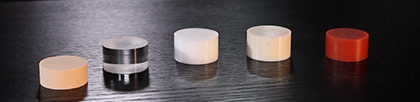 The SRM-20 subtractive milling machine can work with a variety of materials, including modeling wax, chemical wood, foam, acrylic, poly acetate, ABS and PC board. Image courtesy of Roland DGA Corp.
The SRM-20’s VPanel computer controller panel provides a simple interface for adjusting the tool position and setting the starting point for milling. It also has functionality for controlling feed rates and spindle speed overrides, pause and resume operation as well as tracking X,Y,Z motions. Its numeric readout can display millimeters or inches.
Bundled software with the SRM-20 includes MODELA Player 4 for processing STL files produced by such CAD programs as Autodesk Inventor, Rhino and SolidWorks; iModela Creator for creating and milling shapes, holes, textures and patterns; Virtual MODELA for quick previews of the entire milling operation, including simulation of finished shapes and estimates of production time; and ClickMill, which enables direct control of the SRM-20 for surfacing, drilling holes, cutting pockets and other finishing processes.
The SRM-20 interprets both Roland RML code as well as industry-standard NC code (G-code). It supports a USB interface and runs under Windows operating systems. X, Y, and Z operation strokes are 8 (X) x 6 (Y) x 2.38 (Z) inches – 203.2 (X) x 152.4 (Y) x 60.5 (Z) mm. Work piece table size is 9.14 (X) x 6.17 (Y) inches – 232.2 (X) x 156.6 (Y) mm. Mechanical resolution is 0.0000393 in./step (0.000998594 mm/step). The spindle rotation speed is adjustable from 3,000 to 7,000 rpm.
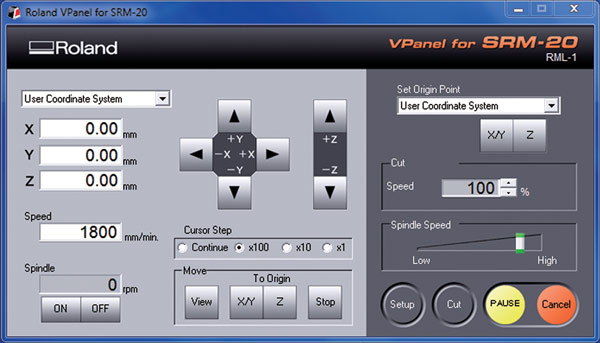 The VPanel interface for the SRM-20 subtractive milling machine is where users can adjust tool positions, set the starting point for milling, control feed rate and spindle speed as well as perform other functions. Image courtesy of Roland DGA Corp.
“The monoFab series desktop fabrication tools are the culmination of over 25 years of experience in 3D milling,” said Rachel Hammer, 3D product manager for Roland DGA, in a press statement. “By combining the capabilities of these advanced rapid prototyping machines, users can select the best method for their workflow, from concept to production. Now, designers have greater opportunities to turn their ideas into reality.”
The list price for the ARM-10 desktop 3D printer is $6,995. The SRM-20 subtractive milling machine list price is $4,995. For more information about the monoFab series of rapid prototyping machines, visit Roland DGA.
Go here for full details on the ARM-10 desktop 3D printer.
Go here for full details on the SRM-20 compact milling machine.
Watch a video on monoFab series rapid prototyping machines.
Download the monoFab series brochure.
Sources: Press materials received from the company and additional information gleaned from the company's website.


Anthony J. Lockwood is Digital Engineering's founding editor. He is now retired. Contact him via [email protected].
Follow DE






About Us · Contact Us · Editorial Team · Advertising · Privacy Policy · Subscriber Services · © 2026 Digital Engineering 24/7 · Peerless Media