Helping design and engineering professionals discover, evaluate and specify technologies and processes that shorten the design cycle and enable success.


Alert!
Digital Engineering ceased publication on July 1, 2026. This website remains available as an archive of engineering content.
For inquiries or information, please email [email protected].
Sponsored

Digital Engineering April 2026
In the latest issue of Digital Engineering, we take a look at the latest innovations in design for additive manufacturing, including the use of natural language inputs, social media cosplayers, and AI integration. The issue also includes a feature…

January Special Focus Issue: Design for Additive
In this Special Focus Issue of Digital Engineering, learn about the latest advancements in design for additive manufacturing, including new software tools, additive in automotive, custom medical devices, and more.
Metal 3D printing is rapidly expanding its presence in manufacturing, with systems capable of producing complex metal prototypes and parts at a high resolution. But the learning curve for this type of additive manufacturing can be high, which can make adoption difficult and costly.
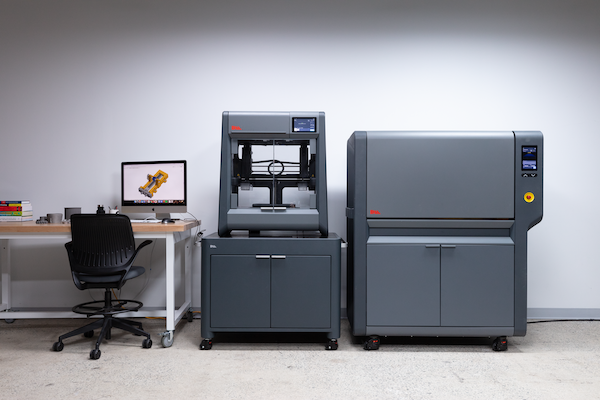
The Desktop Metal Studio System™ provides an easy-to-use metal additive manufacturing platform that can be deployed safely in any environment, offering designers and manufacturers a cost-effective way to quickly turn their tools, jigs, and products into reality. The Desktop Metal solution provides all of the hardware, software, and feedstock needed to rapidly begin printing metal parts.
To produce high-quality prototypes or end-use parts with metal 3D printing often requires a significant amount of operational knowledge, and the additive manufacturing equipment is usually not office friendly. Like their machine shop cousins, some metal printers can generate a lot of material waste, heat, and fumes. For design engineers that want to print a metal prototype or casting, options are limited.
The Desktop Metal Studio System solves all of these challenges, offering the benefits of metal 3D printing that can be accessible in any office, studio or lab setting, in an easy-to-use package that includes both hardware and software.
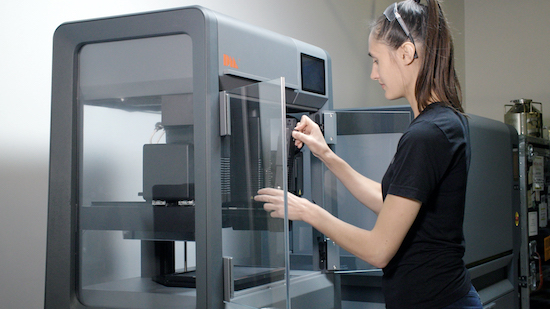
The Studio System features a two-step print-and-sinter process that requires very little training or operator intervention. The furnace in the unit heats parts to remove the binders, then increases the temperature to provide industrial-strength sintering.
The Studio System’s Bound Metal Deposition™ (BMD) technology leverages safe-to-handle feedstock rods made of pre-bound metal powders and polymer binders that can be extruded into complex shapes and then sintered to full density. For users, this means there is no loose powder, no special powder handling requirements, no lasers, no solvents, and no need for specialized facilities to house and manage the print process. Designers can print parts or products in a design lab or even right in their office. The metal rods are available in a variety of alloys..
Desktop Metal Live Studio™ software intuitively guides users through the entire metal 3D printing workflow, including model preparation, automated sintering cycles, and job queueing. It automatically scales and orients parts and applies expert metallurgy to optimize fabrication.
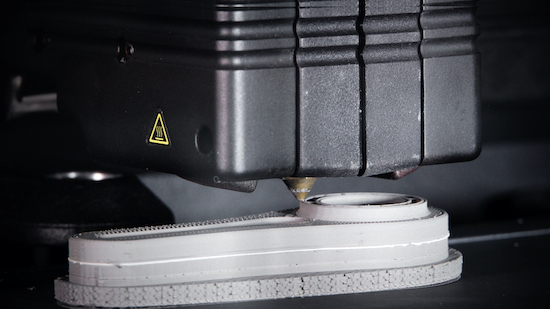
The system also creates Separable Supports™ for complex shapes, which reduces the need for time-consuming post-processing. These supports are generated in the Live Studio software with strategic seams and printed with a ceramic release layer that can be easily broken away by hand.
The Studio System helps users take control of their prototyping processes, providing simplified and easy-to-manage metal printing that lets design and engineering teams focus less on the equipment and more on creating innovative parts and products. In-house metal printing enables rapid prototyping and design iteration, further accelerating the development process.
To learn more about Desktop Metals Studio System, visit the product webpage here, and visit the links below.
Case Study: How Ecrimesa Group Uses the Studio System for Rapid Prototyping
On-Demand Webinar: Walkthrough of Adopting Office Safe 3D Printing


Desktop Metal was started to address a problem—how to make metal 3D printing accessible for engineering teams. In 2013, CEO Ric Fulop began collaborating with world-leading experts in materials science, engineering, and 3D printing. Their work…

Brian Albright is the editorial director of Digital Engineering.
Contact him at [email protected].






About Us · Contact Us · Editorial Team · Advertising · Privacy Policy · Subscriber Services · © 2026 Digital Engineering 24/7 · Peerless Media