Helping design and engineering professionals discover, evaluate and specify technologies and processes that shorten the design cycle and enable success.


Alert!
Digital Engineering ceased publication on July 1, 2026. This website remains available as an archive of engineering content.
For inquiries or information, please email [email protected].

Digital Engineering April 2026
In the latest issue of Digital Engineering, we take a look at the latest innovations in design for additive manufacturing, including the use of natural language inputs, social media cosplayers, and AI integration. The issue also includes a feature…

January Special Focus Issue: Design for Additive
In this Special Focus Issue of Digital Engineering, learn about the latest advancements in design for additive manufacturing, including new software tools, additive in automotive, custom medical devices, and more.
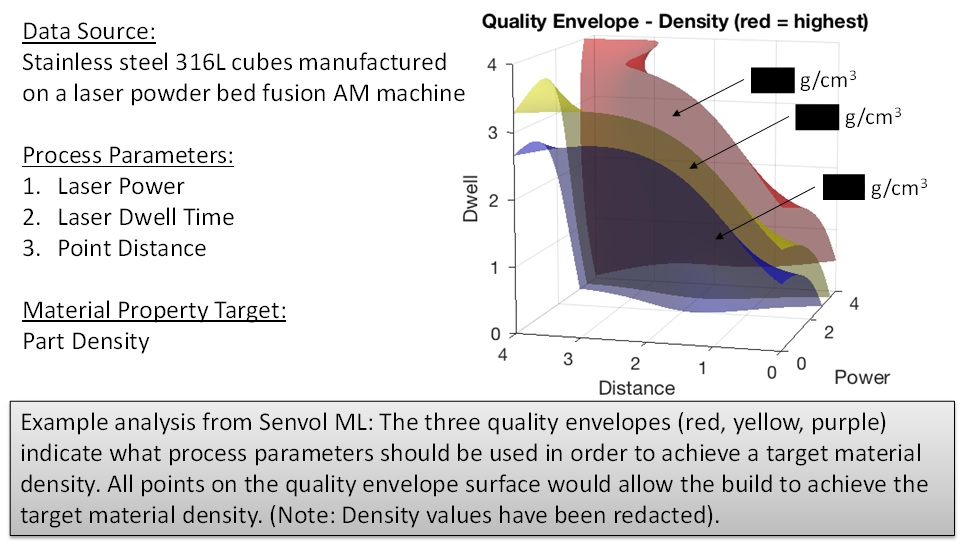
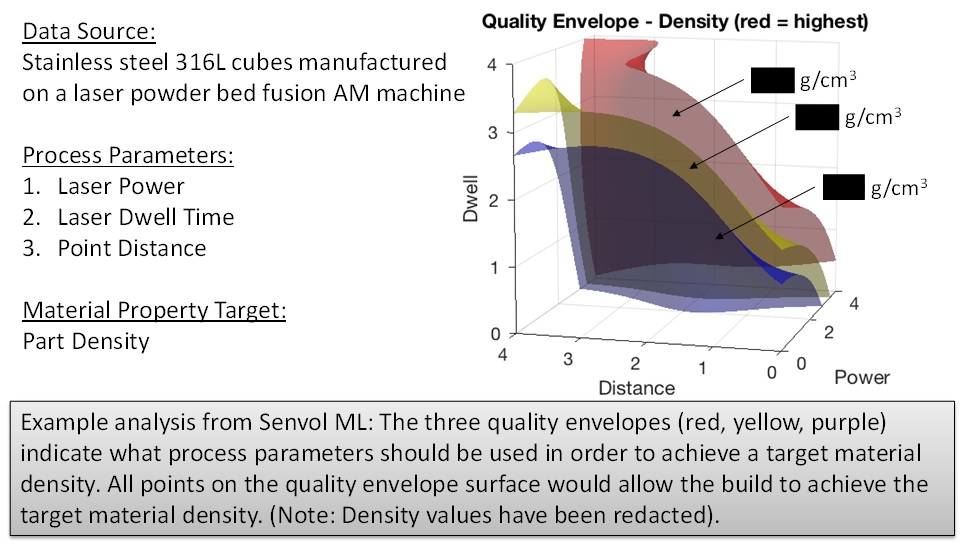 Example of Senvol new machine-learning software for optimizing additive manufacturing process parameters. Users can work with many possible desired outcomes and/or input parameters. Image courtesy Senvol.
Now in its second phase of funding from the U. S. Navy’s Office of Naval Research, the Senvol ML project is aimed at reducing the trial-and-error approach to defining AM material-process procedures. Zach Simkin, co-president of Senvol, says the company has developed a proprietary algorithm that can be “trained” to predict an unlimited variety of performance goals.
“Any material property or mechanical performance target can be addressed,” explains Simkin, “such as density, surface roughness or fatigue life. Because our software is data-driven, we can analyze just about any variable as input and/or output.”
For example, the analysis result for a powder-bed system could show the range of values for laser power, laser dwell time and point distance that, in any combination, would create parts with that density. The reason for a range (instead of a point), presented as a 3D graphical envelope of possible settings, is because there are trade-offs to be made among the parameters (e.g. high laser power must be compensated with high scan speed so that a user is not putting too much energy into the powder bed) – and users need to work in the real world.
“The Senvol ML algorithm also has the capability of showing the AM user which parameters are sensitive and which are robust based on where they’re located in the dimensional space," says Annie Wang, co-president of Senvol. “Users might choose to run the system with a faster scan speed, to shorten print time, if they know they can increase the laser power and still end up with a part of the desired density.”
Eventually the Senvol ML software will include the following four capabilities:
In both cases, he explains, the tools analyze data from each layer of the build. Users can then correlate relationships between irregularities in the build and the resulting mechanical performance.
The company will be demonstrating use cases and actual results during presentations at the upcoming AMUG 2018, RAPID +TCT 2018 and CAASE18 conferences.
With the announcement of Phase II STTR funding, Senvol says its software will be made commercially available to any company looking to qualify AM parts. Contact Senvol ([email protected]) for more details, especially if you are interested in the beta-stage program.


DE's editors contribute news and new product announcements to Digital Engineering. Press releases may be sent to them via [email protected].
Follow DE
Join over 90,000 engineering professionals who get fresh engineering news as soon as it is published.






About Us · Contact Us · Editorial Team · Advertising · Privacy Policy · Subscriber Services · © 2026 Digital Engineering 24/7 · Peerless Media