Helping design and engineering professionals discover, evaluate and specify technologies and processes that shorten the design cycle and enable success.


Alert!
Digital Engineering ceased publication on July 1, 2026. This website remains available as an archive of engineering content.
For inquiries or information, please email [email protected].

Digital Engineering April 2026
In the latest issue of Digital Engineering, we take a look at the latest innovations in design for additive manufacturing, including the use of natural language inputs, social media cosplayers, and AI integration. The issue also includes a feature…

January Special Focus Issue: Design for Additive
In this Special Focus Issue of Digital Engineering, learn about the latest advancements in design for additive manufacturing, including new software tools, additive in automotive, custom medical devices, and more.
Senvol has been selected to lead a program focused on demonstrating a machine learning approach to additive manufacturing process qualification.
The work will be done as part of a contract that Senvol had been awarded by America Makes, the national additive manufacturing institute, and funded by the U.S. Air Force, to apply its machine learning software, Senvol ML, to enable effective additive manufacturing (AM) process qualification/re-
qualification.
Senvol’s partners on the program include Boeing, the National Institute for Aviation Research (NIAR) at Wichita State University, Battelle, ATI Inc., Element Materials Technology, 3Degrees, Pilgrim Consulting, and AoZora Additive.
As part of the program, Senvol will demonstrate a new approach to a delta qualification for AM that leverages machine learning. A machine learning approach is flexible and able to handle any change to the AM process, which makes this approach ideal for sustainment in the long term. The program will demonstrate the approach using a Ti-6Al-4V grade 5 material processed via a laser powder bed fusion AM machine.
“The primary objective of this program is to demonstrate a novel approach, using machine learning, to rapidly and affordably update and/or establish a qualified AM process which can allow for changes in key AM process variables—namely, the use of a new AM machine of a different make or model,” says Dr. Brandon Ribic, America Makes technology director. “By demonstrating a novel approach, we hope to accelerate and reduce the cost of establishing equivalence to the baseline material.”
The Senvol ML software supports the qualification of AM processes and will be used in the program to develop statistically substantiated material properties analogous to material allowables. It will do this while simultaneously optimizing data generation requirements. The software is flexible and can be applied to any AM process, any AM machine, and any AM material, according to Senvol.
“Senvol will implement data-driven machine learning technology that has the potential to substantially reduce the cost of process qualification and re-qualification," says Senvol President Zach Simkin. "By demonstrating a novel approach, Senvol aims to drive tremendous value for the U.S. Air Force, the America Makes membership, and the additive manufacturing industry at large.”
“I am very pleased to join Senvol’s team for this program," says Dr. William E. Frazier, retired chief scientist for Air Vehicle Engineer at NAVAIR / The Navy Senior Scientist for Material Engineering, and currently president of Pilgrim Consulting LLC. "Senvol’s machine learning-enabled approach directly addresses a major industry challenge: the rapid and cost-effective ability to qualify an additive manufacturing process. I have been involved with the qualification of several additive manufacturing processes and materials for flight, and in my opinion, the further development of this technology will have a positive impact on the cost, schedule, and performance of both DoD and commercial platforms.”
Users of the Senvol ML software include organizations in aerospace, defense, oil & gas, consumer products, medical, and automotive industries, as well as AM machine manufacturers and AM material suppliers.
The results from this America Makes program will be available to the America Makes membership as well as to the U.S. government.
To request a demo of the Senvol ML software, contact Senvol at [email protected] for more details.
Sources: Press materials received from the company and additional information gleaned from the company’s website.


As the national accelerator for additive manufacturing (AM) and 3D printing (3DP), America Makes is the nation’s leading and collaborative partner in AM and 3DP technology research, discovery, creation, and innovation. Structured as a…
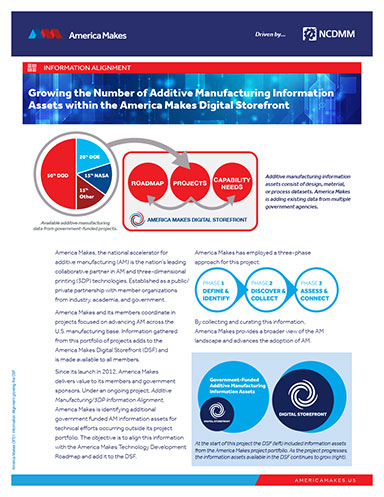
Additive Manufacturing/3DP Information Alignment
Growing the number of additive manufacturing information assets within the America Makes digital storefront.

DE's editors contribute news and new product announcements to Digital Engineering. Press releases may be sent to them via [email protected].
Follow DE






About Us · Contact Us · Editorial Team · Advertising · Privacy Policy · Subscriber Services · © 2026 Digital Engineering 24/7 · Peerless Media