Helping design and engineering professionals discover, evaluate and specify technologies and processes that shorten the design cycle and enable success.



Digital Engineering April 2026
In the latest issue of Digital Engineering, we take a look at the latest innovations in design for additive manufacturing, including the use of natural language inputs, social media cosplayers, and AI integration. The issue also includes a feature…

January Special Focus Issue: Design for Additive
In this Special Focus Issue of Digital Engineering, learn about the latest advancements in design for additive manufacturing, including new software tools, additive in automotive, custom medical devices, and more.
That attitude of shared wonder explains Sfero, the French response to NASA and America Makes’ 3D Printed Habitat Challenge. Technically, the contest is only open to US teams, but a team led by FABulous and Exceltec has developed its own vision of a 3D printed habitat on Mars.
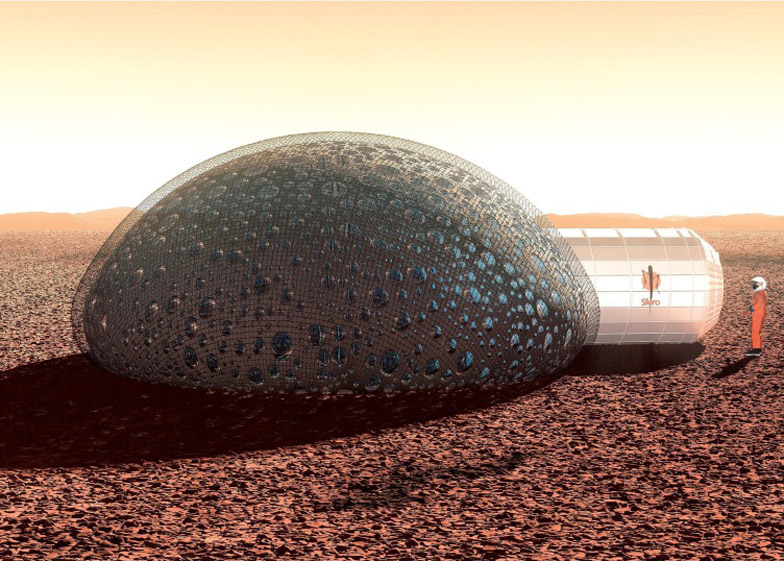
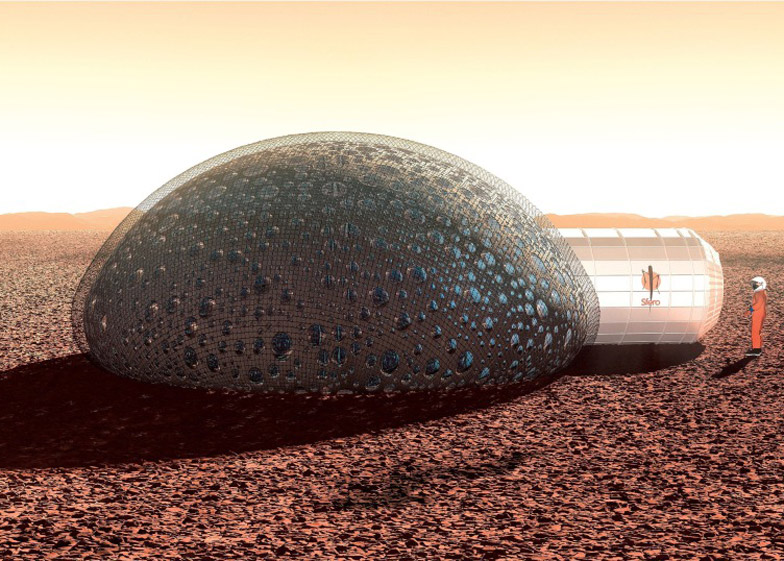 The exterior of the habitat is reminiscent of an igloo. Courtesy of FABulous.
In French, the word Sfero is, according to the pitch, is short for sphere, iron and water. Seeing the habitat as the result of a merging of two worlds – Earth is water, Mars is iron – the team wanted to choose a name and style of production that honored both worlds.
As envisioned by the French, the basic structure of the habitat would be laid down using additive manufacturing (AM). A central mast would drill down into the planet’s surface, acting as both a central pillar and a platform for construction. Robotic arms branching out from the mast would both gather materials for use in AM, and include the 3D printing elements of the design.
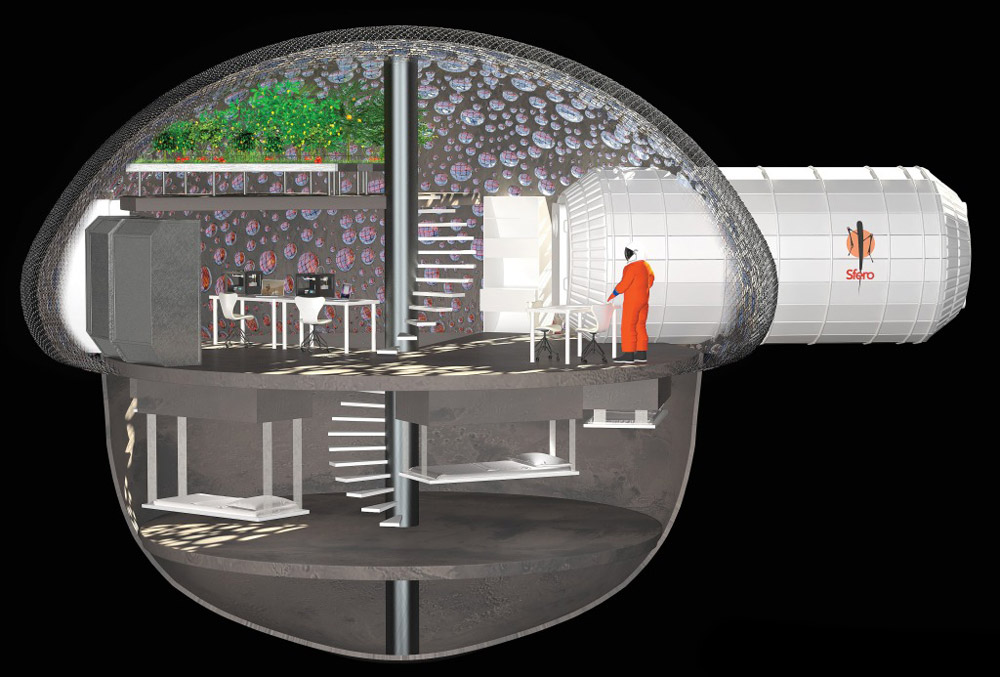 The interior of the habitat would drill down into Mar's surface to provide shelter from radiation. Courtesy of FABulous.
The base material is meant to be iron oxide, which, according to NASA findings, Mars has in abundance. Sfero intends to use that material along with laser melting to build the habitat. The actual appearance of the habitat is intended to be a dome in two parts: an internal and external section. The space between the sections will contain water harvested from the permafrost present on Mars.
Under the dome itself, much of the design is similar to an earlier proposal submitted by RedWorks. Rather than building up and exposing more of the habitat to the Martian climate (or lack thereof), the dwelling burrows into the ground, in something of a spiral pattern.
The Sfero team has targeted the Gale crater on Mars as a potential construction site, noting that minerals found there were similar to those found on Earth in locations such as the Mojave Desert and in Hawaii. These similarities would offer a place within reach to practice and further develop the project.
Below you’ll find a video that explores one idea of 3D printing habitats on Mars.
Source: FABulous


John Newman is a Digital Engineering contributor who focuses on 3D printing. Contact him via [email protected] and read his posts on Rapid Ready Technology.
Follow DE
Join over 90,000 engineering professionals who get fresh engineering news as soon as it is published.






About Us · Contact Us · Editorial Team · Advertising · Privacy Policy · Subscriber Services · © 2026 Digital Engineering 24/7 · Peerless Media