Helping design and engineering professionals discover, evaluate and specify technologies and processes that shorten the design cycle and enable success.




Digital Engineering April 2026
In the latest issue of Digital Engineering, we take a look at the latest innovations in design for additive manufacturing, including the use of natural language inputs, social media cosplayers, and AI integration. The issue also includes a feature…

January Special Focus Issue: Design for Additive
In this Special Focus Issue of Digital Engineering, learn about the latest advancements in design for additive manufacturing, including new software tools, additive in automotive, custom medical devices, and more.
The blades can survive temperatures above 1,250°C (2,282°F) and extremely high pressures.
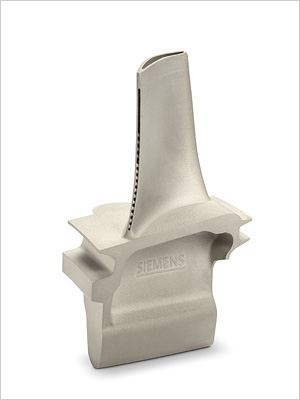 Siemens completed full load engine tests for 3D-printed gas turbine blades. Image: Siemens
"To have this rotating part running is a breakthrough because it is submitted to these extreme loading ... It rotates with 13,600 rotations-per-minute, which means it is the most highly loaded component in the whole gas turbine. So this blade that weighs 180 grams will weigh 11 tons while rotating with this speed,” Jenny Nilsson, team leader for additive manufacturing at Siemens, told Reuters.
The blades were printed by Material Solutions, a company Siemens acquired last year, using nickel superalloy powder. They were tested on a 13-megawatt SGT-400-type industrial gas turbine.
The tests were conducted at the Siemens testing facility in the industrial gas turbine factory in Lincoln, UK.
Siemens claims the process will reduce the design-to-test time from years to months. The blades went from component design to testing in just 18 months, including the development of new material, as well as simulation and quality control.
“When you apply casting procedures it will probably take one to one-and-a-half years to provide you with these blades because of their long lead time for tooling. And by applying additive manufacturing, we could significantly shorten lead time by down to three months," Christoph Haberland, Siemens Manufacturing Engineering, told Reuters.
Because the blades were built via additive manufacturing, Siemens was also able to produce blades with a revised and improved internal cooling geometry.
You can learn more about the tests in the Reuters video below.
Source: Reuters


Brian Albright is the editorial director of Digital Engineering.
Contact him at [email protected].

Join over 90,000 engineering professionals who get fresh engineering news as soon as it is published.






About Us · Contact Us · Editorial Team · Advertising · Privacy Policy · Subscriber Services · © 2026 Digital Engineering 24/7 · Peerless Media