Helping design and engineering professionals discover, evaluate and specify technologies and processes that shorten the design cycle and enable success.



May 2026 Special Focus: Artificial Intelligence in Design and Simulation
In this Special Focus Issue, learn about the latest developments in the integration of artificial intelligence into engineering workflows.

Design & Simulation Software Guide 2025
In this Special Issue, Digital Engineering presents its second annual guide to design and simulation software vendors.
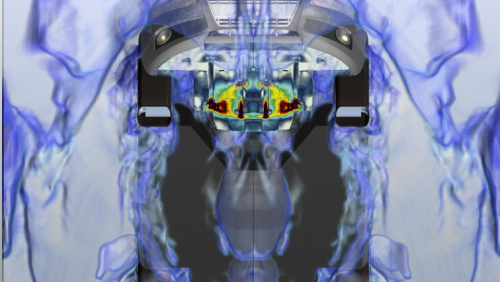
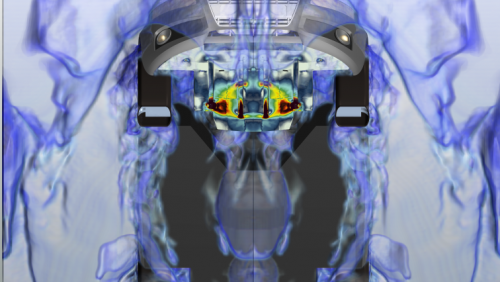 STAR-CCM+ version 12.02 introduces Ray Tracing, a capability that allows engineers to apply photo-realistic renderings to their design and simulation results. Image courtesy of Siemens.
New analysis tools combined with enhanced visual realism enable STAR-CCM+ version 12.02 to help engineers unlock deeper meaning behind complex engineering simulations. Using features such as Adaptive Gridding and the ability to simulate reactions in Solid Oxide Fuel Cells (SOFC), users will be at the forefront of predictive engineering analytics, which increases design efficiency, reduces costs and produces higher quality, innovative designs. Developed by Siemens’ product lifecycle management (PLM) software business, STAR-CCM+ is part of the company’s Simcenter portfolio, a suite of simulation software and test solutions.
“STAR-CCM+ version 12.02 is exclusively focused on making engineers more effective and enabling them to more quickly discover better designs, faster using predictive engineering technology,” said Jean-Claude Ercolanelli, senior vice president of Product Management at Siemens PLM Software. “These same engineers are also increasingly called upon to communicate their results across their organizations, to people who have little direct exposure to interpreting simulation results. Such a new functionality in STAR-CCM+ greatly facilitates this communication using Digital Twin simulation models that not only behave like their real-world counterparts, but also present a precise visual representation, promoting understanding and inspiring confidence.”
STAR-CCM+ v12.02 also introduces Ray Tracing, a capability that allows engineers to apply photo-realistic renderings to their design and simulation results, using similar technology that is used to provide the computer-generated imagery (CGI) special effects in movies and computer games. This enhanced visualization capability is particularly useful when communicating the results of simulations to stakeholders outside of the core simulation community, the company said.
In addition to providing new tools for the analysis of simulation results, STAR-CCM+ v12.02 adds capabilities to accelerate simulation throughput for products that deal with reacting flows, such as furnaces, reformers, internal combustion engines and gas turbines. According to the release, the new Adaptive Gridding capability for combustion tables significantly reduces computational effort without any loss of accuracy. Applicable to all flamelet combustion models, the company said Adaptive Gridding can reduce table size and corresponding memory usage by up to 30 times, increasing efficiency and allowing engineers to iterate designs more quickly.
Per the announcement, this version also includes multi-component gas/liquid species and solid ions models used to analyze electrochemical reactions, such as those that occur in Solid Oxide Fuel Cells (SOFC). SOFC are increasingly being used to generate efficient and clean electricity, and STAR-CCM+ users are now able to create a digital twin to improve further the efficiency of their Solid Oxide Fuel Cells, resulting in cleaner electricity generation cells.
For more on the new features available in STAR-CCM+ v12.02, please visit the Siemens Multidisciplinary Design Exploration site.
Sources: Press materials received from the company and additional information gleaned from the company’s website.


Join over 90,000 engineering professionals who get fresh engineering news as soon as it is published.






About Us · Contact Us · Editorial Team · Advertising · Privacy Policy · Subscriber Services · © 2026 Digital Engineering 24/7 · Peerless Media