Helping design and engineering professionals discover, evaluate and specify technologies and processes that shorten the design cycle and enable success.



May 2026 Special Focus: Artificial Intelligence in Design and Simulation
In this Special Focus Issue, learn about the latest developments in the integration of artificial intelligence into engineering workflows.

Design & Simulation Software Guide 2025
In this Special Issue, Digital Engineering presents its second annual guide to design and simulation software vendors.
Siemens Digital Industries Software has released the latest version of its Simcenter 3D software, building on its charter to facilitate and improve multidisciplinary simulation through a tightly integrated simulation platform.
The latest iteration delivers enhancements across four primary areas: Multidisciplinary integration, faster CAE processes, deeper integration with the digital twin, and continued support for an open and scalable simulation platform. The goal behind the new Simcenter 3D release is to continue to streamline and deliver short cuts to the simulation process so it is more tightly woven into the overall design workflow, delivers consistent simulation results, and supports more seamless iteration, according to Patrick Farrell, senior marketing manager for Simcenter at Siemens Digital Industries Software.
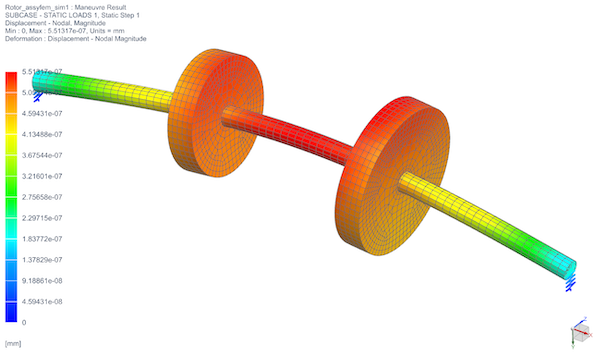
On the multidisciplinary front, the new Simcenter 3D release folds in a number of new simulation domains and makes them accessible from a single, unified platform. For example, the latest version now offers extended rotor dynamics simulation capabilities, including nonlinear connection elements—a capability aimed at engineers working on aerospace, automotive, and gas turbine applications. Support for the new simulation discipline ensures that engineers can minimize rotational unbalance and unnecessary external forces.
“We’re aiming to make all simulation domains available to customers within a single platform using a common model,” Farrell explains. In that way, users aren’t constantly having to create different models, leading to siloed pre- and post- simulation processes—an approach all too common with traditional simulation platforms, he maintains.
Faster CAE processes are another hallmark of the new release. Simcenter 3D has been turbocharged in a number of areas, including the ability to do faster design of experiments. In addition, a new Noise Vibration and Harshness (NVH) composer tool has been finetuned to enable faster development of system-level finite element (FE) models, starting from subassembly models such as an automotive body-in-white, door, and suspension. Automating the full-vehicle FE model increases the speed of workflows and helps reduce human error. “Design changes are where things typically break down with traditional processes,” Farrell explains. “Simcenter 3D rapidly shortcuts that whole process.”
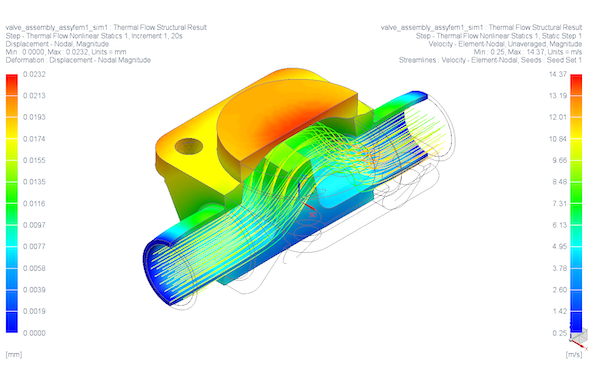
To extend the connection to the digital thread, Siemens Digital Industries Software has enhanced ties between Simcenter 3D and the physical testing domain, including deeper test/analysis correlation capabilities. For example, the latest version of Simcenter 3D features new pre-test planning functions for determining where to place sensor locations. “Correlating analysis with what is happening on the test floor and with physical test data builds confidence in analysis,” Farrell says.
There is also support for additional CAE solvers in the new release, including new capabilities in the Abaqus solver.
Watch this video to get more details on the latest Simcenter 3D release.


Simcenter™ software, from Siemens Digital Industries Software, uniquely combines system simulation, 3D CAE and test to help you predict performance across all critical attributes earlier and throughout the entire product lifecycle. By combining…
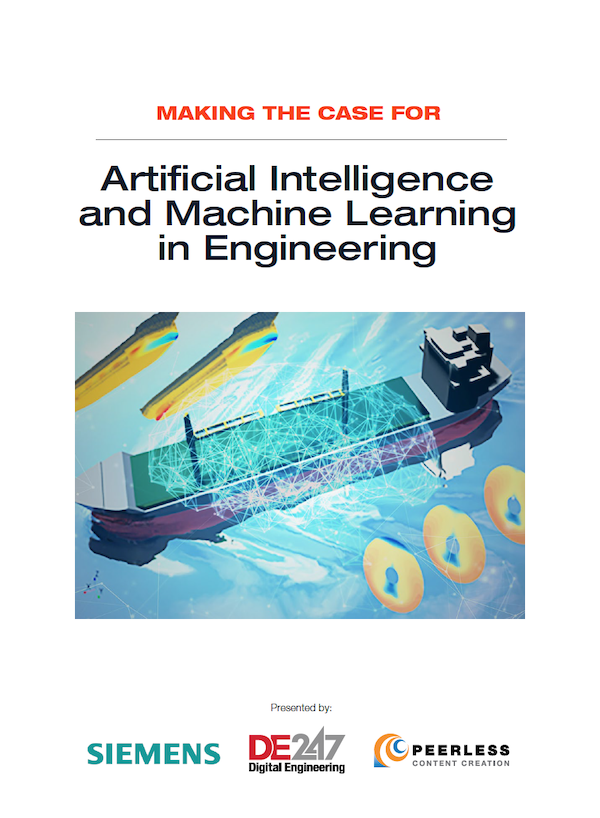
Making the Case for Artificial Intelligence and Machine Learning in Engineering
In this paper, Siemens Digital Industries Software and Digital Engineering will provide an overview of how AI/ML-enabled software can improve design workflows, while also addressing common questions and concerns around implementing this technology in an engineering organization.

Beth Stackpole is a contributing editor to Digital Engineering. Send e-mail about this article to [email protected].
Follow DE
Join over 90,000 engineering professionals who get fresh engineering news as soon as it is published.






About Us · Contact Us · Editorial Team · Advertising · Privacy Policy · Subscriber Services · © 2026 Digital Engineering 24/7 · Peerless Media