Helping design and engineering professionals discover, evaluate and specify technologies and processes that shorten the design cycle and enable success.


Alert!
Digital Engineering ceased publication on July 1, 2026. This website remains available as an archive of engineering content.
For inquiries or information, please email [email protected].
Sponsored
 Dear Desktop Engineering Reader:
“Where’s the beef?” may be the skeptical engineer’s catchphrase, but it entered the vernacular because of an 80-year-old manicurist’s first acting gig: a Wendy’s TV commercial. Meaty stuff is where today’s Check It Out link takes you.
Most everything you’ve read thus far in the Design Engineer’s High-Performance Computing Handbook from DE in partnership with Intel has set the table for what you’ll find in chapter 8, “Simulation Success Stories.” Here, the Handbook transitions away from basic concepts and theories to an exploration of how your peers at small- and medium-sized outfits leverage HPC for advanced simulations and data analyses. (If you’re behind on your reading, you receive all chapters to date with your chapter 8 download.)“Small- and medium-sized” is one key here. The engineering companies discussed cut a broad swath of design disciplines -- automotive, electrical, product design and others. You’ll know some outfits immediately; others are industry known. None are mega-sized.
Your second key takeaway is that each of these firms benefit from running the right simulation software on an HPC infrastructure right-sized for them. What they do will fascinate you because these are engineering reports, not basic programming.
Take the BLOCK Transformatoren-Elektronik story. Their customers specify individual requirements, so new calculations are always needed. They had an HPC cluster and multicore workstations, but COMSOL Multiphysics gave them the extra flexibility to run analyses and their specialized formulas on either platform, saving time and money.
Stanley Black & Decker, way more than just tool people, liked their software, but didn’t like the cost, complexity and potential software licensing issues of HPC. A dedicated HPC appliance from Altair solved that cost-effectively and freed up weeks of new development time.
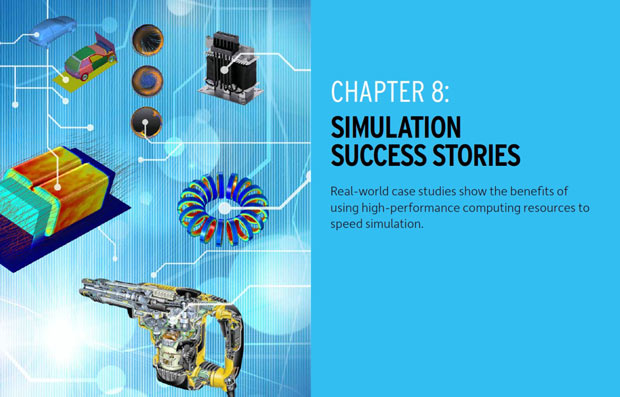 Technologies such as the cloud have made high-performance computing more accessible to design engineers at outfits large and small. Here’s how engineers are leveraging HPC’s vast processing and simulation power right now.
For Farr Yacht Design, maintaining their in-house HPC cluster siphoned away time from their core design competency: prototyping cutting-edge racing and pleasure boat designs. For Farr, a hybrid computing environment of internal and on-demand HPC horsepower proved the answer.
Ultimately, “Simulation Success Stories” is about is optimized design engineering. Still, running the right simulation solution on the right HPC infrastructure steals the show. If you’ve been idling on the sidelines deliberating what’s in this HPC business for your simulations and what it could mean for your joint if done well, chapter 8 of The Design Engineer’s High-Performance Computing Handbook is the beef you’ve hungered for. Hit today’s Check It Out link and see for yourself.
Thanks, Pal. – Lockwood
Anthony J. Lockwood
Editor at Large, Desktop Engineering


Anthony J. Lockwood is Digital Engineering's founding editor. He is now retired. Contact him via [email protected].
Follow DE






About Us · Contact Us · Editorial Team · Advertising · Privacy Policy · Subscriber Services · © 2026 Digital Engineering 24/7 · Peerless Media