Helping design and engineering professionals discover, evaluate and specify technologies and processes that shorten the design cycle and enable success.


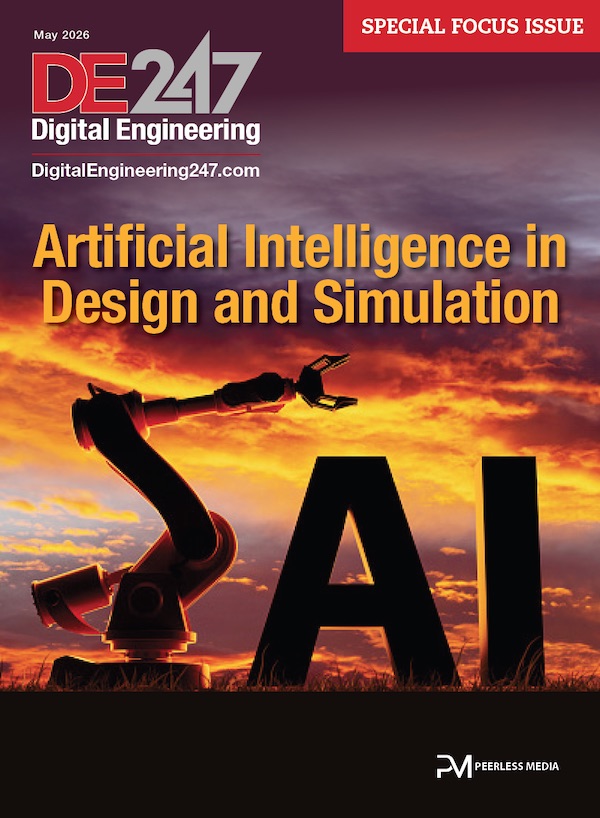
May 2026 Special Focus: Artificial Intelligence in Design and Simulation
In this Special Focus Issue, learn about the latest developments in the integration of artificial intelligence into engineering workflows.

Design & Simulation Software Guide 2025
In this Special Issue, Digital Engineering presents its second annual guide to design and simulation software vendors.
Editor’s note: This commentary was sponsored as part of DE’s Visionary Voices section in the magazine’s15th anniversary issue.
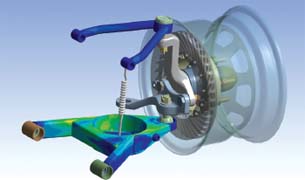 More complex products will require more powerful simulation solutions and a systems approach. |
ANSYS was founded 40 years ago to help product development companies reduce physical prototypes and testing, speeding product development while ensuring a high degree of confidence in product quality. Since 1970, ANSYS software has enabled customers to predict, with accuracy, that their products will thrive in the real world. Customers trust the suite to drive business success through innovation.
For four decades, we have witnessed radical changes in the world of product engineering—the most recent being the proliferation of smart products. In addition, market expectations for product performance continue to rise. Where once it was adequate to develop a design deemed “acceptable,” it is now imperative to find not just a good design, but the optimal design. The increased complexity of products coupled with market demands is leading to a systems approach to design.
Taking a Holistic View
A systems approach requires a holistic view of how subsystems of a product interact with each other and in harmony with users and complex environments. The product must be tested against a wide range of usage scenarios, such as physical components cross talking over each other. This mandates new, more collaborative design processes.
Design engineering teams must be increasingly mindful of intended or unintended interacting forces governed by a range of physics from electromagnetic to thermal to mechanical to fluid dynamics. Today’s products demand that engineering teams span traditional engineering silos. The academic realm has noted this, too, and is considering how best to incorporate multiphysics education as it prepares the next generation.
These systems engineering problems are complex. A key enabler to solving them is the ever-advancing computer power that every year makes unsolvable problems solvable. Arriving at a timely and accurate answer requires advances in high-performance computing (HPC) and the use of the cloud to drive compute capacity. As a result, today’s engineers rapidly solve huge problems—sometimes system-level problems—that once were thought impossible. This cycle will continue.
ANSYS: Anticipating Evolving User Needs
As product engineering evolves, ANSYS continually introduces new simulation tools that anticipate this evolution. To address growing complexity, ANSYS has introduced smarter, broader, faster and more powerful solutions that mirror real-world results with an incredible degree of accuracy.
Our latest product release, ANSYS 13.0, enables greater simulation fidelity that reflects the changing conditions of dynamic performance environments. It also maximizes productivity through new automation and performance features, as well as HPC advancements that deliver speedup ratios dramatically higher than previous releases.
ANSYS 13.0 is also built for collaboration across multiple functional users, allowing groups of engineers to work together in a rapid, high-impact manner as they validate the functional design of new products. Engineers can identify and address any performance issues much earlier in their design processes—allowing the greatest return on product development investments.
The Changing Face of Innovation
The evolution of product engineering, and the corresponding evolution of ANSYS solutions, is changing the basic nature of innovation. While historically engineers focused on small, sequential design enhancements that improved products over time, today’s powerful tools enable designers to create “clean sheet,” breakthrough ideas with a few clicks of a mouse.
By minimizing the time, cost and risk of developing game-changing new product designs, simulation has made it easier to truly innovate—and this is a trend that will only pick up speed as more and more companies embrace engineering simulation.
For future releases of ANSYS, improvements are driven by real-world customer needs—but our primary goal will remain the same. We will continue to anticipate the changing needs of product development teams worldwide by taking engineering simulation, and product innovation, to the next level.
Josh Fredberg is vice president of marketing, ANSYS, Inc.


DE's editors contribute news and new product announcements to Digital Engineering. Press releases may be sent to them via [email protected].
Follow DE
Join over 90,000 engineering professionals who get fresh engineering news as soon as it is published.






About Us · Contact Us · Editorial Team · Advertising · Privacy Policy · Subscriber Services · © 2026 Digital Engineering 24/7 · Peerless Media