Helping design and engineering professionals discover, evaluate and specify technologies and processes that shorten the design cycle and enable success.


Alert!
Digital Engineering ceased publication on July 1, 2026. This website remains available as an archive of engineering content.
For inquiries or information, please email [email protected].

May 2026 Special Focus: Artificial Intelligence in Design and Simulation
In this Special Focus Issue, learn about the latest developments in the integration of artificial intelligence into engineering workflows.

April 2026 Special Focus Issue: Generative Design
In this Special Focus Issue, Digital Engineering takes a look at how generative design solutions can be used across different types of design problems and with a variety of manufacturing approaches to accelerate design space exploration, and…
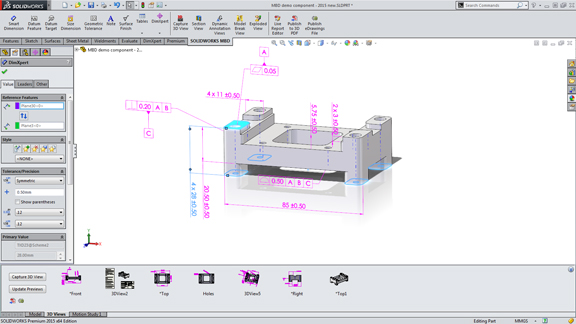 SolidWorks hopes to support the paperless workflow with a new product, SolidWorks MBD.
Is the paperless office a reality? Or a Utopian concept? Whatever you might think, SolidWorks seems convinced there's sufficient interest in it to warrant a new product.
At the press preview of SolidWorks 2015 two weeks ago, the company shared details about a brand new product, dubbed SolidWorks MBD (Model-Based Definition). In a SolidWorks blog post, Jeremy Regnerus, the company's senior user advocate and community manager, writes, "MBD provides an integrated, drawing-less manufacturing solution for SolidWorks 2015. With these tools, you can define, organize, and publish 3D Product Manufacturing Information (PMI) and 3D model data in industry standard file formats ... defines 3D PMI such as dimensions, datums, geometric tolerances, surface finishes, welding symbols, bills of material (BOM), callouts, tables, notes, meta-properties, and other annotations within the SOLIDWORKS 3D environment. The process is both intuitive and interactive and helps multiple people within the supply chain understand the design without the need for 2D drawings."
With MBD, SolidWorks envisions manufacturers publishing annotated 3D views -- one set for shop floor, another for quality inspection, another for a specific vendor, and so on -- to be distributed in the widely adopted eDrawings or 3D PDF format. It's much more than a simple publishing tool, according to SolidWorks global product manager Oboe Wu. He says, "It's an integrated drawing solution to support the entire MBD workflow -- not just 3D PMI but also PMI organization, template customization, and 3D data sharing."
A SolidWorks partner, Anark, also hopes to capture the same market with its product Anark Core MBEWorks. Anark's MBE (only one alphabet away from SolidWorks' MBD) stands for Model-Based Enterprise. According to Anark, MBEWorks "converts SolidWorks 2012 parts and assemblies with 3D dimensions, tolerances, GD&T, and other 3D notes into high-resolution 3D PDF and HTML documents containing manufacture-quality BREP geometry, interactive associativity between features (ASME Y14.41 'visual response' characteristics), and 'machine readable' semantic definitions for each component." Chris Garcia, who now works at Anark as executive VP of global commercial operations and business development, previously worked as VP of R&D at SolidWorks.
MBE or MBD is a natural outcome of the manufacturers' shift to digital prototyping, supported by extensive use of 3D design software. The move to replace paper drawings with lightweight digital 3D drawings is gaining momentum among top-tier aerospace and automotive manufacturers, but at lower levels, some resistance still remains, as seen in this two-year-old discussion thread on SolidWorks forum.
SolidWorks product manager and blogger Matthew Lorono poses the question, "Do you intend on implementing Model-Based Definition? (Get rid of drawings?)" User Glenn S. says, "I work at a university-based facility that designs and tests roadside safety and anti-ram structures (see here) ... Most (probably all) of our fabricators want drawings. Our construction crew will always need them (if we issue them iPads, they would need a new one every two weeks), and [drawings] are also required for the reports that we issue documenting the structure that was tested." Lenny B. is skeptical MBD would work because "[Too] many shops still stay on the oldest computers and software they can until it no longer works."
For some, the resistance is not based on practical concerns or technological hurdles, but instead in culture and habit. Kenneth B. thinks "Working from paper is more natural. I prefer to read printed books as opposed to digital media ... [Digital] annotation/notes will always be a [pain] to have to constantly go to an electronic device to refer back to." A favorable comment comes from Mark K., who says, "I'd just love to see computer screens at every workstation so they could view eDrawings, PDFs ... instead of having paper drawings everywhere. That would be a major step for us." But even he has to admit, "I can't see how you would put together an assembly without some written documentation, drawing, or otherwise." MBD/MBE advocates will likely point out to Mark K. that such assembly instructions can also be produced as dynamic, animated 3D drawings, far easier to understand than a series of static cross-sectional views with arrows and balloons printed on paper.
MBD is a plug-in that requires a license of SolidWorks. Priced $1,995, with $495 annual subscription, MBD costs as much as some full-featured CAD programs. Citing customers he has spoken to, SolidWorks product manager Wu says, "One-third of engineering dollars is spent creating and maintaining 2D drawings." That convinces him that the headache justifies spending the procurement cost of MBD software.
For defense contractors, major suppliers, and government institutions with a 3D workflow that's mature enough to support MBD, the paperless office is already a partial reality. As more manufacturers and field crews switch to mobile devices for work previously done manually with paper drawings, MBD will become easier to implement. Smaller firms may need more convincing, encouragement, and economic incentives to consider MBD.


Kenneth Wong is Digital Engineering's resident blogger and senior editor. Email him at [email protected] or share your thoughts or suggestions at digitaleng.news/facebook.
Follow DE






About Us · Contact Us · Editorial Team · Advertising · Privacy Policy · Subscriber Services · © 2026 Digital Engineering 24/7 · Peerless Media