Helping design and engineering professionals discover, evaluate and specify technologies and processes that shorten the design cycle and enable success.


Alert!
Digital Engineering ceased publication on July 1, 2026. This website remains available as an archive of engineering content.
For inquiries or information, please email [email protected].

May 2026 Special Focus: Artificial Intelligence in Design and Simulation
In this Special Focus Issue, learn about the latest developments in the integration of artificial intelligence into engineering workflows.

Design & Simulation Software Guide 2025
In this Special Issue, Digital Engineering presents its second annual guide to design and simulation software vendors.
“3D printing brings new structural freedom to product design, allowing more complexity in shapes and topology and the efficient production of customized products while accelerating the manufacturing process, since no tooling is needed,” said Uwe Schramm, chief technical officer at Altair, in a prepared press statement. “Topology optimization maximizes this design freedom, enabling complex free-form structure development, seamless individual designs, a shorter design process and optimal 3D printed structures.”
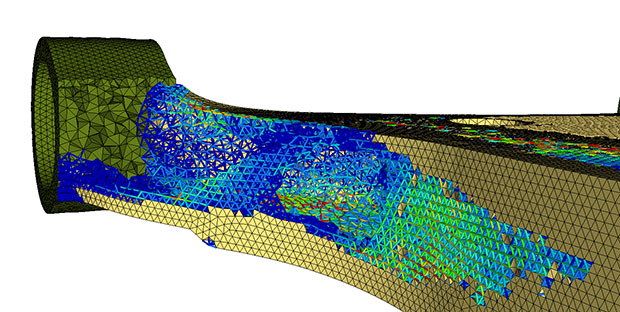
 The OptiStruct structural analysis solver from Altair has new features that extend topology optimization support to additive manufacturing applications that use lattice structures. Image courtesy of Altair Engineering Inc.
Altair says that OptiStruct’s new features for the design and optimization of 3D-printed lattice structures are intended to provide designers CAE analysis tools for optimal and structurally efficient material distribution in additive manufacturing applications. With these new features, OptiStruct now extends topology optimization to assist in the efficient blending of solid-lattice structures with smooth transitional material volumes, says the company. Designers and engineers can use the new capabilities to study lattice performance under tension, compression, shear, flexion, torsion and fatigue life.
Rather than simply apply lattice structures to existing geometry, OptiStruct enables designers to ascertain the best material placement and lattice structures, according to the company. Prior to placing and optimizing lattices, designers can use OptiStruct to determine where a design needs more materials and where more materials are not required.
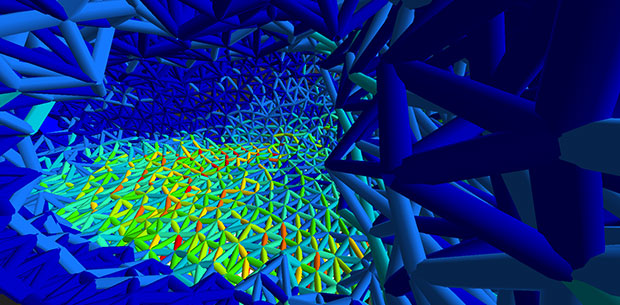
Altair describes the OptiStruct lattice optimization process as having two phases. In the first phase, the software applies standard topology optimization, which allows more porous materials with intermediate densities to exist. OptiStruct then transforms the porous zones into explicit lattice structures with varying material volumes.
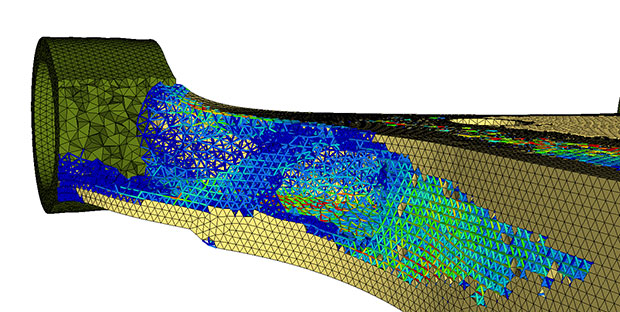 This OptiStruct screen image shows a blended structure with solid and lattice zones. Image courtesy of Altair Engineering Inc.
In the second phase of the operation, OptiStruct optimizes the dimensions of the lattice cells. The result is a structure with solid parts and lattice zones that have varying volumes of materials.
Using OptiStruct, designers can also manipulate material density based upon the result of an optimization process, enabling them to compare stronger versus weaker designs or solid versus void versus lattice designs. This capability will allow designers to consider and optimize such aspects as buckling behavior, thermal performance and dynamic characteristics.
Altair notes that lattice structures can contain hundreds of thousands of lattice cells, which can make conventional STL file transfers a significant bottleneck for the overall process. As a consequence, Altair reports that it is working with companies such as Materialise NV, a member of the Altair Partner Alliance, to streamline data transfers for 3D printing. Altair cites software packages such as Materialise’s 3-MaticSTL as reason for this partnership. 3-MaticSTL, which enables designers to make design modifications on STL files as well as scanned and CAD data directly, also allows designers to focus on improving a given lattice component to ensure that it is properly suited for 3D printing and can create support structures where necessary.
“OptiStruct's lattice capability represents the first step towards integrating smart materials with unique properties in products,” said Ming Zhou, vice president of Software Development at Altair, in a press statement. “Continuing research and development will explore directional behavior and smooth blending of varying lattice cell layouts to take advantage of exotic material characteristics that could bring innovation to various applications.”
OptiStruct is part of Altair HyperWorks, the company’s flagship suite of CAE applications. For more details on OptiStruct technology for topology, topography, size and shape optimization, visit Altair.
Read about all the new features in the current version of the OptiStruct solver.
Access a library of OptiStruct videos
Download the OptiStruct brochure.
See why DE's editors selected OptiStruct as their Pick of the Week.
Sources: Press materials received from the company and additional information gleaned from the company's website.


Anthony J. Lockwood is Digital Engineering's founding editor. He is now retired. Contact him via [email protected].
Follow DE
Join over 90,000 engineering professionals who get fresh engineering news as soon as it is published.






About Us · Contact Us · Editorial Team · Advertising · Privacy Policy · Subscriber Services · © 2026 Digital Engineering 24/7 · Peerless Media