Helping design and engineering professionals discover, evaluate and specify technologies and processes that shorten the design cycle and enable success.


Alert!
Digital Engineering ceased publication on July 1, 2026. This website remains available as an archive of engineering content.
For inquiries or information, please email [email protected].

Digital Engineering April 2026
In the latest issue of Digital Engineering, we take a look at the latest innovations in design for additive manufacturing, including the use of natural language inputs, social media cosplayers, and AI integration. The issue also includes a feature…

January Special Focus Issue: Design for Additive
In this Special Focus Issue of Digital Engineering, learn about the latest advancements in design for additive manufacturing, including new software tools, additive in automotive, custom medical devices, and more.
Stratasys delivers to market advanced elastomers and enhanced materials for its FDM and PolyJet machines. The FDM elastomer solution is intended to provide manufacturers with new levels of elasticity, durability with soluble support, while advanced colors for PolyJet drive enhanced realism to transform legacy design and prototyping processes.
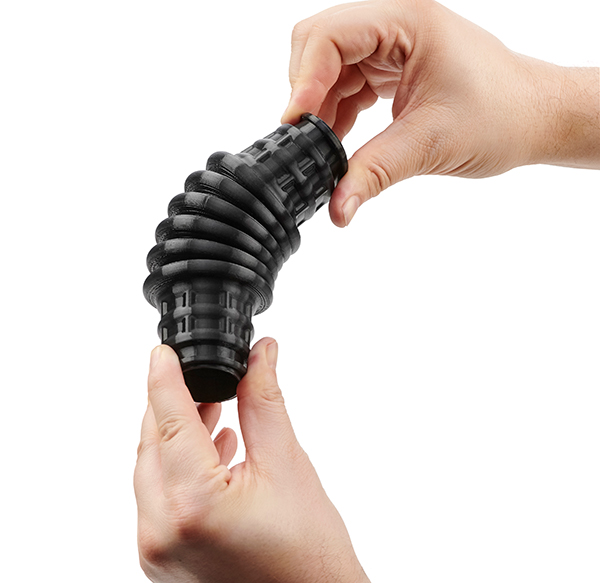
Users can now produce parts with resilience—with an ability to stretch or compress without losing shape. Offered across the F123 3D printer platform and via North America’s service provider, Stratasys Direct Manufacturing, the Stratasys TPU 92A Elastomer is designed for manufacturers requiring high part elongation, toughness, and full design freedom, the company reports.
“Creating elastomer parts using traditional silicone or CNC molds are extremely costly and time-consuming—while it is our view that other additive techniques just cannot deliver parts with the size and complexity of our elastomer approach,” Zehavit Reisin, vice president and head of Solutions and Materials Business, Stratasys. “Manufacturers demand 3D printing solutions that can be put to work in real prototyping and extreme production environments. With reliable and highly resilient parts, our solutions are designed to enable customers to do just that.”
Advancing realism for 3D printed prototypes, Stratasys also announced a range of new materials for its J750 and J735 PolyJet 3D Printers. These enhancements include five new materials with an ability to mimic rubber, leather or plastic.
The Agilus30 White material can mirror such parts as rubber-like seals and gaskets for automakers—or vividly colored models used for prototypes in sporting goods, consumer electronic components or toys/figurines, the company reports. Mixing both rigid and soft materials, Agilus30 White produces a wide range of life-like prototypes on a single printer, the company adds. The newest member of the Agilus family of colors that includes translucent and black, Agilus White is designed to create a high level of detail, especially for such industries industries as healthcare, where white is necessary for such applications as medical devices, the company notes.
VeroVivid Cyan expands the J750 and J735 gamut to more than half a million distinguishable colors, from rigid to opaque, flexible and transparent, the company notes. Producing vibrant colors and translucency in a single print, VeroVivid Cyan and the new VeroFlexVivid engineer effective, realistic prototypes for such markets as consumer goods, packaging and eyewear. Supported by enhanced GrabCAD Print color profiles, designers can actually “print what they see” with enhanced color accuracy.
Stratasys is now making its PEKK-based FDM thermoplastic—Antero800NA—available on F900 3D Printers. This high-performance material is chemical resistant, possesses ultra-low outgassing properties, and exhibits high heat resistance.
MED625FLX is a biocompatible material, well-suited for dental and orthodontic applications such as indirect bonding (IDB) trays and implantology case workups. Now available on both Objet260 Dental and Objet260/500 Dental Selection 3D Printers, the material is designed to advance Indirect Bonding Trays by allowing the direct printing of flexible IDB trays, and is built to enable orthodontists to reduce bracket placement times up to 75% and cut the cost for labs to produce by 40%.
Sources: Press materials received from the company.


DE's editors contribute news and new product announcements to Digital Engineering. Press releases may be sent to them via [email protected].
Follow DE






About Us · Contact Us · Editorial Team · Advertising · Privacy Policy · Subscriber Services · © 2026 Digital Engineering 24/7 · Peerless Media