Helping design and engineering professionals discover, evaluate and specify technologies and processes that shorten the design cycle and enable success.


Alert!
Digital Engineering ceased publication on July 1, 2026. This website remains available as an archive of engineering content.
For inquiries or information, please email [email protected].

Digital Engineering April 2026
In the latest issue of Digital Engineering, we take a look at the latest innovations in design for additive manufacturing, including the use of natural language inputs, social media cosplayers, and AI integration. The issue also includes a feature…

January Special Focus Issue: Design for Additive
In this Special Focus Issue of Digital Engineering, learn about the latest advancements in design for additive manufacturing, including new software tools, additive in automotive, custom medical devices, and more.
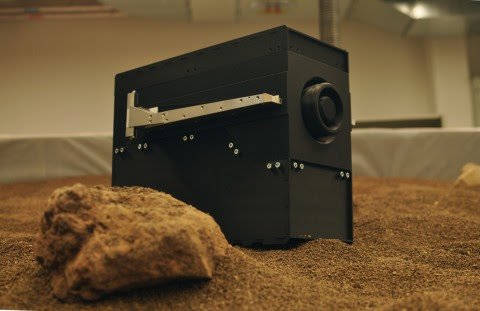 TransRoPorter Prototype with FDM 3D printed components. Image courtesy of Business Wire.
TransRoPorter, built at the Institute for Robotics and Mechatronics (Institut für Robotik und Mechatronik), is an exploration robot designed for unmanned flights to Mars and set for launch in four to five years. To successfully explore Mars with a robot, design and functionality are key factors to meeting the objectives of the mission. Using a Stratasys Fortus 900mc Production 3D Printer, the research team 3D printed a working prototype, significantly reducing production times compared to traditional methods, according to a press release. This enables the team to test the design and functionality of the robot under simulated extreme conditions ahead of time.
Dr. Kaj Fuehrer, Head of System Building Technology South (Leiter Systemhaus Technik Süd), is developing and testing the 3D printed robot prototype together with his colleagues Dr. Stefano Seriani und Dr. Armin Wedler. The TransRoPorter is made from two components: the moveable TRP Rover-Unit, made to navigate in unstructured terrain, and the Payload-Module (PM), which carries spare parts, communication technology and scientific tools. To ensure functionality and practicality of the 3D printed prototype, rigorous testing is required.
“In the planning of this project, we always preferred 3D printing technology,” he said. “It became evident to us that using 3D printing for the production of the TransRoPorter was truly the least expensive, fastest and most elegant solution. Everyone involved in the project is delighted with the outcome.”
Using the Stratasys Fortus900mc Production 3D Printer, the research team are 3D printing large parts in FDM thermoplastic materials. According to Dr. Fuehrer, the ASA material was suited for testing the TransRoPorter prototype, enabling the team to produce a strong enough Box to contain all the technology safely within.
“It was extremely important that the fit was right, that the box could be mounted to the tracks and the docking port worked,” he said. “Utilizing Stratasys FDM 3D printing technology, we found that the material basically has no distortion. The decision for ASA material was consciously made, as it is ideal for our purposes and handling.”
Seriani added: “The stability of the ASA material also played a large role for us. We needed a fully functional prototype that could perform in all tests and withstand the strain of the design. The tough and rigid properties of the Stratasys material were therefore an ideal fit to test the TransRoPorter’s functionality for its journey to Mars.”
According to Dr. Fuehrer, 3D printing also supports other strategic goals. “A new technology leads to new thought processes. Over the past few years, many colleagues are already thinking in 3D and are involving additive manufacturing into plans for other projects they are starting with," he said. "This new knowledge has opened them up to a new set of possibilities within product development.”
For more information, visit Stratasys Ltd.
Source: Press release provided by the company.


Join over 90,000 engineering professionals who get fresh engineering news as soon as it is published.






About Us · Contact Us · Editorial Team · Advertising · Privacy Policy · Subscriber Services · © 2026 Digital Engineering 24/7 · Peerless Media