Helping design and engineering professionals discover, evaluate and specify technologies and processes that shorten the design cycle and enable success.



Digital Engineering April 2026
In the latest issue of Digital Engineering, we take a look at the latest innovations in design for additive manufacturing, including the use of natural language inputs, social media cosplayers, and AI integration. The issue also includes a feature…

January Special Focus Issue: Design for Additive
In this Special Focus Issue of Digital Engineering, learn about the latest advancements in design for additive manufacturing, including new software tools, additive in automotive, custom medical devices, and more.
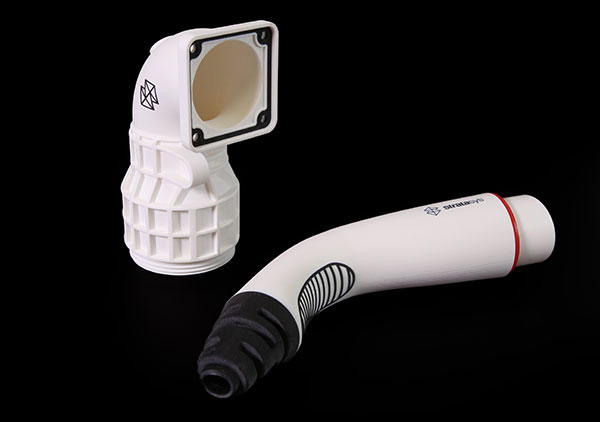
Announced during the Additive Manufacturing Users Group 2025 conference, Stratasys Ltd. introduced PolyJet ToughONE White, an advanced material engineered for tough and durable functional prototyping and end-use parts on its high-end platforms, the company reports.
PolyJet ToughONE material features enhanced impact resistance and flexibility that allow for drillable, millable, and self-tapping features, according to Stratasys. This new material is made for producing functional prototypes across all market segments. It can be used to create accurate manufacturing aids, jigs, and fixtures, with the option for color labeling. Additionally, it is made for custom housings, brackets, and covers in consumer electronics, impact-resistant components, and robotic end-effectors for industrial applications. PolyJet ToughONE material also finds applications in many other key sectors such as automotive, consumer goods, and eyewear.
“Manufacturers are constantly balancing speed, cost, and performance when developing new products, and every unnecessary prototype iteration adds delays and expense,” says Rich Garrity, chief business unit officer at Stratasys. “With ToughONE, we’re giving engineers a material that lets them move from concept to functional testing faster, with precision and performance built in.”
PolyJet ToughONE material also produces complex part geometries, including thin walls, snap fits, and living hinges, while maintaining high dimensional accuracy and surface quality. It integrates with other PolyJet materials, allowing for hybrid models that combine different mechanical properties or different colors within a single part.
Stratasys will debut its PolyJet ToughONE material and printed parts at RAPID + TCT 2025 in Detroit on April 9, showcasing how it streamlines workflows.
Sources: Press materials received from the company and additional information gleaned from the company’s website.


Every day, our customers find simpler, smarter approaches to stubborn design problemsand greater confidence to confront towering human and technological challenges. Less hindered by the usual constraints, they can imagine, design, iterate and…
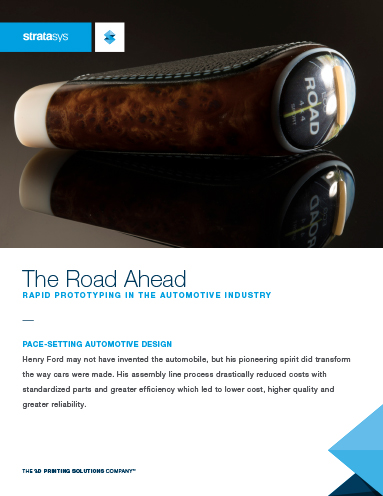
Rapid Prototyping in The Automotive Industry
Henry Ford may not have invented the automobile, but his pioneering spirit did transform the way cars were made. His assembly line process drastically reduced costs with standardized parts and greater efficiency which led to lower cost, higher quality and greater reliability.

DE's editors contribute news and new product announcements to Digital Engineering. Press releases may be sent to them via [email protected].
Follow DE
Join over 90,000 engineering professionals who get fresh engineering news as soon as it is published.






About Us · Contact Us · Editorial Team · Advertising · Privacy Policy · Subscriber Services · © 2026 Digital Engineering 24/7 · Peerless Media