Helping design and engineering professionals discover, evaluate and specify technologies and processes that shorten the design cycle and enable success.


Alert!
Digital Engineering ceased publication on July 1, 2026. This website remains available as an archive of engineering content.
For inquiries or information, please email [email protected].

May 2026 Special Focus: Artificial Intelligence in Design and Simulation
In this Special Focus Issue, learn about the latest developments in the integration of artificial intelligence into engineering workflows.

April 2026 Special Focus Issue: Generative Design
In this Special Focus Issue, Digital Engineering takes a look at how generative design solutions can be used across different types of design problems and with a variety of manufacturing approaches to accelerate design space exploration, and…
The fascination with this "hot" technology isn't lost on the American Society of Mechanical Engineer's (ASME), which gave drones the starring role in its latest student competition. An international contingent of teams, including representatives from the United States, Europe, China, India, Peru, Turkey, and a host of other countries, gathered at the International Mechanical Engineering Congress & Exhibition last month where they unleashed their knowledge and training to create a drone design that could best the competition.
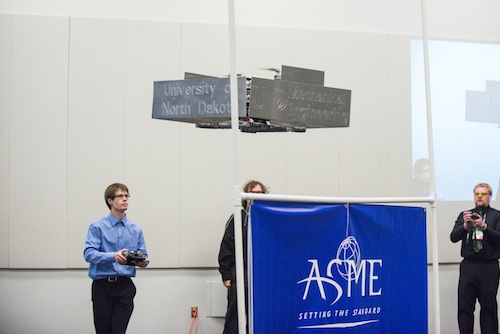
The 2014 student design competition called for the teams to design and build an original drone, pilot it through a series of high and low obstacles, complete a targeted payload drop, and then return to the starting line — all the while, remaining in one piece.
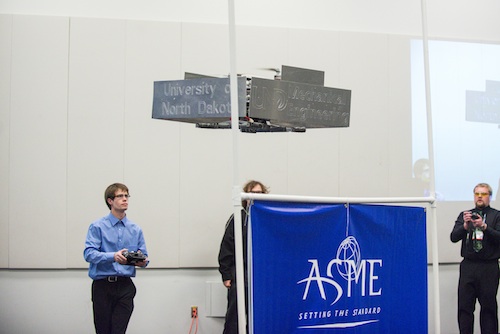 The University of North Dakota's drone took first place at the student competition after mastering the obstacle course. Image Courtesy of the University of North Dakota
For the University of North Dakota, which took first prize, the challenge was all about learning to work together as a team with some pretty serious light weighting design training folded in. The team struggled with how much weight its drone should carry, while still being able to fly sufficiently. The process involved adding and subtracting motors to find the optimal configuration, said Christopher Borseth, a member of the team. Each time the team added a motor to increase performance, it had to fabricate brackets, do wiring, and test performance.
"It became a game of trial and error to optimize the performance of our 'copter to succeed at the competition," he explained.
To design the winning drone, the North Dakota team used PTC's Creo 3D modeling software in the initial stages of development and to make certain that clearances were optimal. "Without 3D modeling, when each piece is brought together in the shop, they may not fit exactly right," he explained.
To produce the finished drone, the team used basic shop hand tools as well as CNC machines. There was also a 3D printer used to create the payload dumping bucket, the pull handle of the kill switch and a protective case to surround one of the batteries.
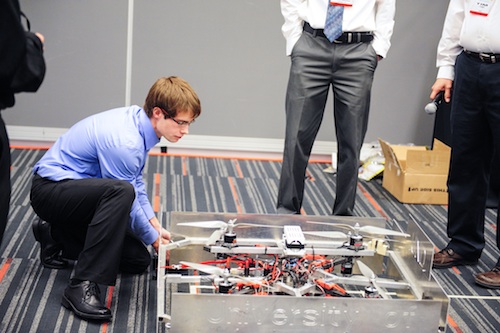 Team members prepare the UAV for the competition. Image Courtesy of the University of North Dakota
The team from California Polytechnical Institute, which placed second in the competition, didn't use CAD or 3D printers as much, because most of its components were commercially available. Overall, the competition gave team members great exposure on how to work together effectively as a multidisciplinary team, officials said.
For the winning University of North Dakota team, the experience definitely advanced expertise on a variety of levels, Borseth said.
"As a team, we learned how to work together and build relationships with each other," he said. "Our fabricating skills improved along with our 3D modeling skills. It made us better engineers."
Check out this video to hear student teams talk about their efforts.


Beth Stackpole is a contributing editor to Digital Engineering. Send e-mail about this article to [email protected].
Follow DE






About Us · Contact Us · Editorial Team · Advertising · Privacy Policy · Subscriber Services · © 2026 Digital Engineering 24/7 · Peerless Media