Helping design and engineering professionals discover, evaluate and specify technologies and processes that shorten the design cycle and enable success.


Alert!
Digital Engineering ceased publication on July 1, 2026. This website remains available as an archive of engineering content.
For inquiries or information, please email [email protected].


Digital Engineering April 2026
In the latest issue of Digital Engineering, we take a look at the latest innovations in design for additive manufacturing, including the use of natural language inputs, social media cosplayers, and AI integration. The issue also includes a feature…

January Special Focus Issue: Design for Additive
In this Special Focus Issue of Digital Engineering, learn about the latest advancements in design for additive manufacturing, including new software tools, additive in automotive, custom medical devices, and more.
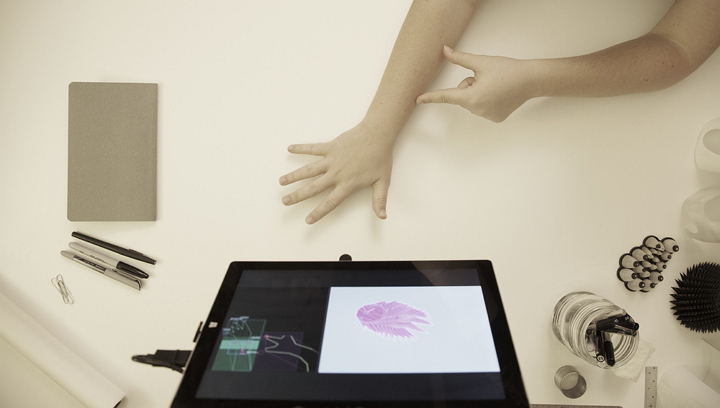
Gannon is a researcher and a teacher at Carnegie Mellon University's School of Architecture, and a Ph.D. candidate in Computational Design. Through her design collective, MADLAB.CC, she has developed a solution called Tactum, software that lets users create 3D print designs by touching an image projected on human skin.
The projected image can be manipulated by hand. Projecting the design on the human body has allowed Gannon to model and create jewelry and other wearable items by crafting the design to the person intended to wear it.
The solution uses a Casio XJA251 projector to extract natural gestures, and a Kinect camera. 3D printing constraints are embedded in the geometry so that every design is printable, even if the user manipulates the model significantly prior to printing.
She has also developed Reverb, which converts those designs into printable meshes.
Gannon's first design was a custom watchband, but she hopes that Tactum can be used for customizing prosthetics and other wearable medical devices. She also wants Tactum to be adopted as a teaching tool. The goal is to make this type of design work more accessible.
“I want them to be intuitive. I want them to be easy to understand. I want to hide complexity and show abstraction,” Gannon told Popular Science.
Gannon has been named artist-in-residence at Autodesk Research, which funded Tactum's development. She plans to further develop Tactum for medical applications during her tenure.
Source: Popular Science


Brian Albright is the editorial director of Digital Engineering.
Contact him at [email protected].






About Us · Contact Us · Editorial Team · Advertising · Privacy Policy · Subscriber Services · © 2026 Digital Engineering 24/7 · Peerless Media