Helping design and engineering professionals discover, evaluate and specify technologies and processes that shorten the design cycle and enable success.


Alert!
Digital Engineering ceased publication on July 1, 2026. This website remains available as an archive of engineering content.
For inquiries or information, please email [email protected].


Digital Engineering April 2026
In the latest issue of Digital Engineering, we take a look at the latest innovations in design for additive manufacturing, including the use of natural language inputs, social media cosplayers, and AI integration. The issue also includes a feature…

January Special Focus Issue: Design for Additive
In this Special Focus Issue of Digital Engineering, learn about the latest advancements in design for additive manufacturing, including new software tools, additive in automotive, custom medical devices, and more.
Fairly rapidly, that all changed. Manufacturers both large and small started selling fully assembled 3D printers and other material options began to appear. The FORM 1 is set to bring stereolithography to the desktop, and the ProDesk3D intends to offer full color prints from another desktop AM system. Now, the TAZ 3D Printer from Aleph Objects is ready to give desktop users the chance to print in a number of different materials.
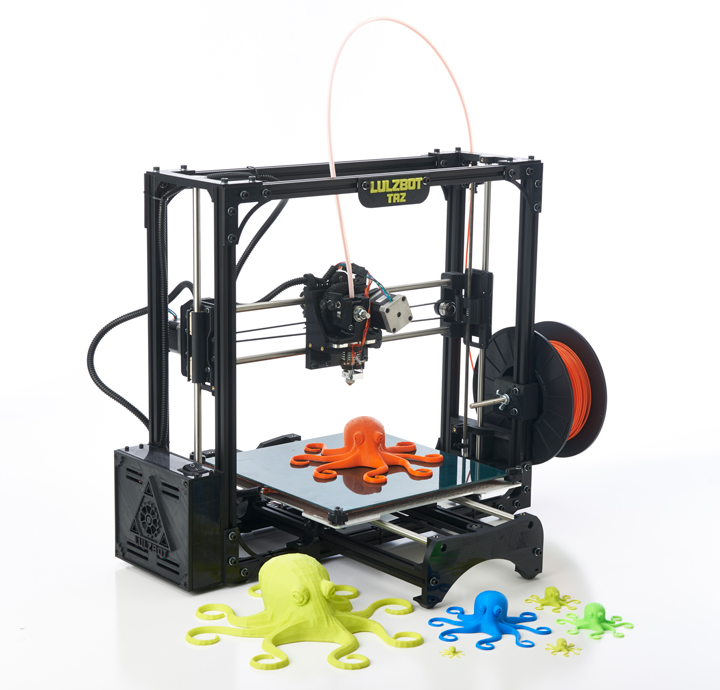
According to the company, TAZ is capable of printing with ABS, PLA, PVA, high-impact polystyrene, and wood filament, and can be modified to print in nylon and polycarbonate. That’s a fairly impressive lineup of materials for a printer retailing at $1,725.
“Our best printer to date, TAZ represents the next evolution in 3D printing,” said Jeff Moe, President of Aleph Objects in press release. “It’s not only the largest printer in its price range, the quality and accuracy of prints are exceptional.”
Speaking of specs, let’s have a look at what TAZ is capable of producing. It has a build envelope of 298 x 275 x 250mm (11.7 x 10.8 x 9.8in), which is respectable for a desktop system. The printer has a layer thickness of 0.075 to 0.35mm (0.003 - 0.0138in), and a print speed of 200mm/sec (7.9in/sec). The only hedge I see is in resolution, which comes in at 0.1mm (0.0039in) in X and Y axes, with, according to the company, the Z axis dependent on layer thickness.
Aleph Objects also advertises as shipping the printer fully assembled and pre-calibrated. All of that adds up to a system that seems fairly priced for small business use. As usual, I look askance at any home-sized 3D printer that costs more than $500, but the TAZ really seems like more machine than any home hobbyist would require.
As there doesn’t seem to be any TAZ video yet available, below you’ll find a short video of Aleph Objects’ AO-100 3D Printer, to give you an idea of what the company’s products look like in use.
Source: Aleph Objects


John Newman is a Digital Engineering contributor who focuses on 3D printing. Contact him via [email protected] and read his posts on Rapid Ready Technology.
Follow DE






About Us · Contact Us · Editorial Team · Advertising · Privacy Policy · Subscriber Services · © 2026 Digital Engineering 24/7 · Peerless Media