Helping design and engineering professionals discover, evaluate and specify technologies and processes that shorten the design cycle and enable success.


Alert!
Digital Engineering ceased publication on July 1, 2026. This website remains available as an archive of engineering content.
For inquiries or information, please email [email protected].

Digital Engineering April 2026
In the latest issue of Digital Engineering, we take a look at the latest innovations in design for additive manufacturing, including the use of natural language inputs, social media cosplayers, and AI integration. The issue also includes a feature…

January Special Focus Issue: Design for Additive
In this Special Focus Issue of Digital Engineering, learn about the latest advancements in design for additive manufacturing, including new software tools, additive in automotive, custom medical devices, and more.
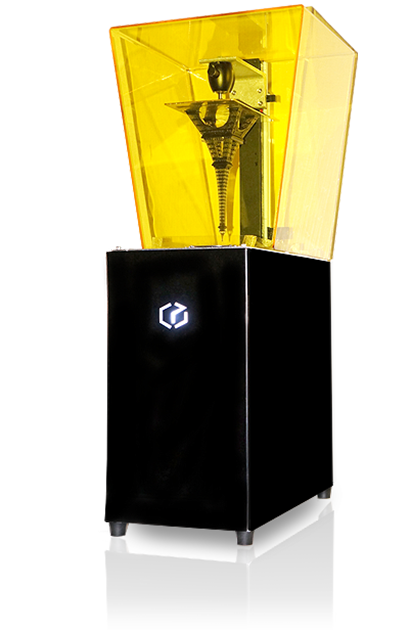
Startup Kudo3D has spent the last couple years developing its own SLA printer, which it has named Titan 1. Rather aiming the digital light projector at the top of the resin tub, Titan 1 works with a bottom up model.
From the website:
… the separation force between the cured resin layer and the bottom of the resin container still limits the minimum feature size, printable mechanical structures and build volume. Founder Ted Syao spent 16 months full time to develop and perfect a patent pending passive self-peeling technology (PSP) for bottom up SLA. PSP employs a flexible resin container to enable a self-peeling process that minimizes the separation force. By minimizing the separation force, features as tiny as a strand of hair can be preserved during the printing process.
To go along with the bottom up design, Titan 1 offers a build envelope of 7.5 x 4.25 x 9.5 in. (19.05 x 10.8 x 24.13 cm). It has a resolution of 100μm XY and 1μm Z, with a print speed of around 1.3 in./hour. The company also claims that its PSP technology, which uses Teflon to prevent sticking, results in a resin tub that is more highly resistant to reactive resins than those produced by its competitors.
According to the company, one of the reason’s Syao started Kudo3D was to offer an affordable product that could produce professional quality parts. While final pricing hasn’t been set, rumors place the Titan 1 at $1,999 for a kit or $2,249 for a fully assembled system. If that price turns out to be true, this new 3D printer will be less expensive than either Formlabs or 3D Systems’ offerings.
Kudo3D has also hinted it may launch a crowdfunding campaign to raise additional capital, so backers may be able to pick up the system at an even lower price.
Below you’ll find a video about the Titan 1.
Source: Kudo3D


John Newman is a Digital Engineering contributor who focuses on 3D printing. Contact him via [email protected] and read his posts on Rapid Ready Technology.
Follow DE






About Us · Contact Us · Editorial Team · Advertising · Privacy Policy · Subscriber Services · © 2026 Digital Engineering 24/7 · Peerless Media