Helping design and engineering professionals discover, evaluate and specify technologies and processes that shorten the design cycle and enable success.




May 2026 Special Focus: Artificial Intelligence in Design and Simulation
In this Special Focus Issue, learn about the latest developments in the integration of artificial intelligence into engineering workflows.

Design & Simulation Software Guide 2025
In this Special Issue, Digital Engineering presents its second annual guide to design and simulation software vendors.
When working with complex, compute-intensive simulations, multiphysics events rank high. A faithful recreation of a fluid-structural or thermo-electromechanical interaction using physics solvers and mesh models could keep a team and its hardware occupied for days, jeopardizing timelines and product releases.
Now that use of reduced order models (ROMs) or surrogate models is gaining traction, we delve into what many engineers may be wondering: Can you replace multiphysics simulation with an AI-trained ROM to save time, cost and headaches? To answer this, we first need to know if a ROM can accurately capture what’s happening in a multiphysics event. Speaking to the experts, we uncover the appeal, pitfalls, and paradox of the black box.
The number of physics involved is not the determining factor in whether a ROM could replace a simulation, according to Bjorn Sjodin, senior vice president of Product Management, COMSOL. “It could be single physics or multiphysics, but the more nonlinear the problem is, the harder it is to train the ROM,” he says.
Similarly, Manzoor Tiwana, lead product manager, Ansys, adds, “the more nonlinear the event, the riskier the simplification is.”
Usually input-output correlations offer a clue. Simply put, if doubling the forces doubles the stress buildup, and tripling and quadrupling the forces produce a similar multiplication, then the relationship is linear, thus the AI-based ROM training will most likely be straightforward. In fact, with this kind of linearity, you do not need a ROM at all. You just need a calculator.
But there are cases where varying the input produces highly unpredictable results. In other words, the input-output correlation is not apparent—at least, not without in-depth mathematical analysis. This is a good indicator that the ROM training will be complex. This is also a good opportunity to develop and deploy a ROM, because distilling the phenomenon, whether it is the behavior of an electrochemical device or the turbulent flows in a multichannel valve, could give engineers a simpler way to replicate it in the future.
“Surrogate models, or ROMs as some might call them, are very good at identifying patterns—certainly better than humans. You can view them as compressed multiphysics models, fast to access, fast to run,” Sjodin says. “But you have to treat it like a black box. Human analysis gives you an understanding of the phenomenon and the data associated with it. The black box cannot assign meanings to what’s happening with the data. So you need to be OK with it.”
Sjodin isn’t the only one who uses the black-box analogy. Tiwana also sees it the same way. “The black box is a simplification of a system,” Tiwana says. “You may be accepting some compromises in accuracy, but it’s very useful if you’re doing design optimization, where you want to see how the system behaves when you change the input parameters and boundary conditions.”
Multiphysics events are inherently complex, requiring intense computation to simulate in 3D meshes. But in ROM development, you may also treat each type of physics separately, then combine them to account for all. “Maybe you create a ROM for mechanical, another for electronics, then combine them to represent the electromechanical system,” says Tiwana.
Livio Mariano, senior director, Global Business Development, Engineering AI & Digital Twin, Altair, adds, “Often the solution is to slice the elephant into smaller pieces or ROMs, then combine them to represent the more complex system behavior.”
There are good reasons to take this approach. Each solver in a computational fluid dynamics (CFD) or finite element analysis (FEA) software is designed to faithfully replicate a certain type of phenomenon: fluid, thermal, structural or electrical. Therefore, the simulation data used for ROM training also reflects this. However, “If your solver can do multiphysics simulations, where different physics come together, you can use that data to train a multiphysics ROM,” Tiwana says.
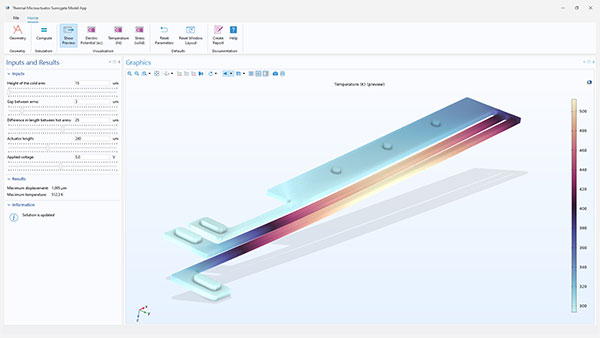
The Thermal Actuator Surrogate Model application shows how you can accelerate a multiphysics analysis using a surrogate model for a fully parametric geometry model. Image courtesy of COMSOL.
At its core, the ROM is a calculation engine, with algorithms that reproduce the complex relationships between input and output parameters. It cannot account for the laws of physics, as full-scale FEA usually does. Therefore, there’s a risk that an inexperienced user might not detect the errors in the ROM’s predictions.
“Some people are beginning to encode the laws of physics in broad strokes into the neural networks [used for training ROMs], but there are currently many limitations,” notes Sjodin.
COMSOL develops COMSOL Multiphysics software, comprising a series of modules. One of the widely used ROM training tools, known as Deep Neural Network (DNN) Surrogate Model, is part of the core package. The company also offers a UQ (uncertainty quantification) Module to assess and assign values to the ROM’s accuracy using surrogate models developed with other methods beside DNNs.
“You can train a ROM in COMSOL using a mix of simulation data and experimental data,” says Sjodin. “The simulation data can be from COMSOL, or from another software.”
Ansys also provides ROM-development tools in its Ansys Twin Builder software, described as an “open solution that allows engineers to create digital twins–connected, virtual replicas of in-service physical assets.” Of note, Ansys is now part of Synopsys, due to the acquisition that was completed this August.
IAV, a Berlin, Germany-headquartered engineering company, designs and develops batteries for electronic vehicles. The company uses COMSOL Multiphysics software for its lithium-ion battery packs. The simulation specialists at the company came up with a surrogate model that can calculate a twin-battery pack’s performance.
Using the COMSOL Application Builder, they created a custom-configured app with restricted inputs and outputs so it could be distributed among non-experts and customers as a way to easily run simulations and see the results. It was an ideal way to “distribute these simulation tasks to people that usually do not do modeling,” observes Jakob Hilgert, a technical consultant at IAV.
At Altair’s 2024 ATCx AI for Engineers conference online, Giuseppe Gullo, FEA design analysis engineer at CNH Industrial, recounted how he and his team shifted from physical tests to virtual validation of agricultural and construction vehicles, such as tractors and loaders. Their simulation consisted of structural analysis, multibody analysis, and durability analysis. CNH engineers used a mix of Altair products, such as Hypermesh, Opstruct, Motionsolve and more.
“We have replaced 70% of the physical tests with virtual simulation,” says Gullo. Charting the durability predictions from the physical tests next to those from the virtual simulation, CNH found a high correlation.
Having proven the reliability of the virtual model, CNH then went on to apply machine learning to develop a ROM. The resulting ROM uses hydraulic forces as input to output the strain signal. The high-fidelity physics solvers take 10 hours to simulate a 35-second event. On the other hand, the ROM can do the same job in two seconds.
The engineers also developed a ROM to replicate the machine’s interaction with the soil based on previous simulation data. The goal was to create a ROM that uses plow depths and speeds to calculate the forces and torques in the interaction. “There was a significant reduction in simulation time: 2 seconds vs. 13 hours on high-fidelity simulation,” says Gullo.
“These performances were achieved using ROMs generated by Altair romAI—an AI-powered solution that streamlines processes, helping organizations reduce time to market, cut costs, and accelerate progress toward their sustainability goals. romAI is developed by Altair, now part of Siemens,” Altair’s Mariano explains.
Black boxes have a safety zone—the range of parameters, boundary conditions and scenarios they’re designed to represent. “If you stray from that, you’re extrapolating; you’re outside the zone,” Sjodin advises. “ROMs are inherently bad at predicting what happens outside that zone. Software like COMSOL gives you warnings when you go outside the validated data.”
ROMs can be designed to prevent inadvertent misuse with limits on the possible inputs. “When our customers are constructing simulation apps [which work as access points to the ROM], they constrain the apps so users can only enter data within the validated range,” says Sjodin.
Being simplified versions of events, ROMs are not as accurate as physics solvers, but paradoxically, they may also be a solution to certain multiphysics problems.
“There are some physics that require more resources to simulate than others. For example: CFD and DEM (discrete element method). In these cases, you can use ROMs to replace those physics causing bottlenecks in the runtime. And to increase the ROMs’ accuracy, you can generate them from real-world data,” suggests Mariano.
There are situations where a ROM may be too risky to deploy because it cannot accurately reveal the geometry changes occurring, which offer valuable insights into how a product might fail and how it might be redesigned. “Imagine a situation where, whenever you apply a certain load, the stresses change the shape of a hole. This type of geometry change affects the meshes,” notes Ansys’ Tiwana.
Fatma Kocer, vice president of Engineering Data Science, Altair, adds, “the risks of using a ROM to replace physics solvers to simulate a multiphysics event is no different than it is to simulate a single physics event.” Instead, she said users should be asking a different set of questions:
ROMs can act as surrogates for full-scale multiphysics simulation, relieving engineers of the pressure to run time-consuming and compute-intensive 3D simulations. But to develop reliable ROMs and to keep improving their accuracy, you need high-fidelity simulation data, as the last question by Kocer suggests. That’s the paradox of the black box.

Engineering simulation is our sole focus. For more than 45 years, we have consistently advanced this technology to meet evolving customer needs.ANSYS develops, markets and supports engineering simulation software used to predict how product…
Study on HPC and Cloud Computing for Engineering Simulation
This new research report explores how companies are using HPC and simulation on the cloud.

Kenneth Wong is Digital Engineering's resident blogger and senior editor. Email him at [email protected] or share your thoughts or suggestions at digitaleng.news/facebook.
Follow DE
Join over 90,000 engineering professionals who get fresh engineering news as soon as it is published.






About Us · Contact Us · Editorial Team · Advertising · Privacy Policy · Subscriber Services · © 2026 Digital Engineering 24/7 · Peerless Media