Helping design and engineering professionals discover, evaluate and specify technologies and processes that shorten the design cycle and enable success.



Digital Engineering April 2026
In the latest issue of Digital Engineering, we take a look at the latest innovations in design for additive manufacturing, including the use of natural language inputs, social media cosplayers, and AI integration. The issue also includes a feature…

January Special Focus Issue: Design for Additive
In this Special Focus Issue of Digital Engineering, learn about the latest advancements in design for additive manufacturing, including new software tools, additive in automotive, custom medical devices, and more.
It seems like NASA is seriously considering making 3D printers part of the standard equipment for every space mission, owing to the flexibility of the technology. Never afraid to push the envelope, the space agency is looking into other ways AM can be used to improve space exploration and reduce costs at the same time.
It costs a lot to get a satellite in orbit, and the larger the satellite, the greater the expense. This is one reason for the rise of CubeSats, which are tiny satellites packed with technology. Multiple CubeSats can be put in orbit for the same cost as one larger satellite. CubeSats aren’t the answer to every problem, however. Some satellites must be built on a larger scale to satisfy the purpose for their existence.
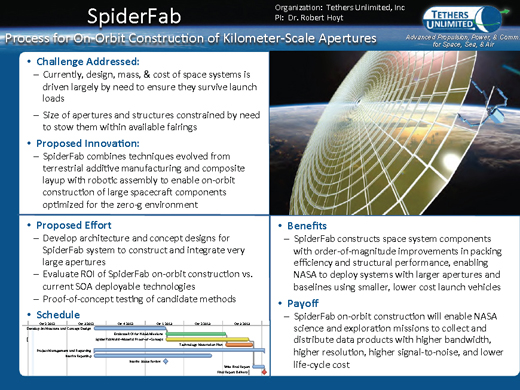
Tethers Unlimited (TU) has proposed a partial solution to the expense of launching large satellites into orbit. Most satellites are designed to kind of fold up to fit inside whatever vehicle is being used to propel it into space. In place of designing a satellite to survive launch, NASA and TU are investigating the use of AM to build large sections of satellites while in orbit.
The proposed solution is a 3D printer called SpiderFab. According to NASA’s website, the AM solution would use:
… a novel additive manufacturing technique called ‘SpiderFab,’ which combines the techniques of fused deposition modeling (FDM) with methods derived from automated composite layup to enable rapid construction of very large, very high-strength-per-mass, lattice-like structures combining both compressive and tensile elements. This technique can integrate both high-strength structural materials and conducting materials to enable construction of multifunctional space system components such as antennas.
This approach would allow NASA to ship raw materials, and any components that can’t be fabricated, into space without having to design the shipment for a launch environment. The SpiderFab would consume the materials and continue to build whatever type of structure was required.
This is a novel solution to a problem that highlights the many different ways that AM can be used. If the SpiderFab system works, it’ll not only save NASA money, but it might even speed up development of future satellites, offering a number of different potential applications.
Below you’ll find a short video that discusses CubeSats.
Source: NASA


John Newman is a Digital Engineering contributor who focuses on 3D printing. Contact him via [email protected] and read his posts on Rapid Ready Technology.
Follow DE
Join over 90,000 engineering professionals who get fresh engineering news as soon as it is published.






About Us · Contact Us · Editorial Team · Advertising · Privacy Policy · Subscriber Services · © 2026 Digital Engineering 24/7 · Peerless Media