Helping design and engineering professionals discover, evaluate and specify technologies and processes that shorten the design cycle and enable success.



Digital Engineering April 2026
In the latest issue of Digital Engineering, we take a look at the latest innovations in design for additive manufacturing, including the use of natural language inputs, social media cosplayers, and AI integration. The issue also includes a feature…

January Special Focus Issue: Design for Additive
In this Special Focus Issue of Digital Engineering, learn about the latest advancements in design for additive manufacturing, including new software tools, additive in automotive, custom medical devices, and more.
Concept Laser is on to the idea that scale is something unique offered by AM, and the Mlab Cusing R is the proof. By standards of home 3D printers, the new system isn’t exactly compact. For what it offers, however, the Mlab Cusing R is a relatively modest sized machine at 705 x 1848 x 1220 mm (27.76 x 72.76 x 48.03 in.).
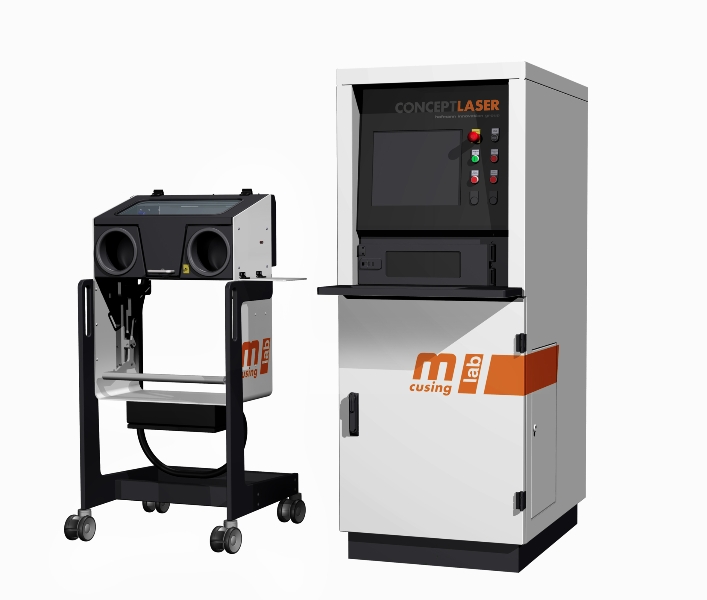
The Mlab Cusing line specializes in building small, complex objects from metal. The target audience for the line includes the dental industry and the field of medical implants. For the new system, the “R” stands for the addition of titanium and titanium alloys to the list of materials, along with gold, silver alloys, bronze, cobalt-chromium alloys and stainless steel.
The idea of scale returns in the design of the build envelope, which, according to the company, can be configured to run at 50 x 50, 70 x 70 or 90 x 90 mm (1.97 x 1.97, 2.76 x 2.76, or 3.54 x 3.54 in.), with a constant 80 mm (3.15 in.) for Z. The Mlab Cusing R uses a 100 W fiber laser with a focus diameter of less than 25 µm to build objects.
Concept Laser has also patented a new method of interacting with materials, which it calls the “glovebox module.”
The glovebox module is docked onto the machine for the loading and unloading process. The build module can simply be pulled out into the glovebox thanks to the drawer principle. The glovebox is then flooded with argon to inert the chamber, essential for safe titanium processing. The operator accesses the build chamber through the glovebox gloves in order to carry out the loading process or to remove components. After the end of the process, the build module is moved back into the machine and finally the glovebox is undocked.
Below you’ll find a video about Concept Laser’s Mlab line.
Source: Concept Laser


John Newman is a Digital Engineering contributor who focuses on 3D printing. Contact him via [email protected] and read his posts on Rapid Ready Technology.
Follow DE
Join over 90,000 engineering professionals who get fresh engineering news as soon as it is published.






About Us · Contact Us · Editorial Team · Advertising · Privacy Policy · Subscriber Services · © 2026 Digital Engineering 24/7 · Peerless Media