Helping design and engineering professionals discover, evaluate and specify technologies and processes that shorten the design cycle and enable success.


Alert!
Digital Engineering ceased publication on July 1, 2026. This website remains available as an archive of engineering content.
For inquiries or information, please email [email protected].


Digital Engineering April 2026
In the latest issue of Digital Engineering, we take a look at the latest innovations in design for additive manufacturing, including the use of natural language inputs, social media cosplayers, and AI integration. The issue also includes a feature…

January Special Focus Issue: Design for Additive
In this Special Focus Issue of Digital Engineering, learn about the latest advancements in design for additive manufacturing, including new software tools, additive in automotive, custom medical devices, and more.
Disney Research and Carnegie Mellon University have turned the technology used to make parts for jet engines to more hug inspiring ends with a new type of AM that uses yarn and felt to build up soft objects, such as teddy bears. Disney researcher Scott Hudson refers to the results of this new kind of 3D printing as something that might be of interest to the Human Computer Interaction community, but most kids will just call the finished object “Teddy.”
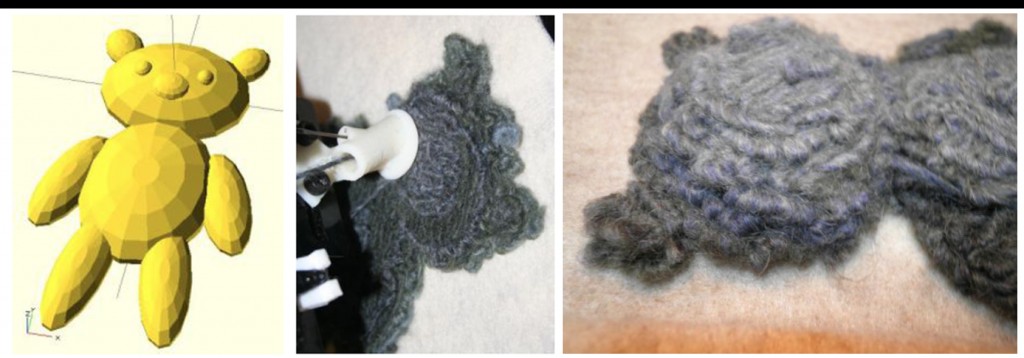
Just like with other forms of AM, the process to build a teddy bear begins with a digital design. That design is then translated into a printing sequence, which is used to build the object. Rather than PLA or resin, this system uses felt and yarn. The machine builds up layers of yarn by punching a threaded needle through the felt, which acts as a sort of backing board.
“I really see this material being used for things that are held close,” said Hudson. “We’re really extending the set of materials available for 3D printing and opening up new possibilities for what can be manufactured.”
In addition to on-demand teddy bears, the new AM system could also be used to manufacture various types of clothing, with scarves and hats being solid potential candidates. Larger kinds of clothing are also possible. Finished clothing will appear similar in appearance to knitted clothing, thought the new process is able to finish a scarf much faster (hours, not days) than your dear old granny can manage.
Hudson also sees potential for additional research based on this first design in the area of “soft robots,” which is a term that’s been given to an ideal for robots meant to interact with humans on a daily basis. Instead of cold, hard plastic, an AM system similar to Hudson’s current model could cover a robot in a soft outer layer that is more pleasant to the touch and probably would be considered less fearsome in appearance.
Below you’ll find a video about the teddy bear printer.
Source: Disney Research


John Newman is a Digital Engineering contributor who focuses on 3D printing. Contact him via [email protected] and read his posts on Rapid Ready Technology.
Follow DE






About Us · Contact Us · Editorial Team · Advertising · Privacy Policy · Subscriber Services · © 2026 Digital Engineering 24/7 · Peerless Media