Helping design and engineering professionals discover, evaluate and specify technologies and processes that shorten the design cycle and enable success.


Alert!
Digital Engineering ceased publication on July 1, 2026. This website remains available as an archive of engineering content.
For inquiries or information, please email [email protected].

Digital Engineering April 2026
In the latest issue of Digital Engineering, we take a look at the latest innovations in design for additive manufacturing, including the use of natural language inputs, social media cosplayers, and AI integration. The issue also includes a feature…

January Special Focus Issue: Design for Additive
In this Special Focus Issue of Digital Engineering, learn about the latest advancements in design for additive manufacturing, including new software tools, additive in automotive, custom medical devices, and more.
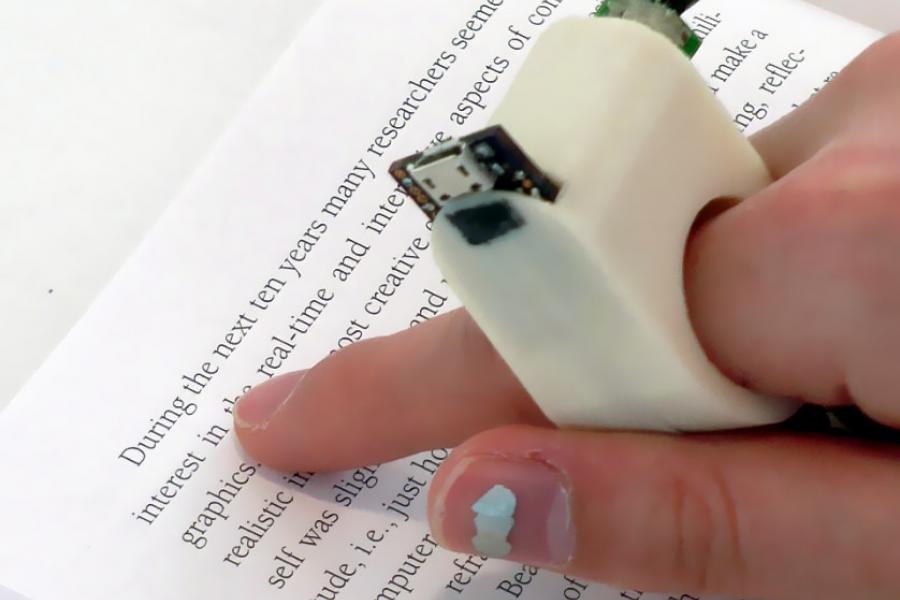
Researchers at MIT’s Media Lab have used AM to help produce a new device that assists blind readers. Called the FingerReader, the device offers the blind a chance to read books for which no Braille translation is available, and can also assist users who developed blindness later in life and never picked up the knack for reading Braille by touch.
 MIT's FingerReader uses 3D printing and digital video technology to assist blind users with reading. Courtesy of MIT Media Lab.
The FingerReader consists of a 3D printed, oversized ring which houses two vibration motors and a high-resolution mini video camera. One vibration motor is embedded in the top of the ring, while the other is embedded in the bottom, along with the video camera.
The motors vibrate to indicate which direction a user should move his finger along a line of text, while the camera captures images of the words. The words are then read aloud to the user as they move their finger along a line.
From the MIT paper about the FingerReader:
When the user veers from the scan line, we trigger a tactile and auditory feedback. When the system cannot find more word blocks along the line we trigger an event to let users know they reached the end of the printed line. New high-confidence words incur an event and invoke the TTS [text-to-speech] engine to utter the word aloud. When skimming, users hear one or two words that are currently under their finger and can decide whether to keep reading or move to another area.
AM has played a major role in the prototyping and testing of the FingerReader, and it seems reasonable to assume the technology will continue to assist in finished models. While a manufacturer could produce multiple sizes of the ring used to house the electronics for the FingerReader, it seems more likely that each user will send in measurements and have ring 3D printed specifically for them.
The FingerReader isn’t the only example of leveraging AM to assist the blind. Other examples include 3D printed paintings and models. Below you’ll find a video about the FingerReader.
Source: MIT Media Lab


John Newman is a Digital Engineering contributor who focuses on 3D printing. Contact him via [email protected] and read his posts on Rapid Ready Technology.
Follow DE






About Us · Contact Us · Editorial Team · Advertising · Privacy Policy · Subscriber Services · © 2026 Digital Engineering 24/7 · Peerless Media