Helping design and engineering professionals discover, evaluate and specify technologies and processes that shorten the design cycle and enable success.



Digital Engineering April 2026
In the latest issue of Digital Engineering, we take a look at the latest innovations in design for additive manufacturing, including the use of natural language inputs, social media cosplayers, and AI integration. The issue also includes a feature…

January Special Focus Issue: Design for Additive
In this Special Focus Issue of Digital Engineering, learn about the latest advancements in design for additive manufacturing, including new software tools, additive in automotive, custom medical devices, and more.
Fast forward to 2015, and the company is cutting 20% of its work staff, only a few short months after it cut a previous 20% and closed all its retail stores. What happened? Is this the end of the consumer 3D printer, or is MakerBot itself the author of most of its woes?
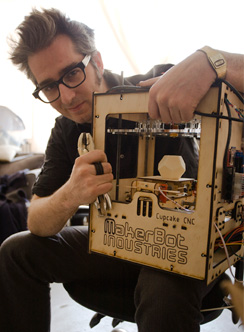 Bre Pettis, co-founder of MakerBot.
The home 3D printer market seems to be doing just fine. It continues to grow, according to Wohlers Report, and continues to baffle experts that expect the entire market to fold at any time. 3D Systems certainly isn’t giving up on the home market. Rather the opposite, it continues to expand the potential for what can be accomplished with a home 3D printer.
Is MakerBot’s decline Stratasys’ fault? It could certainly be argued that — in media coverage anyway — MakerBot appeared to do better prior to the acquisition than as part of a larger corporate structure. But the MakerBot was showing signs of a shift before then. Print the Legend is a fascinating chronicling of MakerBot just prior to its acquisition. One of the biggest causes for upheaval within the company before the recent employee cuts was when the decision was made to move from open source to proprietary technology. That single move alienated much of the maker community, which let its frustration be known via many online forums after years of supporting and collaborating with the MakerBot team.
The acquisition by Stratasys came close enough on the heels of that decision to give MakerBot, and co-founder Bre Pettis in particular, a bad name with some of their former fans. To many ex-MakerBot owners it felt like a betrayal. Imagine the reaction if Steve Jobs had sold Apple to Microsoft and you have an idea of the emotions involved.
Hurt feelings can’t account for the entire loss of revenue though, right? True enough. Another problem MakerBot faced was cost. It’s easy to zip out a 3D printer kit for next to nothing when your staff consists of three guys in a basement. Costs go up exponentially as a company grows and expands operations.
This isn’t a problem unique to MakerBot either. There’s a reason why Kickstarter is one of the most popular places to buy a home 3D printer. Startups offer ridiculous deals during their campaigns that no established company would want to match. A 3D printer for $200? It’s happened.
MakerBot isn’t out of the game, but it’ll take a major effort to keep the MakerBot label from becoming just another brand offered by Stratasys.
Below you’ll find a video from the dawn of MakerBot time.


John Newman is a Digital Engineering contributor who focuses on 3D printing. Contact him via [email protected] and read his posts on Rapid Ready Technology.
Follow DE
Join over 90,000 engineering professionals who get fresh engineering news as soon as it is published.






About Us · Contact Us · Editorial Team · Advertising · Privacy Policy · Subscriber Services · © 2026 Digital Engineering 24/7 · Peerless Media