Helping design and engineering professionals discover, evaluate and specify technologies and processes that shorten the design cycle and enable success.



December 22, 2017 · 3D printing spare parts offers efficiencies over traditional manufacturing. Historically, manufacturers anticipated what they required in spare parts over the course of years, maybe even decades, produced those volumes, then stored and distributed parts as needed. If inventory ran out, they initiated another manufacturing run, often at great expense with significant lead times. An alternative approach is to eliminate aftermarket inventory, 3D printing only what's required on-demand instead of maintaining costly maintenance, repair and operations (MRO) stock.

October 25, 2017 · In this digital issue featuring some of DE’s most popular content on the subject, we take a deeper look at how automotive design engineers are responding to changing regulatory requirements, electric drivetrains and self-driving technologies.
October 2, 2017 · Though a household name in computing systems and printers, HP is a relative newcomer to the 3D printing segment. What can its Multi Jet Fusion (MJF) technology do that others can't? It brings disruptive technology, according to HP's David Tucker, himself a product designer. In this presentation, Tucker discusses the type of projects where MJF offers superior results; ways to prep the CAD model to take advantage of MJF; and methods to optimize print layer and density."
October 2, 2017 · The use of simulations to displace physical tests has become essential in accelerating product development and reducing costs. However, simulation results may be substantially different from what is observed in reality. This could lead to premature product failure, costly warranty payments and a redesign campaign. In this webcast, Dr. Mark Andrews, UQ Technology Steward, SmartUQ, discusses why simulation results might not always be reliable, ways to calibrate simulation using test results and how to spot simulation anomalies and inaccurate results."
September 28, 2017 · In this online roundtable discussion, DE’s Senior Editor Kenneth Wong will interview industry experts to share their thoughts on the promise of digital twins, the current state of the art, and the challenges being faced during early implementations.
July 31, 2017 · Instantaneous real-time, ray-traced rendering can dramatically cut down your product development cycle. In this webinar, panelists explore the benefits of using dedicated rendering hardware to go beyond what's possible with a workstation, to reduce physical prototyping costs.
July 20, 2017 · In this LIVE roundtable, DE’s Kenneth Wong moderates a panel of experts to discuss the state of self-driving vehicles today.
May 19, 2017 · Pioneering automotive and aerospace firms are using additive manufacturing to build lightweight shapes with lattice structures, to consolidate multi-part assemblies into a single 3D-printed component, and to incorporate composite materials. In this LIVE roundtable, DE’s Kenneth Wong moderates a panel of experts to discuss the challenges of applying 3D printing to large-scale parts and structures; modeling tools for sculpting 3D-printable shapes; and methods for simulating the 3D printing process.
March 28, 2017 · Learn how simulation paired with high-performance computing (HPC) can significantly speed up your engineering workflow and enhance innovation.
March 7, 2017 · Read this white paper to examine the return on investment (ROI) of professional workstations with Intel® Xeon® processors for design engineering work as opposed to standard personal computers from three perspectives: the design engineer, the IT professional and executive management.
January 20, 2017 · Increasing product complexity is fueling the need for a far more sophisticated, digital design environment that demands levels of processing power beyond the capacity of yesterday’s workstations. Download this paper to learn 5 ways to know it's time to change your computing workflow.
December 1, 2016 · Engineering teams are transforming traditional workflows to take advantage of new digital-driven design processes.
November 30, 2015 · Differentiate your designs with more effective iterations driven by physically based rendering.
June 22, 2015 · This research brief examines adoption rates and challenges to increased adoption, along with the capabilities and characteristics design engineering teams find important when evaluating 3D printers.
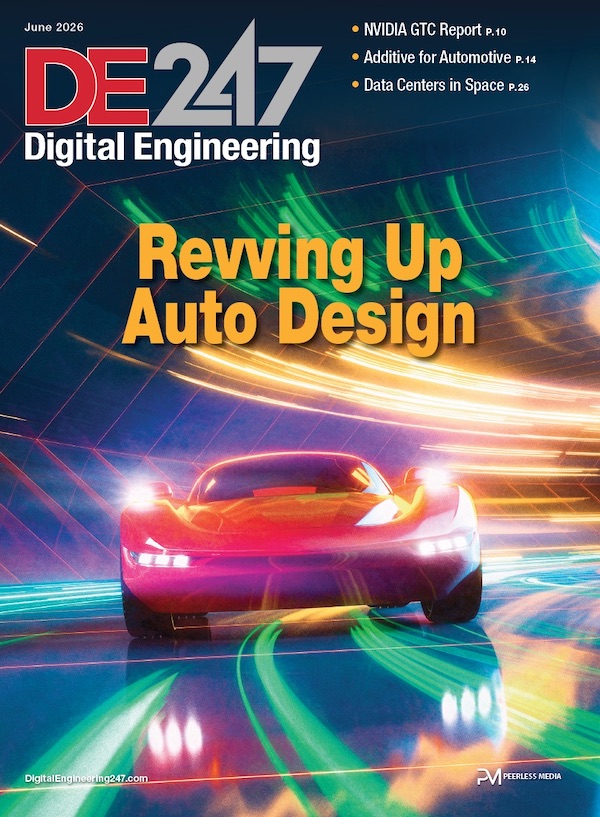
Digital Engineering June 2026
In the latest issue of Digital Engineering, we focus on automotive design innovations, including light and sound simulation, additive manufacturing applications. Our editors head to NVIDIA GTC and RAPID+TCT, and we investigate whether you can…

May 2026 Special Focus: Artificial Intelligence in Design and Simulation
In this Special Focus Issue, learn about the latest developments in the integration of artificial intelligence into engineering workflows.




About Us · Contact Us · Editorial Team · Advertising · Privacy Policy · Subscriber Services · © 2026 Digital Engineering 24/7 · Peerless Media