Helping design and engineering professionals discover, evaluate and specify technologies and processes that shorten the design cycle and enable success.


Alert!
Digital Engineering ceased publication on July 1, 2026. This website remains available as an archive of engineering content.
For inquiries or information, please email [email protected].

May 2026 Special Focus: Artificial Intelligence in Design and Simulation
In this Special Focus Issue, learn about the latest developments in the integration of artificial intelligence into engineering workflows.

April 2026 Special Focus Issue: Generative Design
In this Special Focus Issue, Digital Engineering takes a look at how generative design solutions can be used across different types of design problems and with a variety of manufacturing approaches to accelerate design space exploration, and…
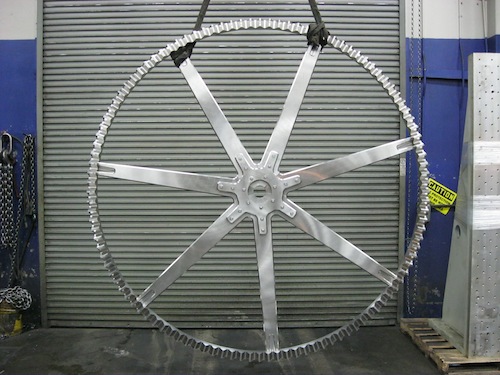
That's what the engineering team at Long Now Foundation is facing as it attempts to design a massive, 200-ft.-tall mechanical clock destined to live for 10,000 years in a specially constructed cave in an undisclosed West Texas mountain location. The Long Now Foundation, a non-profit started by former Disney fellow and engineer Danny Hillis in 1996, sees its charter as facilitating projects that foster long-term thinking and responsibility in the framework of the next 10,000 years.
For the 10,000 Year clock endeavor, the Long Now engineering team is leveraging sophisticated design tools like PTC's Creo and Mathcad engineering calculation software along with rigorous testing and continuous learning to chart a course through this unproven materials science territory. "Humanity has never made anything mechanical that has had to function in this timeframe," notes Taylor Roan, a mechanical engineer on the 10,000 Year Clock project. Adds Jascha Little, another mechanical engineer engaged in the effort, "The biggest challenge is the combination of trying to design something that will tolerate millions or tens of millions of cycles of use out of materials that will last for 10,000 years. Most engineers solve these lifecycle issues using hard materials and steels, but we are restricted from using all of those."
The strict limitation on the range of materials that can be used is primarily related to mechanical wear and tear characteristics and chemical reactivity, the engineers explain. As a result, Roan says there are only a handful of materials under consideration for the clock, including titanium, ruby, sapphire, 316-gauge stainless steel, ceramics, and potentially graphite and quartz.
Beyond navigating new materials science frontiers, the 10,000 Year Clock is also testing the team's mettle for creating a design that is simple enough to withstand an unprecedented number of years of wear and tear. Attention to the proper tolerances is key, the team says, to ensure the clock's mechanical parts hold up even if there are seismic shifts in the earth, for example, and another critical design objective is transparency so the clock can be expanded or fixed decades, even centuries after the engineering team is long gone.
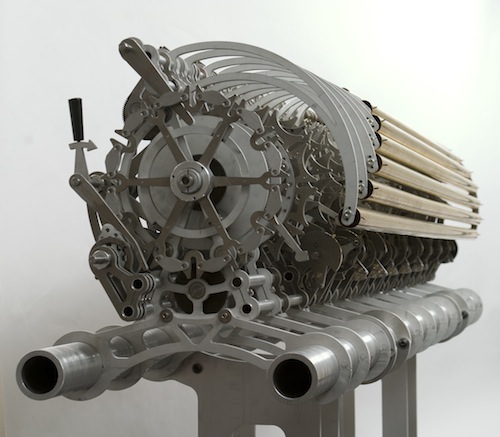
"We wanted to avoid having any black boxes, meaning some kind of magical design that someone who finds this object couldn't figure out through a little bit of study," explains Luke Khanlian, a design engineer on the project. "We'll keep it running in our lifetime, but at some point, someone completely unfamiliar with this is going to want to maintain it or augment it in some way."
In that sense, serviceability is big concern, and the team has approached the design of the mechanical parts with an eye toward making it easy to take apart and put back together. Attention to fasteners, including a mandate not to use female threads in large components, is one tactic, as is an open design that doesn't hide how anything is put together, they say.
Though many years in the making, the 10,000 Year Clock is still a ways from completion. There is currently a prototype in a museum in London, but a completely new prototype has been under way for the last several years. The series of underground chambers and passageways have been excavated and built, and many of the pieces of the clock, including the pendulum, the large winding platform, and the chime generator (which will generate songs so that visitors never hear the same sequence twice) are being tested and evaluated. The hope is that the clock will be up and running in five years. I guess that means time is ticking away for the design team to finish up.
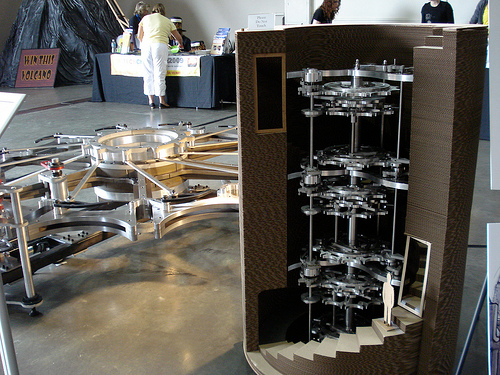
For Desktop Engineering's previous coverage of the 10,000 Year clock, go to Engineering on the Edge.
For those of you who want the complete—and by complete I mean a nearly hour-long video discussion of the 10,000 Year Clock Project—check out the video below from the SETI Institute, which features Project Manager Alexander Rose.


Beth Stackpole is a contributing editor to Digital Engineering. Send e-mail about this article to [email protected].
Follow DE






About Us · Contact Us · Editorial Team · Advertising · Privacy Policy · Subscriber Services · © 2026 Digital Engineering 24/7 · Peerless Media