Helping design and engineering professionals discover, evaluate and specify technologies and processes that shorten the design cycle and enable success.


Alert!
Digital Engineering ceased publication on July 1, 2026. This website remains available as an archive of engineering content.
For inquiries or information, please email [email protected].
Sponsored


Digital Engineering April 2026
In the latest issue of Digital Engineering, we take a look at the latest innovations in design for additive manufacturing, including the use of natural language inputs, social media cosplayers, and AI integration. The issue also includes a feature…

January Special Focus Issue: Design for Additive
In this Special Focus Issue of Digital Engineering, learn about the latest advancements in design for additive manufacturing, including new software tools, additive in automotive, custom medical devices, and more.
Demand for higher resolution and high-precision parts is driving the evolution of additive manufacturing. The latest 3D printer design from Boston Micro Fabrication (BMF) uses a new approach called Projection Micro Stereolithography (PµSL), which is capable of printing polymer parts with 2µm resolution — unprecedented metrics in 3D printing. PµSL enables mold-free, ultra-high-resolution, fast prototyping, and end-part capability not possible before.
BMF globally launched its line of commercial micro-precision 3D printers in 2020 and using BMF’s microArch S130 model, HRL Laboratories, LLC, has now demonstrated ceramic interposers with previously impossible slanted and curved vias with diameters of less than 10µm. Vias are small openings in insulating layers that allow conductive connections between semiconductor layers in integrated circuits.
HRL Lead Engineer Kayleigh Porter:
“We have printed arrays of straight, slanted, and curved vias and have not hit a limit in aspect ratio yet with the low-viscosity ceramic resin that we developed in-house.”
PµSL additive manufacturing now offers nearly limitless possibilities for routing vias. After being printed in ceramic, the vias are metalized to electrically connect different devices and integrated circuits.
“We are developing this technology to improve 3D integrated microelectronic subsystems such as infrared cameras and radar receivers,” said HRL group manager Dr. Tobias Schaedler. “Smaller, lighter, and more power-efficient system designs are currently limited by electrical routing and packaging, but our additive technology could resolve this bottleneck.”
With conventional semiconductor processing methods such as chemical etching, only straight vias can be fabricated. Larger holes can be drilled at angles, but no drilling approach can realize vias with curvature.
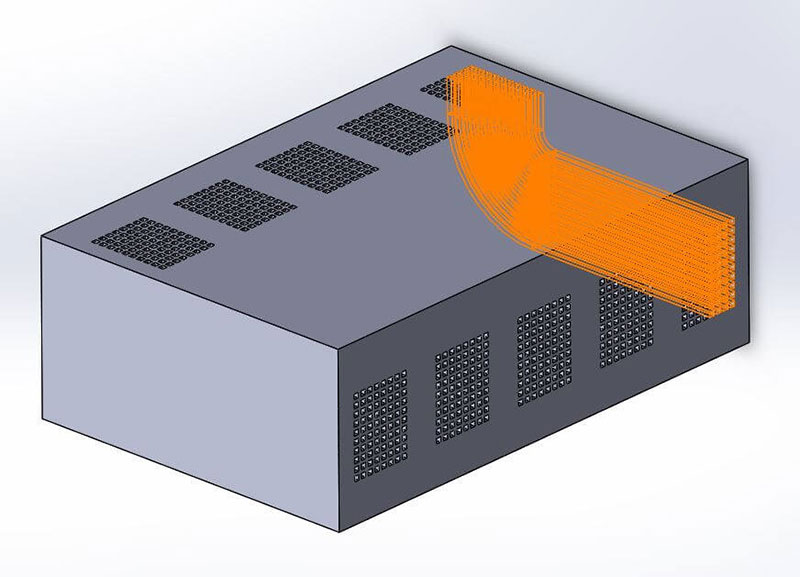
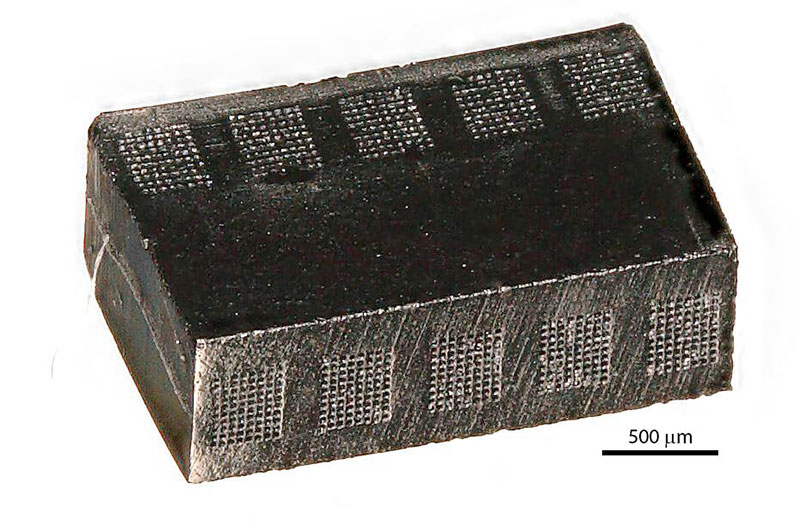
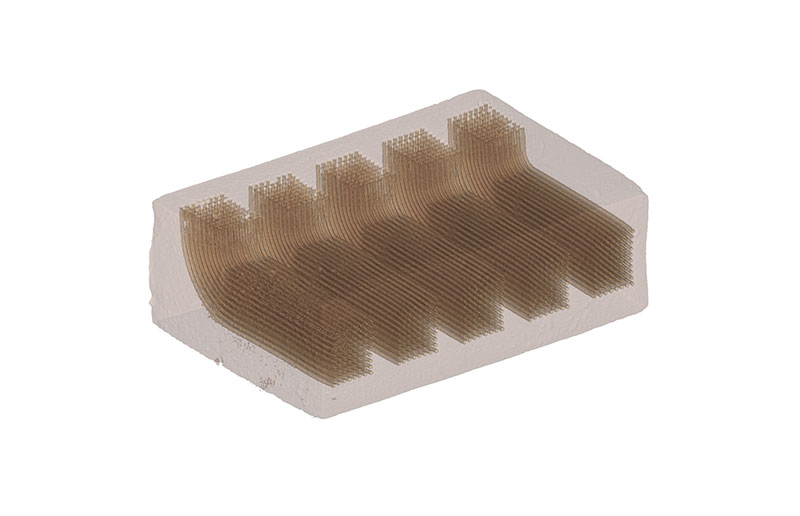 Computer Aided Design of part with curved vias, 3D printed ceramic part. Micro x-ray computer tomography image of curved vias in ceramic
BMF CEO John Kawola:
“We are very excited to collaborate with HRL on this project. The level of resolution, accuracy, and precision that can be achieved at speeds suitable for production made BMF’s microArch S130 the perfect choice for HRL’s project. BMF is constantly working to push the limits of what can be achieved and we will continue to work with HRL and our other customers to meet the needs that their projects demand.”
Contact us to learn more about our micro 3D printing services.
HRL Laboratories’ development effort is currently funded by DARPA’s Microsystems Technology Office under the Focal arrays for Curved Infrared Imagers (FOCII) program.


Boston Micro Fabrication is the world leader in micro-precision 3D printers utilizing Projection Micro Stereolithography (PµSL) technology. Many leading companies worldwide are adopting PµSL to 3D print true microstructures with ultra-high…

Ultra-high Accuracy, Precision, and Resolution Micro 3D Printed Medical Device Manufacturing
Discover how the use of micro-precision 3D printing is aiding medical device producers to tackle two common issues through this white paper.






About Us · Contact Us · Editorial Team · Advertising · Privacy Policy · Subscriber Services · © 2026 Digital Engineering 24/7 · Peerless Media