Helping design and engineering professionals discover, evaluate and specify technologies and processes that shorten the design cycle and enable success.



Digital Engineering April 2026
In the latest issue of Digital Engineering, we take a look at the latest innovations in design for additive manufacturing, including the use of natural language inputs, social media cosplayers, and AI integration. The issue also includes a feature…

January Special Focus Issue: Design for Additive
In this Special Focus Issue of Digital Engineering, learn about the latest advancements in design for additive manufacturing, including new software tools, additive in automotive, custom medical devices, and more.
In the 2012 Olympics, Japan managed to battle to the final bout in a sort of Cinderella story for the fencing world. Part of the team's success rested with its coach, former instructor for the Italian team, and part with good, old fashioned hard work. The third component was custom hilt designs produced on an Objet350 Connex AM system.
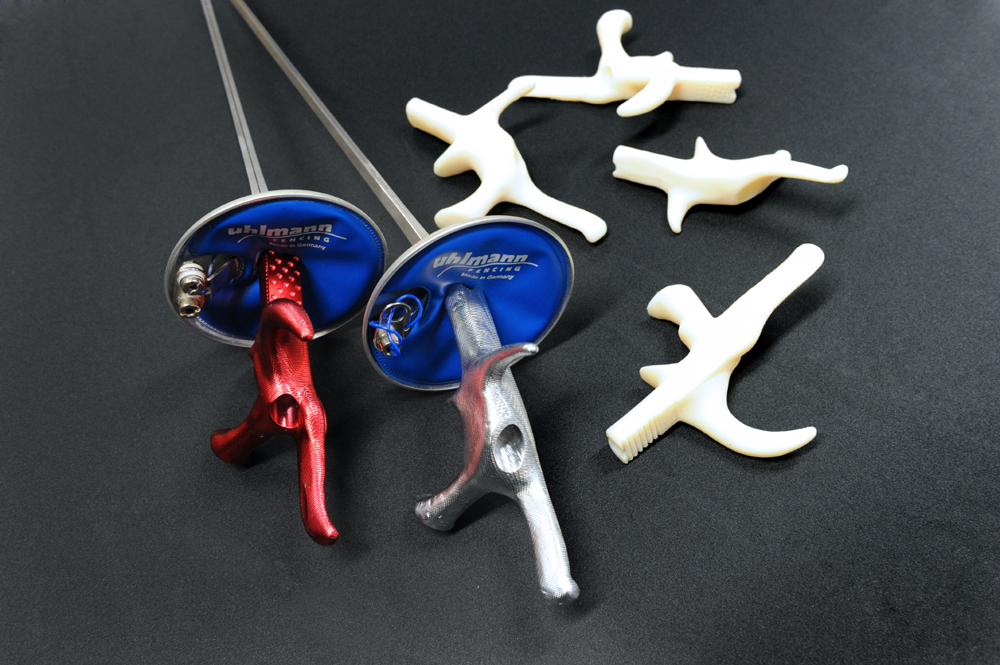
Hilts on modern fencing swords don't look quite how one might expect from watching movies. Instead of a simple rounded hilt with a wire or leather grip, each hilt is modified to fit the grip of the wielder. The result is something that might be mistaken as a coat hook.
In previous years, each hilt was built specifically for a single athlete, and if the sword it was attached to happened to break, that athlete would be out of luck if he didn't have a spare. Now, AM has stepped in to provide a means to quickly design, prototype, and manufacture hilts to ensure each Olympian is properly equipped at all times.
"Players are not engineers. They talk about their requirements instinctively. So, bearing this in mind, we develop various patterns based on different assumptions,” said Osamu Takeda, at the University of Tsukuba, Sports R&D Core. “With the Objet Connex multi-material 3D printer, we can do this easily. We can respond flexibly and promptly because the machine is so accurate."
Each member of the Japanese team was fitted for five hilts prior to the Olympics in London, making it unlikely any athlete would be without a custom hilt at any point during the competition. The team won a silver medal in the event during the 2012 Olympics, due in part, perhaps, to the sense of security in knowing they could compete as hard as necessary without fear their equipment would fail.
Japan, along with other countries, is investigating other ways AM might offer a competitive advantage to their athletes. Possibilities include protective equipment for gymnasts, shoes for javelin throwers, triathlon wear, sailing masts, a footwork assessment system for badminton, and many other designs.
If you have a little time to kill, below you'll find the final between Italy and Japan. If you didn't watch any of the fencing coverage during the Olympics, you might be surprised at just how high tech the sport has become.
Source: Stratasys


John Newman is a Digital Engineering contributor who focuses on 3D printing. Contact him via [email protected] and read his posts on Rapid Ready Technology.
Follow DE
Join over 90,000 engineering professionals who get fresh engineering news as soon as it is published.






About Us · Contact Us · Editorial Team · Advertising · Privacy Policy · Subscriber Services · © 2026 Digital Engineering 24/7 · Peerless Media